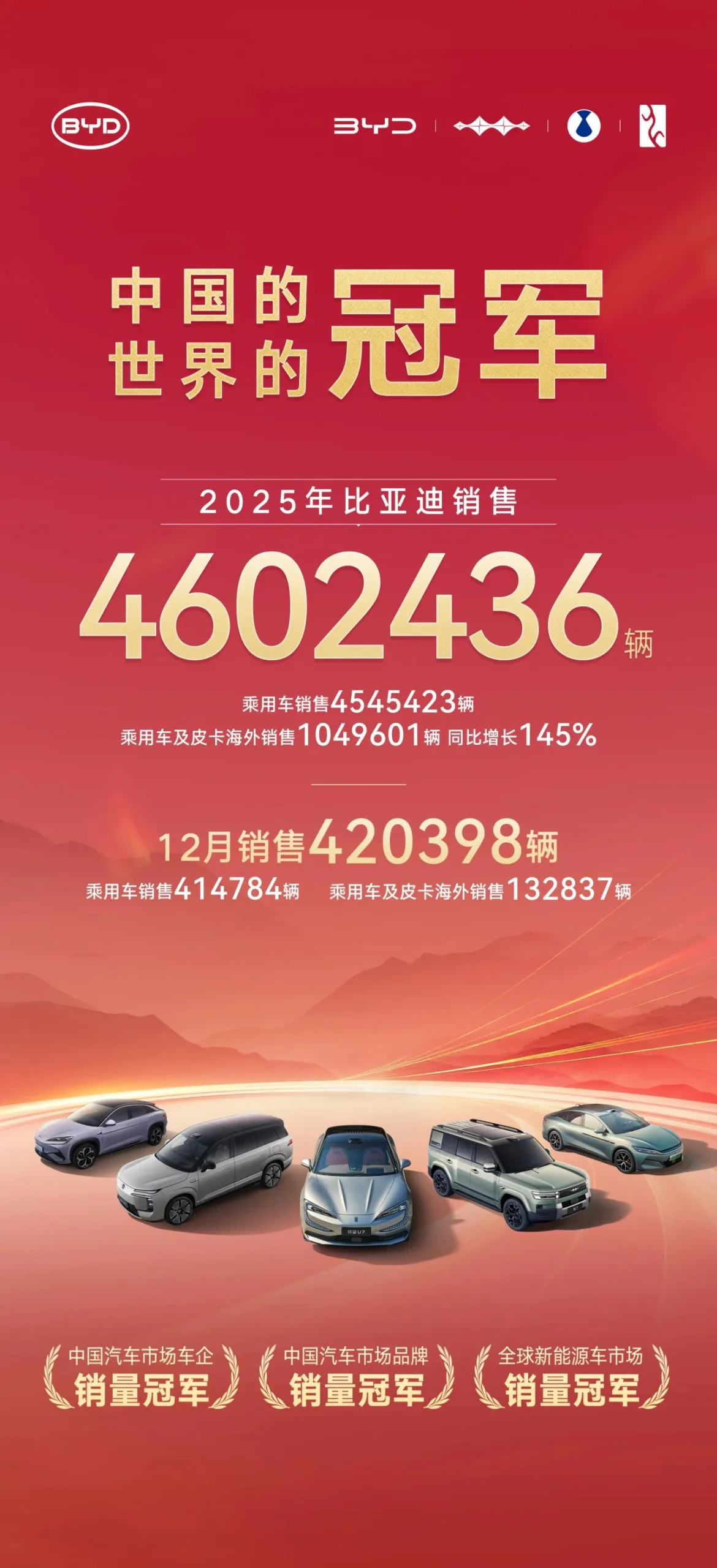
As 2025 drew to a close, BYD posted a year-end scorecard marked by strains and breakthroughs. Full-year new-energy vehicle (NEV) sales totaled 4,602,436, a 7.73% increase from a year earlier, keeping momentum intact in a market where competition is red hot.
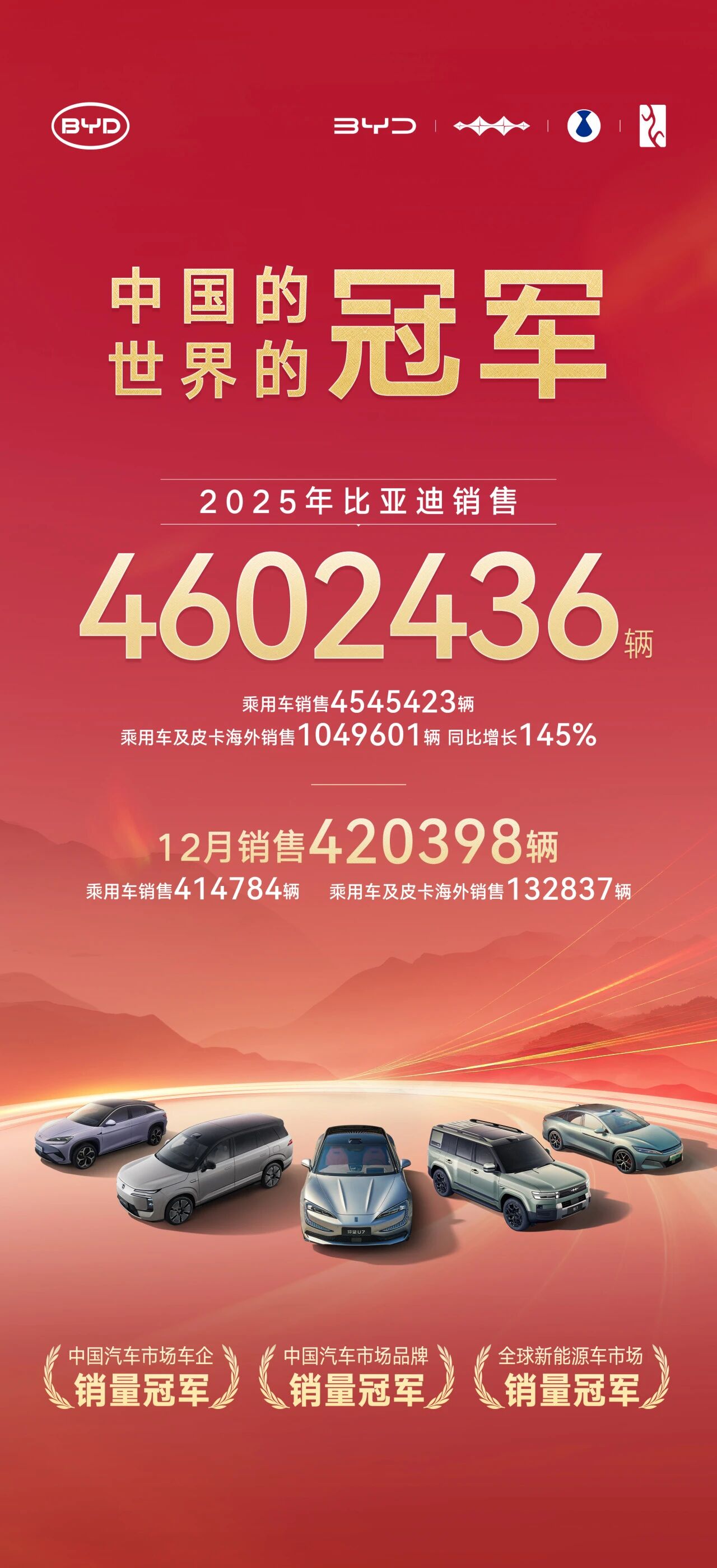
Image source: BYD
December sales came in at 420,398. Year on year, that was an 18.2% drop. Even so, pure-electric models remained the bright spot, with full-year sales hitting 2,256,714 — up 27.86%.
Overseas markets stood out. BYD’s overseas sales topped 1 million in 2025, while December exports reached 133,000 — a 145% year-on-year jump — turning overseas operations into a key growth engine.
Domestic market under pressure, technical bottlenecks loom
From July through November, BYD’s domestic monthly sales fell by double digits, marking five straight months of year-on-year declines.

Image source: BYD Investor Relations
Addressing an extraordinary shareholders’ meeting on December 5, Chairman and CEO Wang Chuanfu confronted the issues head-on, saying BYD’s technological lead isn’t as pronounced as in prior years, the «wow» factor of new breakthroughs has faded, and industry homogenization is increasingly evident.
The rules of competition in China’s NEV market shifted markedly in 2025. «Limited-time one-price» deals fueled an escalating price war in the first half, only to fizzle out in the second. Carmakers then urged an end to cutthroat tactics — calling for a «value war» instead.
In the CNY 100,000–200,000 sweet spot, BYD faced a tight squeeze from Geely Galaxy, Changan Deepal and Li Auto. Their new models pressed hard on intelligent features and pricing strategy, pulling away BYD’s core users.
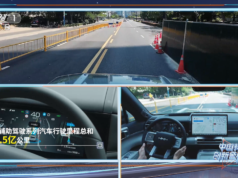
At the same time, rising expectations around BYD’s smart cockpit and driver-assistance features weren’t fully met, which dulled the products’ attraction.
Wang’s remark that «technology isn’t sufficiently ahead» doesn’t dismiss BYD’s strengths; it points to eroding differentiation. The Blade Battery and DM-i Super Hybrid, once disruptive flagships, no longer stand alone as rivals catch up through rapid iteration.
Facing those challenges, BYD said at the meeting it will lean on its 120,000-strong engineering team, zeroing in on electrification pain points and smart-tech pipelines, with plans to roll out technologies that go beyond the Blade Battery and DM-i within 2–3 years. «Products have cycles; technology development does too. Our strength lies in technology. We have the capability — and the confidence — to lead the industry in the coming years with more heavyweight innovations,» the company said.
In 2025, China’s NEV penetration surpassed 50% for two consecutive months starting in October, as the industry shifted from policy support to market self-sustaining demand. BYD, amid that transition, needs to find a new cadence.
Overseas push accelerates, globalization strategy pays off
The contrast abroad was stark. In the first 11 months of 2025, BYD’s overseas sales reached 912,900 — a 2,859.50% surge from a year earlier — far exceeding the prior year’s total. Full-year overseas sales broke past 1 million, cementing their role as BYD’s prime growth engine.
BYD notched breakthroughs across key markets. In the first nine months, it sold 35,604 cars in the UK, up 576.9% year on year — overtaking some established British marques.
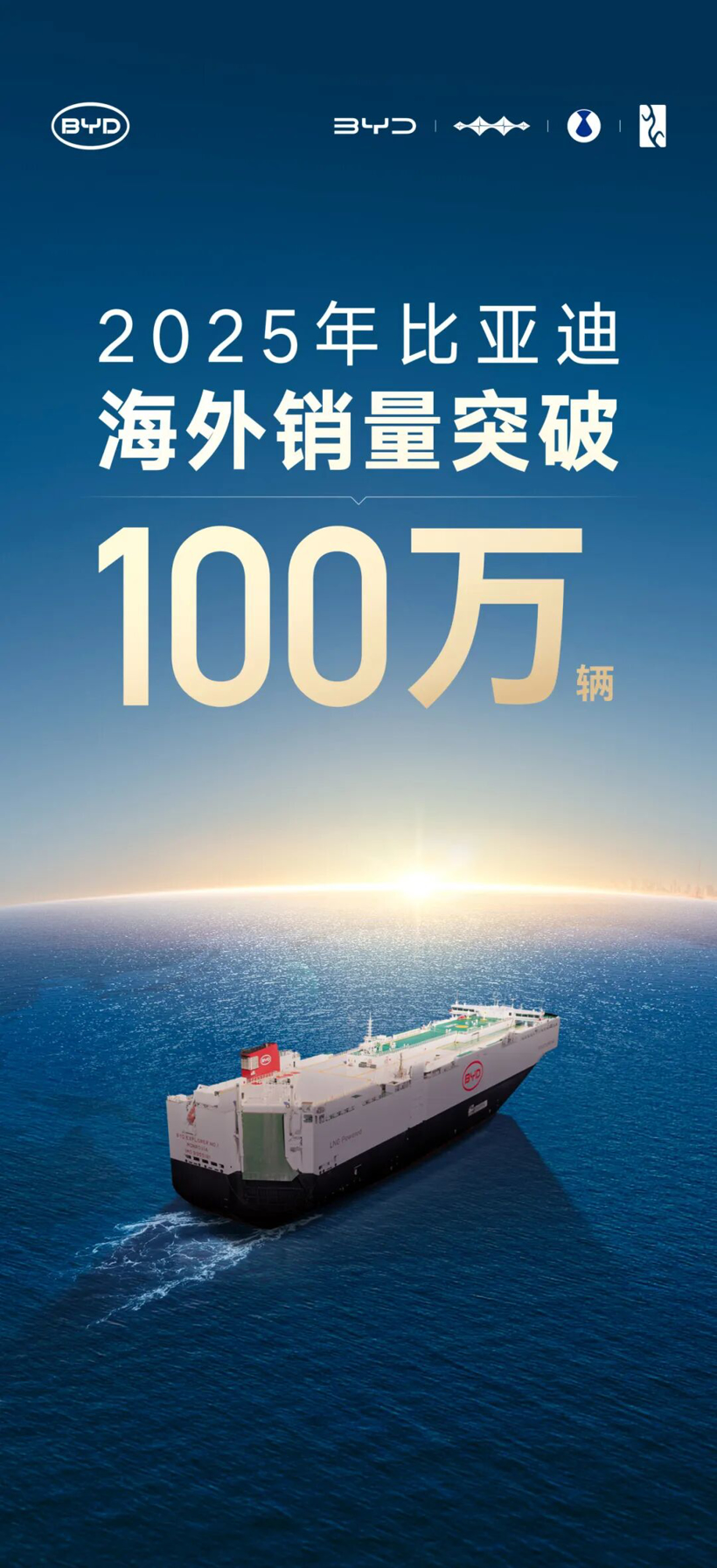
Image source: BYD
BYD’s globalization has evolved from shipping products to exporting whole industrial chains. Plants in Brazil, Thailand and Hungary have come online, enabling local production. At Rayong in Thailand, local staff now independently handle complete vehicle manufacturing; the Brazil facility covers both pure-electric and plug-in hybrids, aiming at the wider South American market.
The company has also built an R&D center in Europe, shifting focus from product delivery to technological breakthroughs. In May 2025, BYD set up its European headquarters in Hungary, deepening ties with the local auto industry.
The European HQ houses three core functions — sales and aftersales, vehicle certification and testing, and model localization design — underscoring tighter integration across the new-energy industry and its supply chains.
BYD tailors strategy to local demand. Data show that in Mexico, Brazil and Turkey, plug-in hybrids draw more interest; in Thailand and Indonesia, pure EVs dominate.
For Japan, BYD developed a pure-electric K-car, the K-EV BYD RACCO, tailored to local demand, and rolled out a dual-track «BEV + hybrid» strategy.
The overseas upswing has also improved BYD’s profit mix. In Europe and Brazil, higher-end models are selling at scale, and steadier pricing means overseas operations not only lift volumes but serve as a «ballast» for profitability — cushioning the weakness at home.
Confronted with EU tariff hikes and other barriers on Chinese EVs, BYD has largely sidestepped them through local production. Such policies have driven up export costs; by some automakers’ estimates, tariffs in the US and Europe alone can carve out more than 15% of profit margins.
Localization, for BYD, has defused much of that pressure.
The «rooted overseas» strategy goes beyond sales channels, emphasizing deeper ties with local society and industry. BYD plans joint research with at least three Hungarian universities and will work with local suppliers and companies to upgrade the NEV value chain.
With 2026 arriving and purchase-tax subsidies for NEVs stepping down, the industry is heading toward a «final showdown» between combustion and electric. Competition will only intensify for BYD. Regaining momentum will hinge on accelerating domestic tech deployment to close the intelligence gap — while driving deeper localization abroad.
BYD’s 2025 underscored the resilience and adaptability of a bellwether of China’s auto industry as it advances its global footprint.