
HONG KONG, Feb 2 (Reuters) – Shares of BYD Co Ltd sank to their lowest level in at least a year on Monday, leading a broader selloff in Chinese automaker stocks after they reported weaker sales in January as a revised subsidy scheme weighed on budget car brands.
The selloff underscores growing investor concern that China’s carmakers are heading into a prolonged slowdown as demand softens at home and policy support becomes less generous.
«Investors were likely surprised by the large degree of the domestic decline which implies a sharp market share loss,» said Eugene Hsiao, head of China equity strategy at Macquarie Capital.
«Overall, we do not expect to see a meaningful turnaround in domestic demand until BYD launches new models with higher value for money compared to rising competitors in the space,» he added.
Automakers face renewed pressure just as intense price competition erodes margins, technological gaps narrow among rivals, and hopes that exports can offset weak domestic sales are being scaled back.
Shenzhen-based BYD’s Hong Kong-listed shares ended down 6.9% at HK$91, marking their biggest one-day percentage drop since May 26, 2025, after hitting the lowest in about a year during the day.
In Shenzhen, BYD’s mainland-listed shares closed down 4.2% at 87.05 yuan after hitting their lowest point since September 2024.
Peers including Geely, Leapmotor, Xiaomi and Xpeng also ended down between 1.2% and 6.8%.
China’s car sales are expected to stagnate this year and are on track for the worst year since 2020, the China Passenger Car Association said last month. Robust electric vehicle exports in 2025 are unlikely to be sustained, it added.
China extended a car subsidy scheme in 2026 but it has shifted from a fixed subsidy to one based on new vehicle prices. This could reduce incentives on lower-priced vehicles that make up the bulk of new car sales in China.
BYD, once propelled by its affordable Dynasty and Ocean model series, has been losing ground to competitors such as Geely and Leapmotor in the sub-$25,000 segment at home due to a weakening of its technological lead. BYD’s 2025 sales growth was the slowest in five years.
BYD was outsold by Geely Auto in January as the former’s car sales fell for the fifth consecutive month. It was BYD’s weakest January performance since 2020, when it was hit by COVID-19 disruptions.
Geely’s sales were flat from a year ago while Stellantis’ Chinese partner Leapmotor reported 27% growth in deliveries last month.
PRESSURE TO INNOVATE
To counter declining domestic demand, BYD has touted plans for product innovations in 2026.
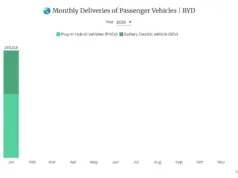
In January, the automaker launched upgraded new versions of a number of plug-in hybrid models with long-range batteries. Sales of plug-in hybrid cars, which made up more than half of BYD’s total car sales, still fell 28.5% in January, extending a trend after they fell 7.9% in 2025.
BYD is seeking faster growth overseas to offset the weakness. Sales outside China jumped 43.3% in January, accounting for 48% of its total deliveries in the month.
Last month BYD said it has targeted 1.3 million vehicles in overseas shipments for this year, suggesting a 24% increase from 2025 but lower than an earlier goal of up to 1.6 million vehicles which its management told Citi in a meeting in November.
BYD’s Hong Kong shares have fallen nearly 40% since May 2025. Warren Buffett’s Berkshire Hathaway, which had been a long-standing investor in BYD since 2008, fully exited the Chinese automaker last year.
(Reporting by Hong Kong, Shanghai and Beijing newsroom; Editing by Stephen Coates)