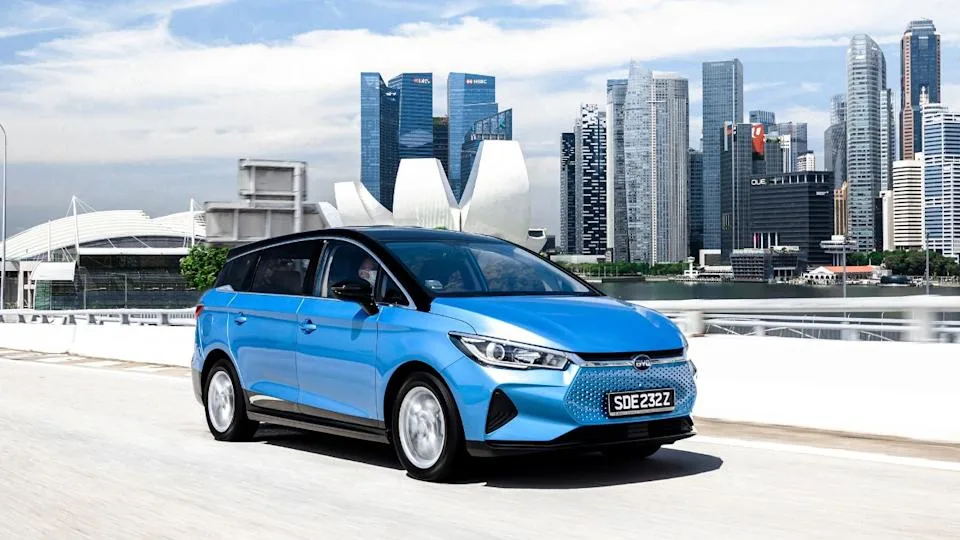
The American electric vehicle market entered a new phase on October 1, 2025. Public Law 119-21, known as the One Big Beautiful Bill Act (OBBBA) and signed on July 4, 2025, ended the federal Clean Vehicle Credit, worth up to $7,500, for vehicles acquired after September 30, 2025.
This change forced a shift from a subsidy-driven market to one defined by price competition. Upfront costs and vehicle reliability are now the primary priorities for U.S. EV buyers. The central question is whether affordable international models can successfully enter the local market under these new conditions.
Background

Photo Courtesy: Byd.
Several automakers saw a significant sales surge in late 2025 as consumers rushed to buy before the deadline. Tesla reported record global third-quarter deliveries of 497,099 vehicles, and coverage at the time linked part of the surge to U.S. buyers rushing to take delivery before the federal EV credit ends on September 30, 2025.
Advertisement
Advertisement
In this environment, the advantage goes to manufacturers that can maintain low prices without government help while meeting U.S. safety, emissions, and service requirements.
Chinese manufacturer BYD is structurally prepared for this transition. Their vertical integration allows them to manufacture batteries and semiconductors in-house, controlling costs without relying on American incentives.
EV Price War

Photo Courtesy: BYD.
While Tesla leads the premium sector, BYD produces budget-friendly models like the Seagull (branded as the Dolphin Mini in certain regions) for roughly €20,000 in parts of Europe.
Although there is no official U.S. price, a sub-$20,000 entry could disrupt the budget segment for price-sensitive American buyers. If BYD can navigate the current trade barriers, it may finally bring affordable electric options to a wider demographic.
America First and Trade Barriers

Image Credit: Joe Ravi, CC BY-SA 3.0/Wiki Commons.
U.S. trade policy remains the biggest obstacle. A Section 301 tariff rate of 100% on Chinese-made EVs effectively doubles the duty on the vehicle itself, and many summaries describe the total passenger car tariff burden as about 102.5% once the standard 2.5% U.S. car duty is included.
Advertisement
Advertisement
On February 20, 2026, the Supreme Court ruled that the President cannot use the International Emergency Economic Powers Act (IEEPA) to impose tariffs.
This ruling struck down the «emergency» duties applied in 2025 but did not affect the 100% Section 301 tariff, which remains in place.
Following the court’s decision, the administration signed a Section 122 proclamation on February 20, 2026, imposing a temporary 10% import duty for 150 days, with the duty taking effect February 24, 2026. The proclamation includes major carve-outs, including passenger vehicles and many vehicle parts, as well as USMCA-compliant goods from Canada and Mexico.
While BYD’s U.S. subsidiaries have sued to seek refunds of IEEPA-based tariffs they have paid, the 100% Section 301 tariff rate on China-made EVs remains the core barrier to selling a China-built BYD passenger vehicle competitively in the U.S.
Advertisement
Advertisement
If these restrictions eventually ease, BYD’s manufacturing strategy and scale could make it a dominant force in the U.S. market.
These are the key factors that make BYD’s leadership in the global EV market a very distinct possibility.
1. Vertical Integration in the U.S. Market

Image Credit: BYD.
Advertisement
Advertisement
BYD’s ability to build core parts internally reduces base costs and supply chain delays. This is useful for the U.S. market, where manufacturers must pay for FMVSS crash testing and EPA certification.
If BYD establishes assembly in North America (such as in Mexico), it must meet USMCA rules. These rules require a 75% Regional Value Content (RVC) for duty-free status.
Simply shipping parts to a nearby country is not enough: they must meet specific labor and part-sourcing thresholds to avoid high tariffs.
2. Blade Battery and Lfp Technology

Image Credit: BYD.
The Blade Battery uses lithium iron phosphate (LFP) chemistry. This design removes the need for nickel and cobalt, reducing material costs.
Advertisement
Advertisement
Safety is another factor. BYD has demonstrated the Blade Battery’s resistance to thermal runaway in public tests. For U.S. buyers, this translates to potentially lower insurance and warranty costs. Stable battery prices also allow for more predictable monthly loan payments.
3. Production Automation

Image Credit: BYD.
Investment in factory automation and digital-twin systems has increased BYD’s output and quality control.
For the U.S. market, these systems provide the data needed for regulatory compliance and safety certifications. Higher production volumes help spread out the fixed costs of entering a new market.
4. The Seagull as an Entry Model

Image Credit: BYD.
The BYD Seagull (known as the Dolphin Mini in some regions) serves as a benchmark for small EV pricing. It is a smaller, distinct model from the standard Dolphin.
Advertisement
Advertisement
A U.S. version of the Seagull would require engineering changes to meet NHTSA safety standards and EPA range tests. If certified, it could reach buyers who have been priced out of the new car market since the repeal of federal credits.
5. Localization To Avoid Tariffs

Image Credit: Robert T Bell from Oshawa, Canada – IMG_7387CC BY 2.0/Wiki Commons.
Advertisement
Advertisement
BYD is currently litigating to challenge certain tariffs and is exploring local production in Mexico. Building vehicles within the USMCA zone or inside the U.S. would reduce or eliminate Section 301 duties. This strategy requires time and capital but provides a permanent way to keep retail prices low without relying on consumer tax credits.
6. Financing and the OBBBA Deduction

Image Credit: SofikoS/Shutterstock.
U.S. buyers prioritize monthly payments and resale value. BYD’s financing strategy must account for the OBBBA Car Loan Interest Deduction (active 2025–2028).
Under current guidance, this deduction is generally limited to interest on loans for new personal-use vehicles that are assembled in the United States, and it is also subject to eligibility limits, including income-based phaseouts. Since BYD does not currently assemble passenger vehicles in the U.S., it must lower its MSRP even further or offer its own financing subsidies to compete with U.S.-made cars that qualify for the tax deduction.
7. Charging and Service Infrastructure

Image Credit: EV Charging sarawuth/Shutterstock.
Success in the U.S. requires a reliable service network and charging compatibility. By 2026, many major automakers have committed to native NACS ports on new EVs, making NACS a leading standard in North America, though CCS vehicles and stations still remain widely in service.
Advertisement
Advertisement
BYD will need to adopt native NACS ports or provide reliable adapters to satisfy consumer expectations. Providing transparent crash test data and establishing local service centers will be necessary to build trust with American drivers.
Final Assessment
Photo Courtesy: BYD.
BYD’s business model does not rely on government subsidies like California’s coming EV rebate for new buyers. Their focus on vertical integration and LFP battery technology provides a framework for affordability.
While trade barriers and the repeal of the $7,500 credit create challenges, BYD’s ability to control manufacturing costs puts it in a strong position. If they can localize production and adapt to the OBBBA’s new incentive structure, they could become a major force in the U.S. market.
Read More


![BYD unveils new Toyota Camry-sized Seal 07 EV with 705 km range [Images]](https://automundochina.com/wp-content/uploads/2026/03/byd-unveils-new-toyota-camry-sized-seal-07-ev-with-705-km-range-images-238x178.webp "BYD unveils new Toyota Camry-sized Seal 07 EV with 705 km range [Images]")