Support CleanTechnica’s work through a Substack subscription or on Stripe.
Or support our Kickstarter campaign!

Last week, Canada lowered its tariffs on Chinese made cars from the 100 percent level it set two years ago at the behest of the Biden administration to as little as 6.1 percent for the first 49,000 cars imported. In total, the tariff should average about 15 percent thereafter.
Writing for Bloomberg, Lisa Stillman said sales of electric cars — particularly those manufactured by BYD — are surging, despite the Mexican government ratcheting up tariffs on them. She says, “Mexico City is abuzz with cheap, battery-powered compacts made by the likes of China’s BYD. The world’s largest EV maker nearly doubled its Mexican sales volume last year and now accounts for about seven of every 10 electric and plug-in hybrid vehicles sold there.”
Cars with plugs, which includes PHEVs, now account for about 9 percent of the new car market in Mexico. Stillman notes that Chinese companies like BYD see opportunity in developing economies with infrastructure challenges, fragmented distribution, and lower income levels, like Mexico.
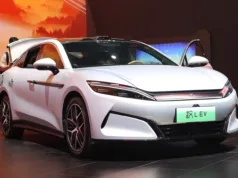
Mónica Reyes Rosas, who lives in Mexico City, told Stillman she switched from a gasoline-powered Ford Ranger to a BYD King plug-in hybrid sedan that cost her 463,000 pesos ($26,307). “You save a lot on gasoline and the price is extremely competitive,” Reyes said. What does a BYD King look like? Squint a little and it could be mistaken for a Tesla Model 3. The least expensive Model 3 in Mexico costs about the same as the BYD King.
The most popular BYD model in Mexico is the Dolphin Mini EV, which sells for about $21,000 — $2,000 less than its nearest competitor, the Chevrolet Spark EUV, which was introduced to the Mexican market in the third quarter of 2025.
The price of gasoline in Mexico City this year is about $1.35 a liter, or about $5.00 a gallon. Electricity costs about 12 cents per kWh for those who use less and rises to around 18 cents per kWh for those who use more. Roughly speaking, “fuel” for an electric car should be less than half the cost of gasoline for a conventional vehicle.
Ratcheting Up Tariffs
The arrival of Chinese cars has taken Mexico by surprise, leading to concerns from legacy carmakers with manufacturing operations in Mexico and pressure from the US government. Last year, as part of a wider effort to address growing dependence on China, President Claudia Sheinbaum proposed tariffs as high as 50 percent on some products from countries that don’t have free trade deals with Mexico. China is currently one of those countries.
Stillman says those tariffs went into effect on January 1, 2026, but how much impact they will have on the new car market is unclear. David González, a BYD salesperson in Mexico City, told her that BYD offered year-end discounts to sell more units ahead of the enactment of the new tariffs. Even so, he didn’t expect a major dent to sales because he believes BYD would not raise prices by more than 15,000 pesos ($900) and would absorb any additional costs.
Roberto Rocha, the co-founder and chief executive officer of Vemo, an EV taxi and charging company that’s partnered with Uber in Mexico, said Chinese carmakers like BYD, Anhui, and JAC, whose cars make up the majority of Vemo’s taxi fleet, can remain competitive at 50 percent tariffs.
Some analysts say tariffs are unlikely to change the fundamental demand and supply dynamics in Mexico. “Non-Chinese manufacturers have invested very little in bringing these technologies to Mexico,” said Eugenio Grandio, president of EMA, Mexico’s EV association, and a former Tesla executive. “They say there’s no demand, and then they complain that the Chinese are selling them. So is there demand, or isn’t there?”
Lower Prices
The fact of the matter is: BYD sells good electric cars at significantly lower prices than the competition.
There is a lesson there for EV advocates. We can talk till we are blue in the face about lower emissions, powerful acceleration, regenerative braking, and lower maintenance costs, but for a large number of new car buyers, their primary concern is the price, followed by the price, and ending with the price. There are good things happening in Europe, where Renault and Volkswagen are introducing lower priced EVs, or will do so soon.
GM manufactures a trio of EVs in Mexico, but sold only 1,540 of them there last year. Ford makes the Mustang Mach-E in the country, but it costs $10,000 more than it does in the US — odd, and hardly a recipe for robust sales. Nissan gave up on marketing its LEAF in Mexico three years ago. Even Tesla sold fewer than 4,000 cars in Mexico in 2024, according to BloombergNEF’s most recent estimate, which was about one-quarter of BYD’s estimated volume for fully electric vehicles that year.
US Automakers Have Little Interest In Mexico
For major US and Japanese carmakers, the Mexican EV market is too small and immature to justify making a major push at a time when global demand is softening. They are content to offer gasoline or hybrid gas-electric models that make up the bulk of Mexico’s sales.
That has opened up a door for Chinese brands like BYD, Chery, and Great Wall — companies that specialize in battery-electric vehicles. In 2021, fewer than 500 Chinese EVs and plug-in hybrids were imported into Mexico. By 2025, the number surged to nearly 100,000, according to a Bloomberg analysis of customs data compiled by Big Trade Data. BYD is leading the charge, accounting for more than 80 percent of the total.
Just as BYD is doing in South America, it is enticing customers with below-market loan rates. Customers are being offered new car loans at 7.9 percent — well below the norm of 13 percent or more from other lending sources. We said earlier that the price is the most important factor in new car purchase decisions, but, actually, for people buying on credit, the monthly payment is often the determining factor.
EV Incentives Despite Tariffs
Despite the new tariffs, Mexico still offers incentives to EV buyers. Battery electrics and plug-in hybrids are exempt from federal tax at the time of purchase, and they receive a deduction in the income tax known as ISR. Some states in Mexico have waived annual fees on EVs and hybrids, and those cars are also spared the cost of expensive emissions tests.
When air quality is poor in Mexico City and certain other metropolitan zones, EVs and plug-in hybrids are allowed on the road at all times, whereas other vehicles can only be driven on certain days. Also, under a program known as “Plan Mexico,’’ electric and plug-in hybrid cars bought between 2025 and 2030 will receive an immediate tax deduction of as much as 86% of their value.
That’s not all. Mexico’s government is providing incentives for constructing EV charging infrastructure. There is a 30 percent tax credit for public charging station installations, and CFE, the national utility company, has a program that rewards people who install a dedicated meter for charging their electric vehicles. Once installed, those customers pay a commercial rate for electricity that is lower than the standard residential rate.
BYD Mania
Stella Li, the president of BYD Americas (who seems to be everywhere, all the time, and all at once), announced last year that her company will offer cars in Mexico that feature so-called “flash charging” — which allows them to replenish their battery packs in about the same time as it takes to get a tank of gas — beginning in April.
“If you go to any city in Mexico, you can see that BYD is the darling,” Li said at a press conference in Zhengzhou, China, with Mexican journalists in November, comparing the popularity of her company’s dealerships with Apple stores. “Every time we have a weekend event, it’s full of people. They dream about their own BYD car.”
Executives at GM and Ford can only dream of such enthusiasm among their customers. Same old, same old just doesn’t cut it in the age of the new, new thing.
Support CleanTechnica via Kickstarter

Sign up for CleanTechnica’s Weekly Substack for Zach and Scott’s in-depth analyses and high level summaries, sign up for our daily newsletter, and follow us on Google News!
Have a tip for CleanTechnica? Want to advertise? Want to suggest a guest for our CleanTech Talk podcast? Contact us here.
Sign up for our daily newsletter for 15 new cleantech stories a day. Or sign up for our weekly one on top stories of the week if daily is too frequent.
CleanTechnica uses affiliate links. See our policy here.
CleanTechnica’s Comment Policy