BYD’s Executive Vice President Stella Li confirmed on 14 March that the automaker’s recently-opened plant in Brazil’s Bahia state has secured export orders of around 100,000 units, split evenly between Argentina and Mexico. The announcement sent the automaker’s Hong Kong-listed shares up as much as 8.3% on 16 March, marking the stock’s largest single-day gain in 13 months.
The announcement was made at an event hosted by BYD in Rio de Janeiro wherein the company also announced plans to build a BRL 300m (US$58m) research centre. Due for completion in 2028, the facility will gather tropical climate data to help shape product development for markets in the region.
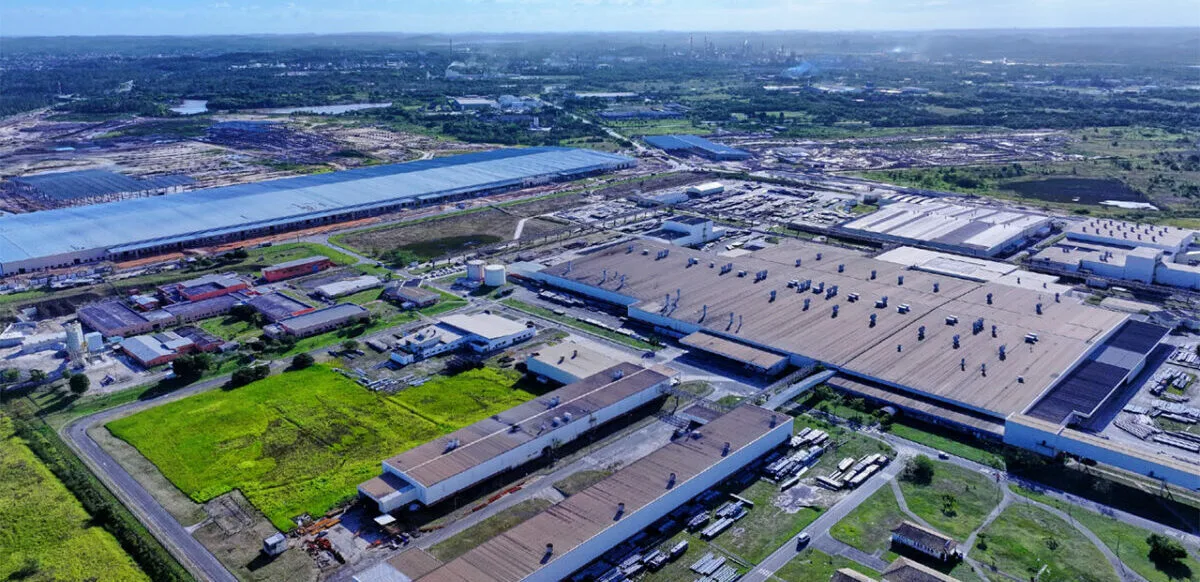
The Camaçari facility in Bahia is, in reality, a converted former Ford plant that began producing BYD units on 1 July 2025. The site currently has an annual capacity of 150,000 vehicles and produces the Dolphin Mini, Song Pro, and King hybrid; the first unit to roll off production lines was a Seagull city car. The plant has a planned capacity of 600,000 units to be reached in the future, and given the 112,900 units it sold in the country during 2025—ranking it the seventh best-selling automaker—it may need to advance its expansion plans sooner than later.
BYD has thus far invested BRL 1.4bn of a planned BRL 5.5bn total commitment at the site, which currently employs 1,000 people with 3,000 further positions planned. Vertical integration efforts are also underway, in part a reaction to Brazil ending its temporary scheme of reduced duties for electric vehicle (EV) and hybrid components. BYD has indicated plans to source or manufacture 50% of parts locally by end-2026; it has also acquired mining rights for two tracts of land in Brazil’s ‘lithium valley’, and is courting local refiner Sigma Lithium about a potential acquisition.

Despite serving as a strategic linchpin for Latin America, BYD’s Bahia plant carries some fairly substantial reputational baggage. State prosecutors filed a BRL 257m (US$45m) lawsuit against BYD and two of its contractors in May 2025, alleging that 220 Chinese construction workers were trafficked into Brazil and subjected to conditions described as “analogous to slavery”. The automaker initially characterised early reporting on the conditions as an attempt to smear Chinese brands, before subsequently stating that it does not tolerate violations of Brazilian law or human dignity.
The orders are a bright spot in an otherwise troubled few months for BYD, which increasingly finds itself relying on overseas growth to offset lost market share in China. Overall sales fell 36% in the first two months of 2026 to 400,241 units, even as exports gained momentum and now account for a near-equal share of total volume. The automaker is targeting 1.3 million overseas vehicle sales across 2026, with Latin America a central pillar of that ambition given BYD’s effective exclusion from US markets by tariffs of 100% or above on Chinese-made EVs.
Mexico continues to be a major strategic priority for BYD despite some recent headaches. The company shelved plans for a 150,000-unit factory in the country in mid-2025, citing geopolitical volatility and pressure from the US over fears that Mexico could serve as a tariff backdoor. Fears were, in fact, mutual: China’s Commerce Ministry had already delayed approval for the project in March 2025 over concerns that the company’s technology could leak north of the border.
Despite this, the automaker remains keen to set up production in the country, and is among the finalists reportedly vying to acquire a shuttered Nissan-Mercedes plant in Aguascalientes.