Brazil Electric Vehicle Market Graph 2026
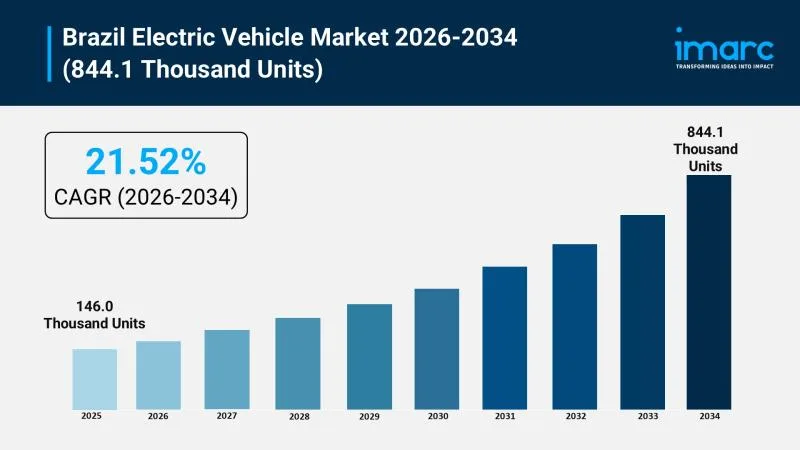
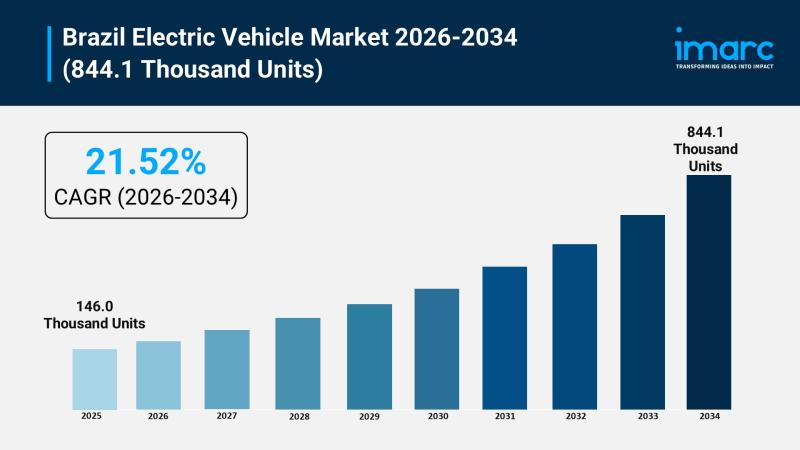
The Brazil electric vehicle (EV) market is currently witnessing an unprecedented surge, having reached a volume of 146.0 Thousand Units in 2025. Fueled by a combination of stringent environmental policies and a strategic shift toward domestic production by global automakers, the market is projected to reach 844.1 Thousand Units by 2034. This rapid expansion represents a robust Compound Annual Growth Rate (CAGR) of 21.52% during the forecast period of 2026-2034.
Key Market Trends & Highlights (2026-2034)
• Market Size & Growth: The market reached a volume of 146.0 Thousand Units in 2025 and is projected to surge to 844.1 Thousand Units by 2034, expanding at a rapid CAGR of 21.52%.
• Production Surge: There is a definitive shift from improved vehicles to domestic manufacturing. Major Chinese automakers like BYD and Great Wall Motors (GWM) are establishing local factories (such as BYD’s complex in Camaçari) to lower costs and bypass import taxes.
• Key Drivers: Growth is fueled by government incentives like the «Green Mobility and Innovation Program» (Mover) and «Rota 2030,» alongside rising environmental awareness-surveys indicate 90% of Brazilians believe climate change impacts their daily lives.
• Dominant Segments: Passenger Vehicles hold the largest market share due to the introduction of affordable compact models. In terms of propulsion, Hybrid Electric Vehicles (HEVs) lead the market, serving as a practical transition technology, while Battery Electric Vehicles (BEVs) are the fastest-growing segment.
• Regional Hubs: The Southeast region (São Paulo, Rio de Janeiro) dominates due to superior charging infrastructure and purchasing power. The Northeast is emerging as a critical manufacturing hub due to new factory investments.
• Key Players: The market is characterized by intense competition between legacy automakers and new entrants, including BYD, Great Wall Motor (GWM), Toyota, Stellantis, Volkswagen, and Volvo.
Challenges the Industry Must Address
Despite the strong growth outlook, key challenges remain:
• Charging Infrastructure: While growing, the network of public charging stations remains concentrated in the Southeast, creating «charging deserts» in other regions.
• High Upfront Costs: Despite incentives, the initial purchase price of EVs remains higher than internal combustion engine vehicles for the mass market.
• Grid Reliability: The added load from widespread EV charging requires significant upgrades to Brazil’s power distribution grid to prevent outages.
The urgency of this transition is underscored by the market’s explosive recent performance; sales of electrified vehicles jumped by nearly 146% year-over-year in the first half of 2024 alone, signaling a definitive shift in consumer preference. This momentum is further accelerated by the entry of major Chinese manufacturers like BYD and Great Wall Motors (GWM), who are establishing local production hubs to lower costs and meet the soaring demand for cleaner mobility solutions.
Request for a sample to get detailed understanding about the market: https://www.imarcgroup.com/brazil-electric-vehicle-market/requestsample
What is Driving Brazil Electric Vehicle Market’s Boom?
The report identifies three core forces reshaping Brazil’s EV landscape:
• Government Incentives and Policy Support: The implementation of the «Green Mobility and Innovation Program» (Mover) and «Rota 2030» initiatives provides substantial tax relief and financial incentives for both manufacturers and buyers, significantly lowering the barrier to entry for electric mobility.
• Domestic Manufacturing Expansion: Global automotive giants are localizing production to bypass import taxes; for instance, BYD is establishing a major manufacturing complex in Camaçari to produce EVs and batteries domestically, ensuring stable supply and competitive pricing.
• Rising Environmental Awareness: With surveys indicating that 90% of Brazilians believe climate change affects their daily lives, consumer sentiment is heavily pivoting toward sustainable transportation options to mitigate urban air pollution.
Key Market Insights at a Glance
The following highlights the leading segments by category based on 2025 market share data:
• Vehicle Type – Passenger Vehicles: Leading market segment, driven by the growing availability of affordable compact EV models and changing urban lifestyle preferences.
• Propulsion Type – Hybrid Electric Vehicle (HEV): Leading market segment, favored for offering a bridge between traditional combustion engines and full electrification, especially with flex-fuel hybrid technology.
• Component – Battery Cells and Packs: Leading market segment, as the demand for high-density, cost-effective energy storage solutions intensifies with rising vehicle sales.
• Region – Southeast: Leading market share, anchored by the developed infrastructure and high purchasing power in states like São Paulo and Rio de Janeiro.
Detailed Segment Analysis
1. By Vehicle Type: Passenger Vehicles Dominates the Market
Passenger vehicles currently hold the largest share of the Brazilian EV market. This dominance is driven by the introduction of competitively priced electric hatchbacks and SUVs that appeal to the country’s middle class. The segment is witnessing a surge in demand as consumers seek to escape rising gasoline prices and benefit from lower long-term maintenance costs associated with EVs.
Commercial vehicles are also gaining traction, particularly in the logistics and public transport sectors. Cities are increasingly adopting electric buses to reduce carbon footprints, while delivery companies are electrifying their last-mile fleets to meet corporate sustainability goals.
Connect for detailed segmentation analysis, ask for analyst: https://www.imarcgroup.com/request?type=report&id=24644&flag=C3
2. By Propulsion Type: Hybrid Electric Vehicle (HEV) Leads
Hybrid Electric Vehicles (HEVs) currently lead the market, serving as a practical transition technology for Brazilian drivers. The popularity of HEVs is bolstered by Brazil’s unique ethanol infrastructure, allowing for the development of flex-fuel hybrids that run on both clean electricity and sugarcane-based ethanol.
However, Battery Electric Vehicles (BEVs) are the fastest-growing sub-segment. With improved charging infrastructure and the arrival of «affordable» BEV models from Chinese automakers, the shift toward fully electric platforms is accelerating rapidly.
3. By Component: Battery Cells and Packs Commands Share
The battery segment is the most critical component driving market value. As the heart of the EV, demand for lithium-ion battery packs is skyrocketing. This segment is supported by Brazil’s rich reserves of strategic minerals like lithium, which are attracting investments for local battery supply chains.
Other critical components such as on-board chargers and electric motors are also seeing increased local production, reducing reliance on expensive imports and strengthening the domestic automotive ecosystem.
4. By Region: Southeast Leads with Major Infrastructure
The Southeast region remains the epicenter of Brazil’s electric vehicle revolution.
• Southeast (Dominant): Home to the largest charging network and the wealthiest consumer base in São Paulo and Rio de Janeiro.
• South: A growing market supported by high environmental awareness and tech adoption.
• Northeast: Emerging as a production hub, notably with BYD’s new factory in Bahia boosting regional economic activity.
• Central-West: Seeing gradual adoption driven by agricultural wealth and urban development.
Technology Is Redefining Automotive Operations
Technological advancements are at the forefront of the Brazilian EV market’s evolution.3 The integration of «Vehicle-to-Grid» (V2G) technology is being explored, allowing EVs to serve as mobile energy storage units that can stabilize the grid. Furthermore, the development of solid-state batteries promises to revolutionize range and safety standards in the coming years.
Local innovation is also thriving, with companies like HORSE partnering with local firms to produce Brazil’s first home-grown Extended Range Electric Vehicle (EREV) engines. These technological leaps are critical in addressing range anxiety and making EVs a viable option for cross-country travel in
Brazil’s vast territory.
Key Players Shaping the Brazil Electric Vehicle Market
The market is defined by intense competition between traditional incumbents and aggressive new entrants, including:
• BMW AG
• BYD Auto Co. Ltd.
• Chery Automobile Co. Ltd.
• Ford Motor Company
• General Motors Company
• Great Wall Motor Co. Ltd.
• Honda Motor Co. Ltd.
• Hyundai Motor Company
• Nissan Motor Co. Ltd.
• Renault S.A.
• Stellantis N.V.
• Toyota Motor Corporation
• Volkswagen AG
• Volvo Car Corporation
Request Customization: https://www.imarcgroup.com/request?type=report&id=24644&flag=E
Media & Sales Contact
IMARC Group,
134 N 4th St. Brooklyn, NY 11249, USA
Email: sales@imarcgroup.com
Tel No: (D) +91 120 433 0800
United States: +1-201971-6302
About IMARC Group
IMARC Group is a leading global market research company providing data-driven insights and expert consulting services to businesses seeking to achieve their strategic objectives. With a multi-disciplinary team of industry experts, IMARC delivers thorough, reliable market intelligence across sectors including Automotive, Technology, Energy, and Manufacturing.
This release was published on openPR.