- Trade groups representing American carmakers have sent a letter to President Trump asking that he bar Chinese auto manufacturers from the United States.
- There are over 100 carmakers in China, but while one Buick, one Lincoln, and a Polestar model are Chinese-made, no other Chinese cars are sold here.
- Trump’s planned visit to China March 31 is now delayed due to war with Iran.
Trade groups representing US automakers have sent a letter to President Donald Trump asking him to bar Chinese carmakers from selling vehicles in the United States. They also asked that he bar them from building factories here.
Reuters, which had viewed a letter signed by the trade groups, reported that the groups raised “serious concerns about China’s ongoing efforts to dominate global automotive manufacturing and to gain access to the US market. These actions pose a direct threat to America’s global competitiveness, national security, and automotive industrial base.”
Trump had planned to visit China March 31 to discuss trade, but he just announced a delay to that meeting so he can deal with the war against Iran.
The letter was from the Alliance for Automotive Innovation, the National Automobile Dealers Association, Autos Drive America, the American Automotive Policy Council, and MEMA, the Vehicle Suppliers Association.
The five groups represent automakers, car dealers, and parts manufacturers. Specifically, they called for maintaining a 2025 Commerce Department cybersecurity regulation that effectively keeps nearly all Chinese vehicles out of the US market.

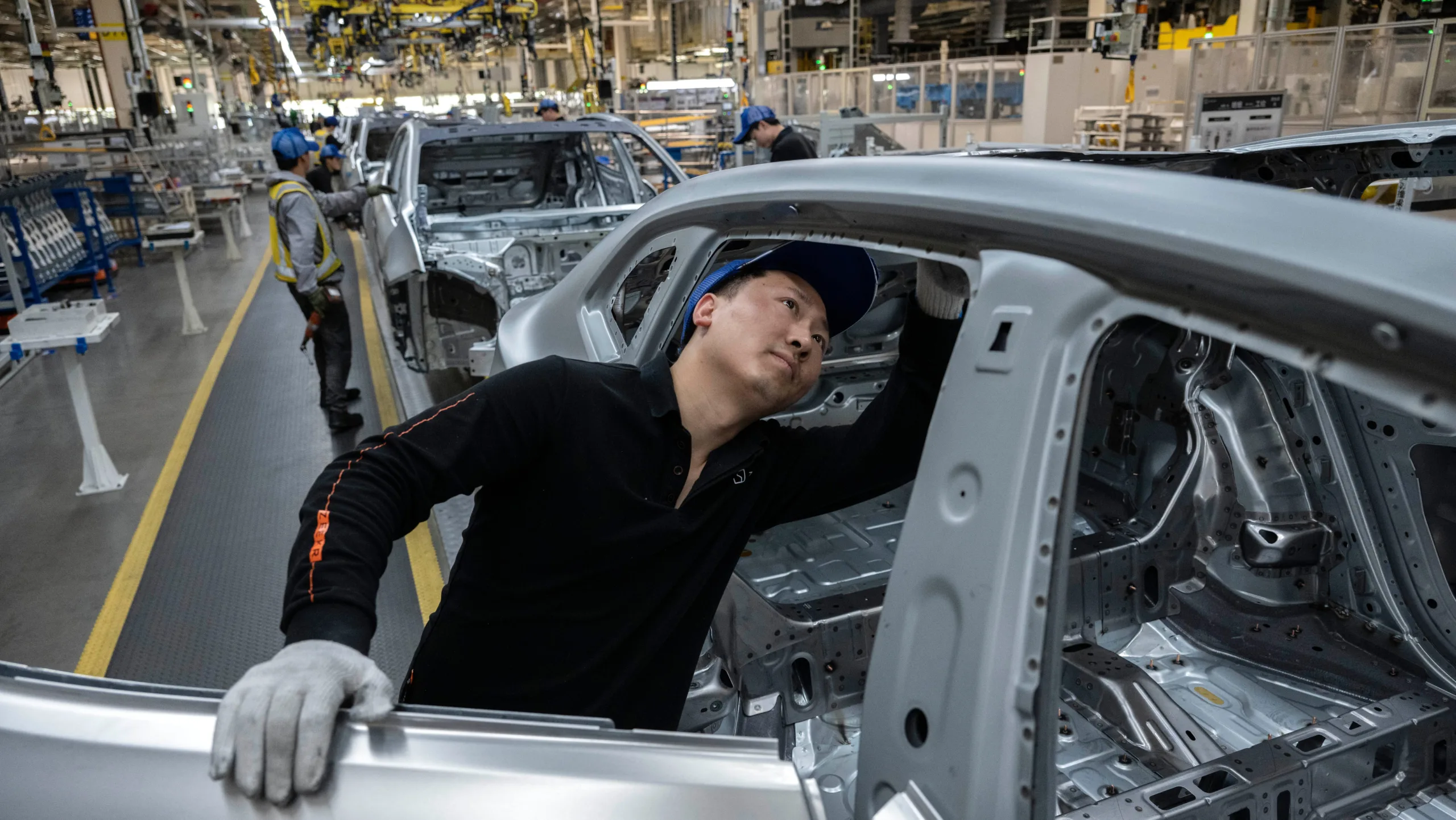
A worker on the Zeekr assembly line.
The Buick Envision, Lincoln Nautilus, and the Polestar 2 are made in China for sale in the US. Volvo used to sell some Chinese-manufactured cars in the US but has since relocated production of those models to Europe and South Carolina.
There are over 100 carmakers in China, and the country has control over much of the raw materials needed to make electric cars. So, you could argue that the eventual presence of Chinese carmakers in the US seems like an inevitability.
Nonetheless, American carmakers want to keep them out, at least for the time being. Similar protectionist sentiments ran high among US automakers when Japanese carmakers became a major player after the OPEC oil embargo of 1973.
Reuters quoted the Chinese embassy in Washington rejecting the criticism, saying Chinese-made cars are popular globally “not by using so-called ‘unfair practices’ but by emerging from the fierce market competition with technological innovation and superb quality. China’s door has been open to global auto companies, including US auto companies who have fully shared in the dividends of China’s big market.”
But foreign carmakers have traditionally faced obstacles to manufacturing in China, initially having to work with a joint-venture model required by the government that often meant sharing technology with their Chinese hosts. Now they also face a hypercompetitive landscape where foreign market share collapsed from 64% in 2020 to roughly 31% in 2025, according to CNBC.
“While foreign ownership restrictions have eased, local brands dominate with lower costs and faster electric vehicle (EV) development,” CNBC said.
As recently as January, Reuters noted, Trump said he was open to Chinese automakers building vehicles in the United States. “If they want to come in and build a plant and hire you and hire your friends and your neighbors, that’s great, I love that,” he told the Detroit Economic Club.
In December, the Alliance for Automotive Innovation, which represents General Motors, Ford, Toyota, Volkswagen, Hyundai, Stellantis, and other major automakers, said, “China poses a clear and present threat to the auto industry in the US,” and urged Washington to prevent Chinese government-backed automakers and battery manufacturers from opening US manufacturing plants.
Do you want Chinese cars here? Let us know in the comments.

Mark Vaughn grew up in a Ford family and spent many hours holding a trouble light over a straight-six miraculously fed by a single-barrel carburetor while his father cursed the Blue Oval, all its products and everyone who ever worked there. This was his introduction to objective automotive criticism. He started writing for City News Service in Los Angeles, then moved to Europe and became editor of a car magazine called, creatively, Auto. He decided Auto should cover Formula 1, sports prototypes and touring cars—no one stopped him! From there he interviewed with Autoweek at the 1989 Frankfurt motor show and has been with us ever since.