Ouyang Minggao said solid-state batteries may require 5 to 10 years to reach a 1% market share, adding a longer-term adoption estimate to his earlier comments on the technology’s rollout, according to China News Weekly.
The estimate adds a market adoption timeline to earlier disclosures from the same event, which focused on vehicle-level deployment and technical development stages.
Ouyang Minggao, a Chinese Academy of Sciences academician and Tsinghua University professor, has led research on battery systems and new-energy vehicle powertrains.
Deployment vs adoption
Ouyang said all-solid-state batteries are expected to begin vehicle installation around 2027, according to the report.
China News Weekly presents this as an initial deployment phase, distinct from broader market adoption. It notes that entering vehicles does not equate to large-scale commercialisation, which depends on further development and scaling.
The report also states that test vehicles equipped with solid-state batteries are expected to appear between late 2026 and 2027.
Industry activity
Chery announced that its solid-state battery has reached an energy density of 400 Wh/kg, with a target of 600 Wh/kg and plans for vehicle testing in 2027. Geely said it aims to complete its first in-house solid-state battery pack in 2026 and begin vehicle validation.
Battery supplier Eve Energy also released solid-state battery products, including a 60 Ah automotive cell and a consumer-focused design optimised for lower-pressure conditions.
Japanese automakers continue parallel development programs. Toyota plans small-scale production around 2026 and larger-scale output after 2030, while Nissan aims to launch a production vehicle equipped with solid-state batteries in 2028.
Battery structure
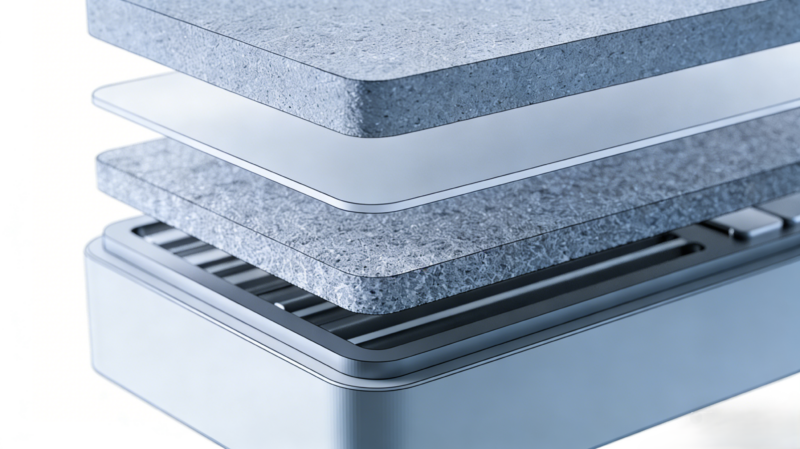
The report explains that conventional lithium-ion batteries consist of a cathode, an anode, an electrolyte, and a separator, with liquid electrolytes enabling ion transport.
All-solid-state batteries replace the liquid electrolyte and separator with solid-state materials, forming a “liquid-free” structure. This design is associated with a higher theoretical energy density compared with current commercial lithium-ion batteries, which are around 300 Wh/kg.
Technical challenges
Large-scale adoption depends on resolving multiple technical challenges, including high interfacial resistance at solid-solid interfaces, lithium dendrite formation, and limitations in cycle-life performance.
The report adds that cost reduction requires scaling production volumes, as manufacturing capacity expansion is linked to lower unit costs.
It also notes that safety characteristics are still under evaluation. Ouyang said solid-state batteries are not “absolutely safe,” and that the technology remains at an early stage with multiple issues yet to be addressed.
Market scaling
Despite ongoing development and announcements, solid-state batteries are unlikely to reach meaningful market scale in the near term.
Ouyang’s estimate that reaching 1% market share could take 5 to 10 years suggests that large-scale adoption lies beyond the initial phase of vehicle integration.

Follow us for ev updates