

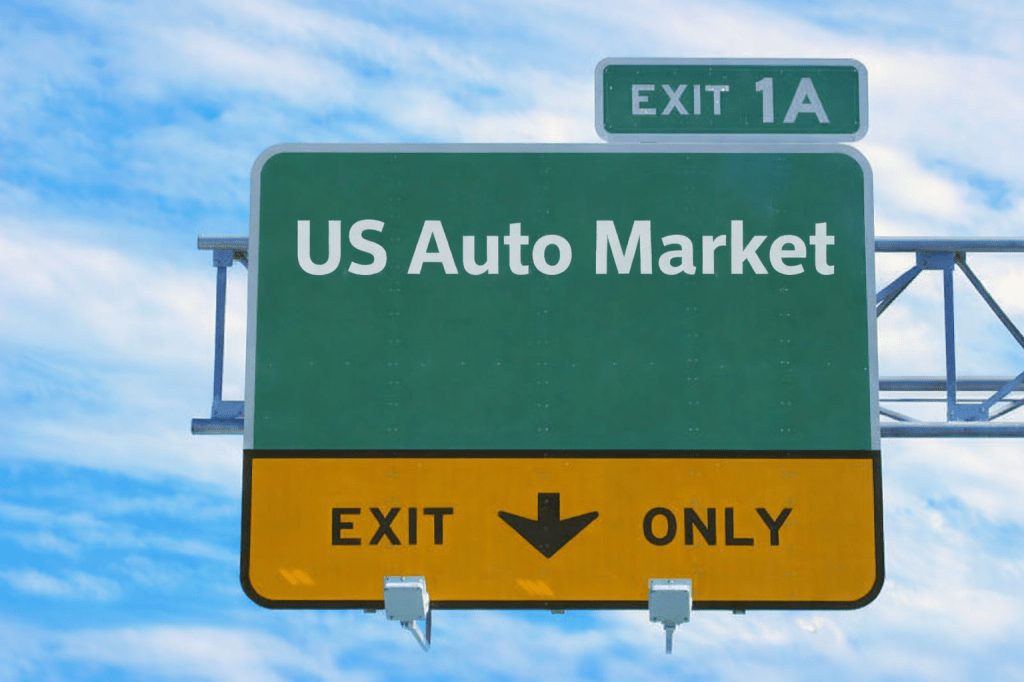
How Trump’s trade war built a Canadian on-ramp for Chinese EVs.
Electric vehicles (EVs) in the U.S. are at an impasse. Sales are down after the expiration of Biden-era tax credits and federal efforts to build out a national charging network fell flat. Ford and GM have announced significant pullbacks on their EV ambitions, and Tesla seems more worried about robotaxis and robots than delivering new models that would expand their reach to more consumers. Meanwhile, the Trump administration is uprooting regulatory support that encourages EVs, going so far as to challenge the endangerment finding, which grants the EPA authority to regulate greenhouse gas emissions.
Despite all this, there is still a strong bull case for electric cars because EVs don’t have to have policy support to survive (though it helps) and we don’t need American brands to be leaders in the transition (though that would be good for US industry, which risks being permanently left behind).
If we want more EVs in the US, all we need to do is allow the world’s most popular EVs, which are made by Chinese brands, to compete directly in the US market. This is why I think a recent landmark trade deal announced between Canada and China is a big deal, not just for Canada, but for the US and the climate.

What Happened?
In January, Canadian Prime Minister Mark Carney flew to Beijing and stood beside Chinese President Xi Jinping to announce a trade deal. In exchange for clearance to export some canola oil to China, Canada will allow up to 49,000 Chinese electric vehicles into the country at a 6.1% tariff—down from the 100% tariff imposed just fifteen months earlier. That 100% tariff matches the US tariff on Chinese EVs imposed under Biden. The quota will grow to 70,000 vehicles per year over five years, with half required to be priced under C$35,000, ensuring that Chinese imports will demonstrate that quality EVs can also be affordable.
The irony here is that this move only occurred because Trump’s antagonistic positioning vis-a-vis Canada has forced Carney into a diversification strategy. This is a tariff boomerang—by squeezing Canada, Trump pushed them to open the door to Beijing in a way that will bring Chinese EVs to our doorstep.
The State of Play
The case for allowing Chinese EVs into the North American market is simple: Chinese EVs are great and affordable cars. You don’t have to drive a Chinese EV to know this—you just need to see that they are beating Western brands in markets wherever they directly compete.
In 2025, Tesla lost its crown as the world’s largest EV maker to China’s BYD, selling 1.64 million vehicles compared to BYD’s 2.26 million (this figure includes some hybrids, but BYD does sell more all-electric cars than Tesla). In Europe, the contrast is stark: Tesla’s registrations fell 40% year-over-year in July 2025, while BYD’s rose 225%. In China itself, Tesla dropped out of the top 10 EV sellers. China controls roughly 70% of global EV production and 69% of the global EV battery market. Six of the top ten selling global EV brands are now Chinese.
The pressure to expand internationally is intensifying, because China’s EV market may be nearing saturation. Electric vehicles now account for nearly 60% of new car sales in China, and government subsidies were cut in half at the start of this year. Investors fear that this will limit growth, while competition may cut into margins—as a result, BYD’s stock has fallen roughly 40% from its peak. This is pressuring Chinese brands to look elsewhere for new customers: in 2024, Chinese EV companies spent more building supply chains abroad than at home. For these companies, Canada’s door is opening at just the right time.
From Imports to Domestic Production
History suggests that limited import quotas can be a precursor for domestic production. In 1981, when Reagan capped auto imports from Japan at 1.68 million vehicles per year, Japanese automakers responded by building factories in the U.S.—Honda in Ohio, Nissan in Tennessee, Toyota in Kentucky—embedding themselves permanently in the North American industry.
Canada seems receptive to this path. The January 49,000-vehicle deal is a small share of the 1.7 million vehicles sold annually in Canada. But the Canadian government has suggested that imports are just the beginning. The press releases all mention expected “joint-venture investment” within three years. BYD has a minor foothold already: they have operated a bus assembly plant in Newmarket, Ontario since 2019, and BYD is already registered with Transport Canada to import passenger vehicles. Carney has since reinforced the investment message at an auto-parts plant in Woodbridge, Ontario, framing the China partnership as a long-term industrial strategy, not a one-off trade deal.

This parallels Chinese investment in Europe, where Hungary has become the beachhead: BYD is building its first European factory in Szeged, and CATL is constructing a $7.8 billion battery plant in Debrecen. Hungary offers access to the broader EU market by maintaining friendly relations with Beijing. Canada could be to the United States what Hungary is to the European Union: a gateway.
The Boomerang
I think the Canada-China deal could turn out to be a major factor for the EV transition in the US. Here is my reasoning. First, I think the Chinese brands will succeed in Canada—after all, the same cars are winning over customers in other global markets—while giving the brands critical experience in navigating regulatory and safety hurdles.
Second, post-Trump, I suspect the US-Canada relationship will thaw substantially. The degree of integration, in particular for the auto industry, may never fully return to what it was in 2016, but the current level of discord is likely to be an aberration. If the two nations cozy back up, Chinese investments in assembly or supply chains in Canada would become a strong point of entry to the US market.
Of course, the boomerang might not work this way for one of several possible reasons. First, note that Chinese EVs have been available in Mexico for some time, so mere proximity isn’t sufficient.
Second, the Chinese automakers have to believe that investing in Canada is a prelude to US access. Producing for the Canadian market alone won’t rationalize full investment in assembly and a supply chain. Assembly alone, which is a significant investment, doesn’t even guarantee free access. The current US-Mexico-Canada Agreement is based on rules of origin—roughly 75% of a product must be internal to qualify for duty-free status, so firms would need a significant supply chain in North America. The USMCA is up for renegotiation this summer, so this issue may directly enter discussions.
Third, there are also explicit trade rules associated with internet-connected vehicles: the Commerce Department has already moved to prohibit certain China-linked software and hardware in connected vehicles on American roads—exactly the kind of rule that could block a Canadian backdoor even if the manufacturing hurdle is cleared.

Security is a real barrier: connected vehicles collect and transmit enormous amounts of data—location histories, travel patterns, passenger behavior—raising real questions about what happens when such data flow through Chinese-owned systems. These concerns are legitimate. But the solution is technology and regulation, not a permanent trade ban. Canada, whose data and safety standards are closely aligned with American ones, may be well-positioned to serve as a regulatory proving ground—working out the data governance frameworks and technical standards that a future US administration would need before opening its own market. America’s tech industry should be working on those standards now, so they’re ready when we need them.
It is also possible that the boomerang doesn’t happen because the Chinese automakers jump directly into the US market. President Trump recently told the Economic Club of Detroit, “Let China come in—if they want to come in and build the plant and hire you and hire your friends and your neighbors, that’s great.” Chinese brands already have a toehold here as well—BYD produces buses in Lancaster, California. Geely—which owns Polestar and Volvo—already sells cars in the US market and is reportedly eyeing a North American entry for its Zeekr and Lynk & Co brands within three years, likely leveraging the existing Volvo plant in South Carolina.
That said, bi-partisan skepticism of the Chinese and the mercurial nature of White House policy makes Canada an appealing place to position within North America. This is why I think the tariff boomerang is real possibility—a firm grip in Canada might provide a safer on ramp to the US market over the next three to five years.
Should We Welcome Chinese EVs?
In addition to helping the climate, Chinese EVs could address a growing affordability concern in the US automobile market. The average new car sold in the United States now costs around $50,000, while the average Chinese export costs just $19,000. That gap reflects a US market that is increasingly catering to luxury and leaving anyone looking for reliable, affordable transportation to hunt through the used car lot.
America’s domestic answer to affordable EVs is Tesla’s Model 3, which retails for $39,000 to $57,000, still a barrier for most people, or perhaps the Slate truck: a Jeff Bezos-backed startup promising a bare-bones electric pickup with no display screen and crank windows, priced in the mid-$20,000s. That’s a hopeful experiment in American ingenuity—but Chinese companies have already proven they can make a real car, packed with features, at a better price point, at enormous scale. BYD has a fully electric crossover SUV priced at $14,000. Even adjusting for some differences to reach the US market, this is a price point that could transform the direction of EVs in the US. If the cars are produced in North America, it is hard to predict how cheap they would be, but I for one would like to find out. Let’s give it a try.
Follow us on Bluesky and LinkedIn, and our new Instagram. Subscribe to our email list to keep up with future content and announcements.
Suggested citation: Sallee, James. “The Electric Vehicle Tariff Boomerang” Energy Institute Blog, UC Berkeley, March 2, 2026, https://energyathaas.wordpress.com/2026/03/02/the-electric-vehicle-tariff-boomerang/




![BYD unveils new Toyota Camry-sized Seal 07 EV with 705 km range [Images]](https://automundochina.com/wp-content/uploads/2026/03/byd-unveils-new-toyota-camry-sized-seal-07-ev-with-705-km-range-images-100x75.webp "BYD unveils new Toyota Camry-sized Seal 07 EV with 705 km range [Images]")
