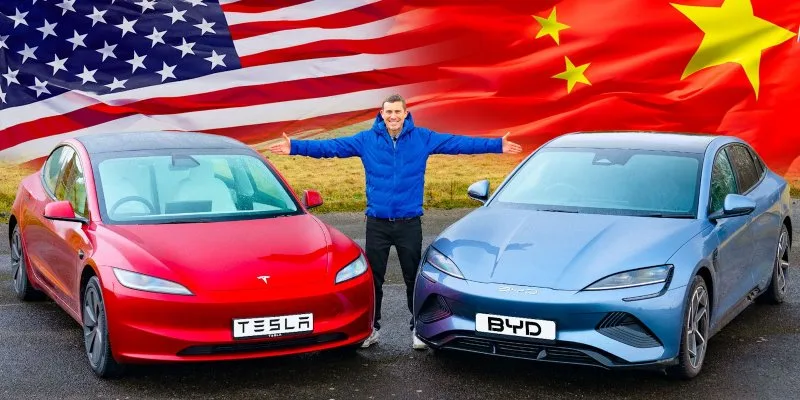
China has once again surprised the world. Despite repeated attempts to corner Chinese manufacturers, the country continues to rank at the top of global standings.
This time China has overtaken Elon Musk’s Tesla. The Chinese company BYD has become the world’s largest seller of electric vehicles. For the first time, BYD has surpassed Musk’s previously unbeatable company in annual sales.
As the BBC reports, Tesla’s car sales fell by almost 9 percent in 2025, totaling 1.64 million vehicles worldwide. This marks the second consecutive year of decline. Meanwhile, BYD’s sales rose by almost 28 percent over the year. The Chinese company sold a total of 2.25 million electric vehicles, one million of which were outside China.

Source: Reuters
According to American analysts, part of the issue lies in Musk’s political activity and the mixed reaction to the company’s strategy. However, they also acknowledge the growing competitiveness of Chinese manufacturers. Tesla’s electric vehicle sales fell by 16 percent in the last three months of 2025.
This decline was attributed to the cancellation of government subsidies that had allowed prices to be reduced. In other words, Tesla vehicles are now significantly more expensive than BYD models. And in conditions where the magic of the brand no longer plays a decisive global role, this has become an important factor in the widening gap in favor of the Chinese company. Reuters reports that demand for electric vehicles declined after tax incentives expired in the United States.
The main reason is that Chinese automakers are setting prices lower than well-known brands and are aggressively capturing market share. From the perspective of American analysts, this amounts to “pressure on Western companies.” Voices are already being heard calling for new threats of sanctions against China in order to balance the situation.
According to the BBC, Wall Street analysts have lowered their Tesla sales forecasts for 2026. In response to the situation, Tesla attempted to change course in October by releasing cheaper versions of its two best-selling models. Meanwhile, Reuters notes that Tesla, whose sales declined by about 8.6 percent in 2025, is facing intense competition, especially in Europe. This raises questions about its ability to revive its core automotive business, as CEO Elon Musk increasingly shifts the company’s focus toward robotaxis and humanoid robots.
“Investors are so focused on Tesla’s future that they are ignoring delivery figures. All attention is on Optimus, robotaxis and artificial intelligence,” Reuters quotes Dennis Dick, a trader at Triple D Trading and a Tesla shareholder, as saying.
Growing competition from Chinese and European automakers such as BYD and Volkswagen has had a negative impact on Tesla’s sales performance. At the same time, Reuters reports that BYD announced record overseas sales of 1 million vehicles in 2025 — about 150 percent more than in 2024. The company says it plans to sell up to 1.6 million vehicles outside China in 2026.
However, BYD itself also faces challenges. The company’s sales growth slowed to 7.73 percent in 2025 — its lowest level in five years — due to declining domestic demand. This is happening against the backdrop of a weakening of the company’s technological leadership. As the Chinese newspaper Southern Metropolis Daily previously reported, during a meeting with investors in December, BYD Chairman Wang Chuanfu stated that the company is preparing to introduce major innovations in 2026, but did not specify what they would be.

Source: Al Jazeera
Why are buyers choosing the Chinese model over Elon Musk’s vehicles? The answer is quite simple. As noted on industry platforms, BYD often wins on affordability, range of models, and battery safety (LFP Blade technology). It offers lower prices, compact city cars, and traditional controls. Tesla leads in efficiency, fast charging on the Supercharger network, advanced software integration, outstanding performance, and premium technologies such as autopilot, but has a less intuitive interface with minimal physical buttons and higher prices.
The choice depends on priorities: BYD is better suited for economical city use, while Tesla is preferable for long-distance travel and advanced technology.
Thus, BYD is simply more affordable. The company offers a wider price range — from compact city cars to premium sedans — thanks to its control over battery production, which lowers costs. Its Blade LFP batteries are safer, more resistant to overheating, and cheaper than their Western counterparts. In addition, Chinese cars retain traditional control layouts familiar to drivers.
However, Tesla’s advantages should not be ignored. Its vehicles have a longer driving range on a single charge, the Supercharger network enables rapid charging, and the company remains a leader in software, autopilot systems, vehicle handling, and performance.
Even so, as already noted, today’s world, facing crisis after crisis, is becoming more focused on budget-friendly cars than expensive brands. The days when price was secondary and brand prestige was decisive are over. And Chinese manufacturers have adapted to this new reality better than traditional carmakers.
By Tural Heybatov