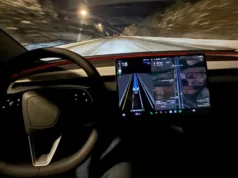
Tesla confirmed on Friday that it has established an AI training center in China, as it aims to enable local training for Tesla AI and its Full Self-Driving (FSD) software.
The information was revealed by Vice-President Tao Lin, according to local media outlet Caixin News.
The VP did not disclose the computing capacity of this center but mentioned that it is sufficient to meet current needs.
Introduced a year ago in China — though only “partially,” as described by Chief Executive Officer Elon Musk — one of the company’s known struggles with FSD there was the lack of local training data.
Due to laws against data export, to train the model Tesla “just used publicly available video on the Internet of roads and signs in China and used that to train in sim[ulation],” Musk wrote on X last year.
With the latest move, the company aims to further develop its Full Self-Driving (Supervised) software — named ‘Intelligent Assisted Driving’ (“智能辅助驾驶”) there — towards its full approval.
However, no timeline has been set for deployment, Tao said — contradicting earlier statements by the company’s CEO, which were later denied by Chinese authorities.
First Launch
Tesla‘s self-driving software was released in China a year ago for 64,000 yuan ($7,800). Customers can only purchase the software, with no subscription option offered.
It is unclear whether that will change as the company shifts to a subscription-only model starting February 14.
A few weeks after the launch, Tesla announced that owners would be able to access a one-month free trial of the software, available between March 17 and April 16.
However, the trial was then temporarily halted, with the company announcing it was reworking the software in China to comply with updated regulatory requirements.
Some of these concerns included false advertising of software capabilities in China, which led the Ministry of Industry and Information Technology (MIIT) to ban terms like ‘autonomous driving’ or ‘full self-driving.’
Over the past few months, Tesla has been offering free FSD transfers to customers who trade in their current vehicles for newer models, coinciding with the rollout of the new Model Y L and the longer-range Model 3 in China.
Last September, The Beijing News reported that seven Tesla owners in China have sued the company over FSD capabilities.
The users claimed that the vehicles they bought with its Full Self-Driving (Supervised) software cannot deliver the advertised features because of hardware limitations.
Musk Claims
Musk first mentioned in November, during Tesla‘s Annual Shareholder Meeting, that regulators were leaning to “fully” approving FSD in China in the first quarter of 2026.
Speaking at the World Economic Forum last month, Elon Musk said the company was targeting approval of FSD in China “hopefully next month.”
“We hope to get Supervised Full Self-Driving approval in Europe, hopefully next month, and then maybe a similar timing for China, hopefully” he said.
However, sources have told state-owned outlet China Daily days later that the information was “not true.”
The source did not provide any additional information on whether Chinese regulators are currently reviewing the FSD system, nor on a possible timeline for such a review.
Chinese authorities become the second to deny public claims of FSD approval by Musk.
Late last year, Tesla stated on X that it would receive approval of the software by February 2026 in the Netherlands.
“RDW has committed to granting Netherlands National approval in February 2026,” the company stated, referring to the Dutch authority.
However, according to RWD, approval is not granted. The two entities have agreed to meet in February so Tesla can demonstrate if the system’s capabilities meet the requirements.
Tesla‘s Full-Self Driving (Supervised) is currently available in the United States, Canada, Puerto Rico, Mexico, Australia, New Zealand and South Korea.
Tests are currently underway in Israel and in several European cities.