The writer, a Los Angeles freelancer, is a former Detroit News business reporter. This column first appeared in his blog, Starkman Approved.
By Eric Starkman
China’s electric vehicle industry could not ask for a more authentic or credible pitchman than Ford CEO Jim Farley. While Farley has shown he is no wizard when it comes to automotive manufacturing, his connection to the product is undeniable. When he is not quietly volunteering at the Detroit homeless shelter he supports, Farley races his own classic cars and remains deeply involved in Ford’s racing programs.
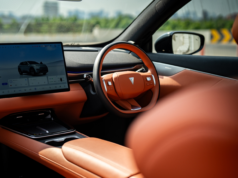
In 2024, Farley disclosed that he had been driving a China-made Xiaomi SU7 sports car for six months and that he did not want to give it back. He also said he had traveled to China multiple times and was jolted by what he witnessed.

“It’s the most humbling thing I have ever seen,” Farley said. “They have far superior in-vehicle technology. Huawei and Xiaomi are in every car. You get in, you don’t have to pair your phone. Your whole digital life is mirrored in the car. The cost, the quality of their vehicles are far superior to what I see in the West.”
Farley was not issuing a warning. He was offering a confession.
Carney opens the gate
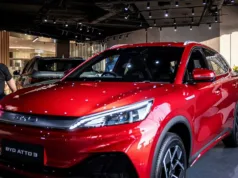
Imagine tens of thousands of Canadians making that discovery firsthand and you begin to grasp the significance of Prime Minister Mark Carney’s decision to slash tariffs and allow up to 49,000 Chinese-built electric and hybrid vehicles per year into Canada at a 6.1 percent duty. That rate mirrors the standard tariff Canada applied before it aligned with the United States and imposed a 100 percent surtax that effectively sealed the North American market, protecting domestic automakers, most notably GM and Ford, even as both have steadily reduced their unionized manufacturing footprint in Canada.
Canadian unions remain far more powerful than their American counterparts, which helps explain why Carney’s China deal lands as much as a political signal as an economic one.

“We are opening the floodgates,” warned Lana Payne, national president of Unifor, which represents Canadian autoworkers. “For the folks who think this is great because they’re going to get a few cheap cars, cheap has a price — and the price is good jobs in the auto sector in Canada and good jobs that support communities and an industrial base.”
Payne pointed to Chinese state subsidies as evidence of unfair competition, a claim that rings hollow only if one forgets the billions of dollars Canadian taxpayers have already poured into GM and other foreign automakers to preserve jobs and attract EV investment. Unifor itself was instrumental in securing those subsidies.
“It’s not fair play,” Payne said, noting how Chinese automakers have expanded their market share in Europe and Brazil.
Whatever else Carney’s trade agreement may be, it can fairly be read as a calculated rebuke to President Trump’s tariff-first trade regime, a posture Carney, the Davos globalist, has openly criticized. The message is not subtle. Canada will reopen its market to China on its own terms, even if doing so undermines Washington’s trade posture and complicates North American industrial strategy.
Carney’s deceptive math
Under the deal, the annual import cap rises to 70,000 vehicles by year five. The Carney government has said it “anticipates” that roughly half will be affordable EVs priced below $35,000. Carney insists this represents less than three percent of Canada’s annual auto sales, framing the move as modest and controlled.
That framing is deliberately misleading. The relevant denominator is not total vehicle sales. It is EV sales.
Final Canadian EV figures for 2025 are not yet available, but even a generous estimate places them at no more than 170,000 vehicles after a roughly 32 percent decline in the first nine months of the year. Viewed through that lens, the quota represents a staggeringly large share of Canada’s EV market, instantly positioning Chinese manufacturers as price setters in a sector Canada is struggling to sustain.
One caveat matters. The 49,000-vehicle figure does not mean 49,000 Chinese-brand EVs suddenly flooding Canada. The quota applies to all electric and hybrid vehicles built in China, including Teslas and vehicles produced there by Western automakers. In 2022 and 2023, roughly 40,000 such vehicles already entered Canada, most of them Teslas, making the immediate increase closer to 9,000 units.
But quotas do not remain static. They establish precedent, and precedent has a habit of expanding.
GM’s Canadian tab
GM’s vulnerability in Canada is self-inflicted. The company received roughly $500 million in federal and provincial support to produce electric delivery vehicles at its CAMI plant in Ingersoll, then shuttered the operation and sent more than 1,000 workers to the unemployment line. GM once built the gas-powered Equinox in Ontario before shifting production to Mexico, where it now also manufactures the electric version.
Canada also paid heavily for GM’s survival during the 2008 bankruptcy, ultimately losing an estimated C$800 million. In return, GM closed its massive Oshawa plant in 2019, wiping out roughly 5,000 plant and supplier jobs. When the facility reopened in 2020 to build highly profitable Silverado pickups, many jobs were rebuilt on worse terms, with lower pay for new hires and far less security.
Canadians can buy GM vehicles and also have good reason to resent GM’s conduct. GM remains a sales powerhouse in Canada, but its corporate behavior has given Canadians little reason to view it as a reliable long-term partner. GM’s EV sales have been stronger in Canada than in the U.S., even as the company builds several of its most affordable models in Mexico.
Once China’s EVs gain a foothold, it is not hard to imagine Canadians clamoring for more.
The bridges already exist
Ontario Premier Doug Ford has warned that China has secured access to Canada “without any real guarantee of equal or immediate investment in Canada’s auto sector,” adding that the deal risks jeopardizing Canada’s access to the U.S. market, still its largest export destination.

Toyota and Honda may be especially exposed. Some of their most popular U.S. vehicles are manufactured in Canada, and future EV production allocations by these automakers could be affected if Canada continues to trade industrial leverage for short-term affordability.
For GM and Ford, China’s entry into Canada could prove existential. Millions of Americans visit Canada each year. They will notice when Canadians are driving EVs that feel technologically superior to what Detroit sells at home, often at prices below the gas-powered vehicles still dominating U.S. showrooms.
There is a final irony in Carney’s deal. Jim Farley traveled halfway around the world to experience the future of the automobile. Before long, he may only need to drive to Windsor, barely 10 miles from Ford’s headquarters in Dearborn.
With 19 bridges and tunnels connecting Canada to the United States, China’s EV manufacturers don’t need to break down barriers. They only need to cross them.