Tesla (TSLA +0.50%) has been a pioneer in the electric vehicle (EV) market. Though it wasn’t the first to make one, it helped them become far more mainstream than they were before. Tesla remains a leader in this niche. However, the company faces increasing competition, including from BYD (BYDDY +7.63%), a China-based EV maker. When looking at both companies’ performances on equity markets over the past year — with Tesla gaining 32% and BYD dropping 29% — the former seems to be doing just fine, while its Chinese counterpart is struggling. But there is more to the story, much more. Here’s why Tesla might be worried about BYD.
Image source: The Motley Fool.
By the numbers
Last year, Tesla made 1.65 million EVs, with total deliveries landing in the neighborhood of 1.64 million. The company’s two main models, the 3 and the Y, accounted for the overwhelming majority of deliveries. Others include the Model X and S — which Tesla announced earlier this year that it was discontinuing — as well as its Cybertruck. Tesla is working on releasing a newer version of its Roadster, a sports car that was the first Tesla ever launched. The company’s lineup also features a semitruck. Tesla’s deliveries fell by 9% year over year in 2025, partly due to growing competition and the U.S. EV tax credits expiring in September.

Today’s Change
(0.50%) $1.81
Current Price
$363.64
Key Data Points
Market Cap
$1.4T
Day’s Range
$362.06 – $367.26
52wk Range
$214.25 – $498.83
Volume
279K
Avg Vol
61M
Gross Margin
18.03%
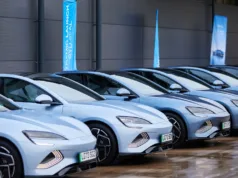
Meanwhile, BYD produced 2.22 million passenger EVs last year — up 25% year over year — while total deliveries in this category were 2.26 million, up almost 28% compared to 2024. In other words, BYD’s production and deliveries were higher than Tesla’s. Further, BYD has been unveiling major upgrades, including the introduction of a fast-charging battery that can go from 20% to 97% in less than 12 minutes, even in freezing temperatures when charging typically takes much longer.
As the leader in the largest EV market — China — and as the company continues to innovate while offering some EV options that appeal to price-sensitive buyers (Tesla’s EVs tend to be on the pricey side), BYD could pose a serious challenge to Tesla’s long-term EV ambitions.
Is Tesla a car company?
Tesla’s strategy is shifting. After discontinuing two of its EV models, the company will use the newly vacated space in its factory in Fremont, California, to build its artificial intelligence (AI)-powered Optimus humanoid robots, eventually reaching one million robots per year. This says a lot about Tesla: The company sees a future beyond its EV business that remains, by far, its biggest source of revenue. Tesla is looking to usher in a technological revolution. Manufacturing robots with uncanny human likeness that can learn and perform tasks — in the home and in the office — by watching people do them or by watching videos could be a game changer.

BYD Company
Today’s Change
(7.63%) $0.94
Current Price
$13.33
Key Data Points
Market Cap
$137B
Day’s Range
$13.33 – $13.37
52wk Range
$11.20 – $20.05
Volume
302K
Avg Vol
1.9M
Gross Margin
16.09%
Dividend Yield
1.48%
That means cheaper labor (provided Tesla can produce the robots at scale cost-effectively), less time spent by human workers on routine, repetitive tasks, and more time spent on more complex tasks, including innovative and creative activities. As Tesla’s CEO, Elon Musk, said:
I think long-term Optimus will have a very significant impact on the US GDP. It will actually move the needle on US GDP significantly.
Now, Musk tends to get ahead of himself sometimes, so perhaps we can’t take his word for it. The main point here, though, is that Tesla’s bulls see a future in robotics, so they aren’t — and shouldn’t be — too worried about BYD, so long as the company can make its new vision a reality. That said, there are plenty of risks with Tesla’s new strategy to consider, even besides competition. The robots Tesla produces may not reach the level of sophistication the company claims, or it may not be able to mass-produce them cost-effectively, among other potential issues, including legal and regulatory considerations.
Meanwhile, Tesla’s runaway valuation is worth keeping an eye (or two) on. The company is trading at 175x forward earnings, a multiple that already seems to assume Tesla’s strategic shift to robots will be at least somewhat successful. The company will need excellent execution to live up to this valuation, and if it falls short, its shares could lag broader equities by a significant margin over the next five to 10 years. That might be an even bigger worry for investors than BYD.