Support CleanTechnica’s work through a Substack subscription or on Stripe.
When Canada’s then–Deputy Prime Minister Chrystia Freeland warned last year about “the elephant in the room” in global EV trade, she was referring to China — its scale, its speed, and its growing dominance of the electric vehicle supply chain.
As Prime Minister Mark Carney arrived in Beijing yesterday, that elephant was no longer lurking in the background. That elephant was standing squarely in front of Ottawa’s EV policy, trunk stretched around, heavy foot planted right in front of the Forbidden City.
Canada’s 100% tariff on Chinese electric vehicles is no longer just a trade barrier the moment Carney shakes Xi Jing’s hand and that subject is brought forth from the agenda.
It is an industrial positioning statement — and one that increasingly puts Canada out of sync with how the global EV transition is actually unfolding. It is also mimicking the position of the US, still pondering over its ambitions over the Great White North and Greenland.
From the perspective of one who has seen and deeply been entrenched in Chinese internationality and the way car companies do business, I believe Carney’s visit isn’t just restoring diplomatic warmth after years of tension. It is Canada understanding how much of the scale, direction, and inevitability of the world’s economy is driven by China — and how other major economies are responding to it.
China’s EV system is already post-transition
Let’s face it. The global EV shift is in China.
Though the market share percentages show much more progress in the Nordic countries, specifically Norway, which leads significantly in terms of EV adoption rate, near 98% BEV share. Sweden, Denmark, and Finland are close behind. But in China, those percentages translate to huge numbers. It is China that dominates in total volume, with more than 50% of the world’s BEV sales.
Last year, the official report of the China Association of Automobile Manufacturers (CAMA) showed the country near 60% of BEV sales, not including hybrids. Alongside emerging markets like Vietnam, Thailand, and Indonesia which show huge acceleration, Asia is shifting the global EV center of gravity. Canada knows that China is no longer “building up” its EV industry. It has already crossed the threshold.
Data from CAMA also show that by late 2024, production and sales of new energy vehicles — battery electric and plug-in hybrids — were growing at more than 30 percent year on year, with exports accelerating even faster. The phenomena is described not as marginal growth, but as system momentum.
Consumer data from the China Passenger Car Association (CPCA) makes the implication unavoidable: EVs are no longer a policy artifact or a subsidized niche. They are the default purchase.
That matters because it changes the meaning of “overcapacity.”
Unlike just 10 years ago, Chinese automakers are not dumping excess cars because of weak domestic demand. They are exporting because their home market is saturated and their factories are scaled for a world that is electrifying more slowly than China already has.
This is the real elephant in the room.
And that is what Canadian policymakers keep circling without naming, finding a trap to loop it in, but it has a footprint larger than any rope Canada can lay its hand on — China’s EV industry is structurally ahead, not temporarily advantaged.
What Canada is blocking isn’t just volume — it’s capability
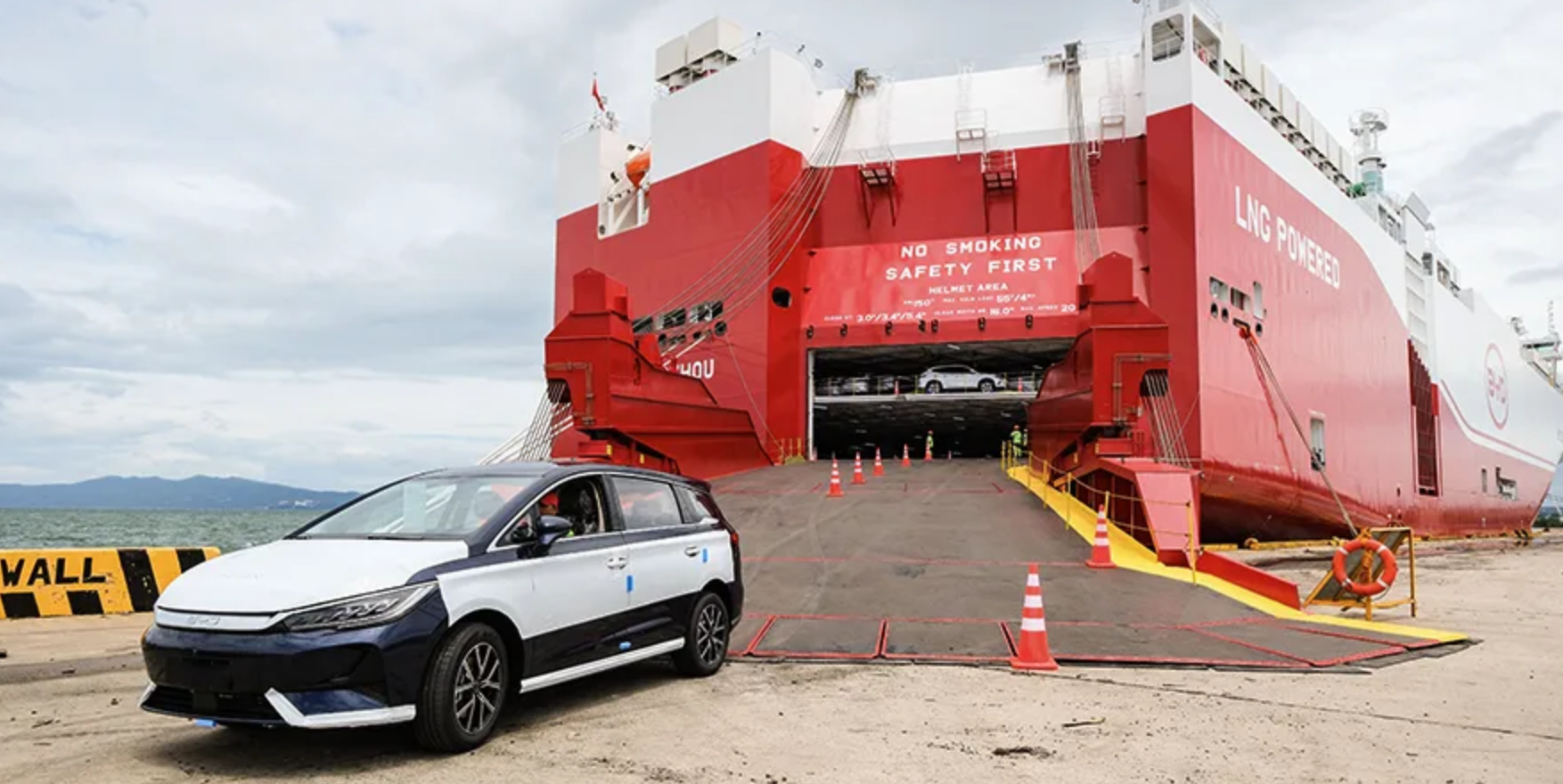
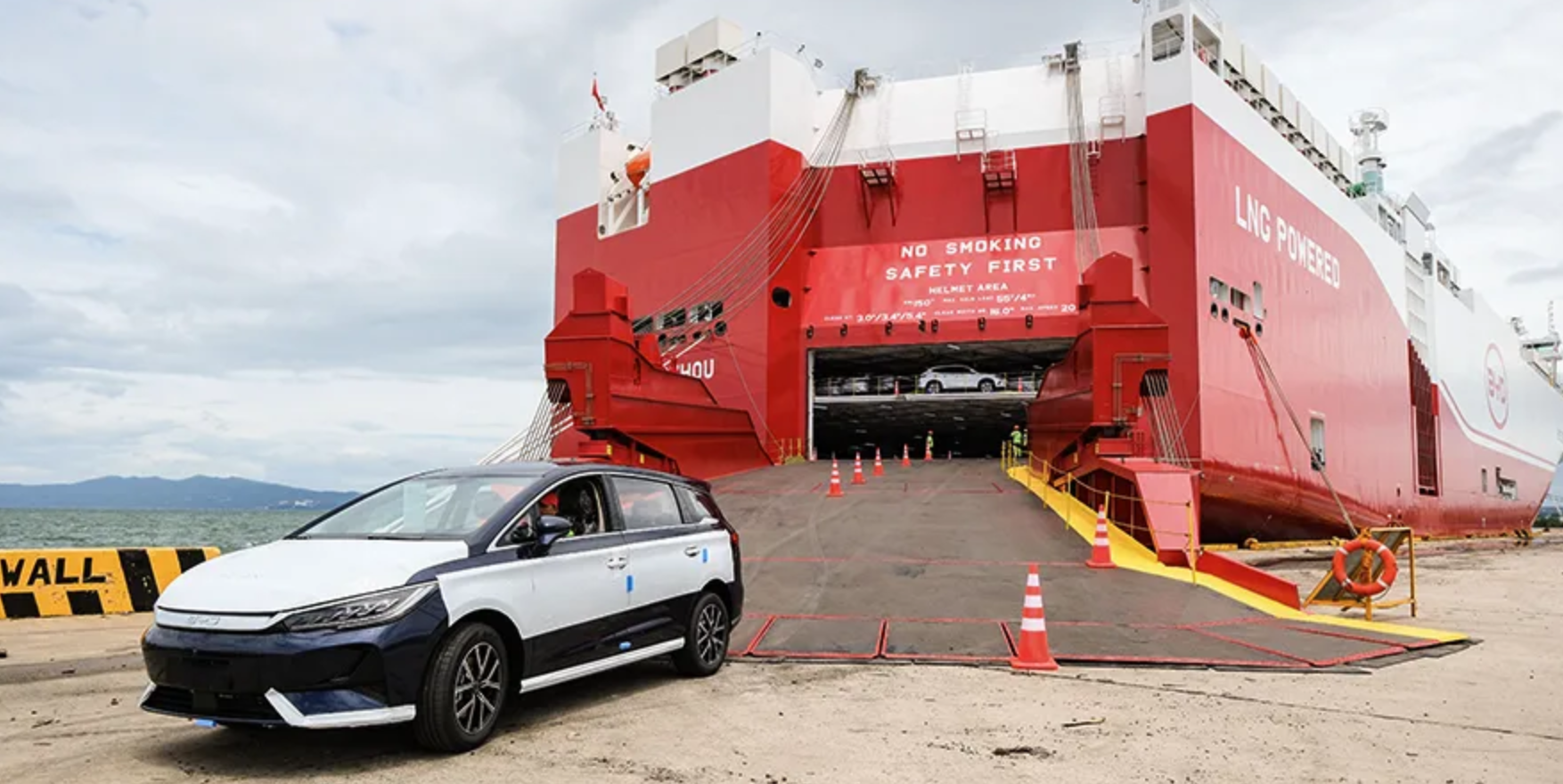
CleanTechnica sources at the China Electric Vehicle Association (CAVA) say that brands — particularly BYD — represent the full EV stack: they make batteries, stamp body parts, weld assemblies, develop the software and electronics firms, create the charging infrastructure providers, manage the software integrators, and even ship the vehicles themselves!
What this implies is increasingly uncomfortable for Ottawa to accept. China’s lead is no longer just cost. It is integration. It also says that Canada’s tariff wall has not slowed that learning, development, and production curve. It has simply excluded electric vehicles from the Canadian market.
Our source laments that the result is a paradox, as Canada claims to be protecting its auto sector yet is also cutting itself off from the fastest-advancing EV ecosystem on the planet — at exactly the moment its own EV supply chains remain partial, fragile, and subsidy-dependent.
Europe: tariffs paired with conditional access
Contrast this with the European Union. Brussels has moved to impose anti-subsidy duties on Chinese EVs, but it has not treated tariffs as an end state. Instead, they are leverage.
Europe is actively negotiating localized production, joint ventures, and technology transfer. Chinese automakers are already building or planning factories in Hungary, Spain, and other EU member states. The message from Brussels is explicit: access to Europe’s market comes with conditions, but it remains negotiable.
The EU understands something Canada currently does not. Tariffs buy time only if they are paired with an industrial plan for what happens during that time.
Mexico: integration beats exclusion
Mexico’s approach is even more revealing. Instead of walling off Chinese EVs, Mexico has positioned itself as a manufacturing platform.
Chinese automakers are investing in Mexican assembly not because Mexico is politically aligned with Beijing, but because it sits inside North American supply chains. Mexico is using geography and trade architecture to insert itself into the EV transition — not to stop it.
That strategy carries risk, especially with Washington. But it also delivers factories, jobs, and technical capability. Mexico is betting that being indispensable to EV manufacturing is safer than trying to remain insulated from it.
Canada, by contrast, is attempting insulation without scale.
Ottawa’s narrowing corridor
This is the context in which Carney’s Beijing visit matters.
Another source at BYD told CleanTechnica that part of the economic planning meetings will be with the major EV makers and groups. The idea is de-escalate Beijing’s retaliation against Canadian canola producers. The economic ministers from Ottawa will try to shield an exposed vulnerability, caused by Justin Trudeau who hoped EV tariffs would never trigger, but did.
Agriculture is politically sensitive, economically real, and structurally convenient as leverage. The temptation to trade EV access for agricultural relief is obvious — and dangerous.
Former Canadian high commissioner Stewart Beck, in a report I read, is right to warn that any serious negotiation will take time. China does not do quick swaps when industrial leverage is involved.
The question now is if lowering or cutting EV tariffs outright would inflame Ontario and risk friction with the United States. Holding them indefinitely leaves Prairie exporters as collateral damage in a standoff China can afford to wait out.
The leverage imbalance is clear. China can pause. Canada bleeds.
Beijing is signaling something Ottawa hasn’t acknowledged yet.
Sources at CAVA told CleanTechnica that senior executives from major Chinese automakers — possibly led by BYD — are expected to participate alongside China’s economic ministers in meetings with Carney. Crucially, these executives are not coming to lobby for tariff relief or to push an export-first EV agenda.
Their message is more pragmatic — and more strategically revealing.
According to those same sources, Chinese automakers are exploring Ontario’s direction and how it is prepared to host real industrial investment: vehicle assembly, component manufacturing, and localized EV supply chains. The objective is not to use Canada as a backdoor into the United States.
That pathway was widely understood to be politically closed. Until Ontario Premier Doug Ford proposed a “build here or stay out” strategy. Instead of dropping the 100% tariffs on imported Chinese EVs, Ontario is advocating for a framework that welcomes Chinese investment — but only if it includes: mandatory local content that will require Chinese EV giants (like BYD or MG) to open manufacturing plants in Ontario; the employment of unionized Canadian workers rather than shipping in completed units; technology sharing and establishing joint ventures with Ontario’s existing parts-manufacturing ecosystem.
North America is optional
China’s domestic EV market alone is now large enough to absorb production volumes that once depended on overseas expansion. From Beijing’s perspective, North America is increasingly optional. Any investment in Canada would be about diversification, geopolitical hedging, and long-term positioning — not desperation for market access.
That puts Canada in an unfamiliar position. For the first time in this standoff, it is not well entrenched, sources tell us, Chinese carmakers do not urgently need a deal.
Can it be like Australia?
No, it cannot. Though both are commonwealth nations, Canberra has no domestic auto industry left to protect, and it has largely accepted that reality. It used to have its own brands reworked from British and American marques, like Holden.
But rather than attempting to wall off Chinese EVs, Australia has focused on accelerating adoption, electrifying fleets, and leveraging its position as a critical supplier of lithium, nickel, and other battery materials.
Chinese EVs have entered the Australian market with relatively few barriers. The result has been rapid price compression, faster EV uptake, and growing consumer familiarity with Chinese brands. Australia has accepted that competition, not exclusion, is the fastest way to force the transition.
That does not mean Australia is naïve about China.
Trade relations have been sometimes volatile, and Canberra has absorbed real economic pressure in other sectors. But in EVs, it has drawn a clear line: blocking technology that accelerates decarbonization is a cost Australia is unwilling to bear.
The contrast with Canada is stark. Both countries are resource-rich. Both are US allies. Both are exposed to Chinese economic leverage. Yet Australia has treated EVs as an inevitability to manage, while Canada has treated them as a threat to delay. One approach prioritizes speed and system learning. The other prioritizes protection — without scale.
How about conditional entry?
If Canada wants a strategy that resembles Europe’s more than America’s, the logic is straightforward.
Market access should be conditional.
If Chinese automakers want Canadian consumers, they should also have to commit to Canadian production, Canadian labor, and Canadian supply chains. That is not capitulation. It is industrial bargaining — the same model China itself imposed on foreign automakers for decades.
Such a framework would not flood Canada with low-cost imports. It would force capital, technology, and know-how to land on Canadian soil. It would also give Ottawa something tariffs alone never will: leverage over outcomes rather than borders.
A test Canada can’t avoid
From a non-analyst’s point of view, Carney’s Beijing trip is not a diplomatic reset. It is a stress test of whether Canada can adapt its EV policy to a world where China already sets the pace, as America turns its back, while Europe negotiates the terms, and while Mexico builds the factories.
Tariffs can slow entry. They cannot stop the EV transition.
Sign up for CleanTechnica’s Weekly Substack for Zach and Scott’s in-depth analyses and high level summaries, sign up for our daily newsletter, and follow us on Google News!
Have a tip for CleanTechnica? Want to advertise? Want to suggest a guest for our CleanTech Talk podcast? Contact us here.
Sign up for our daily newsletter for 15 new cleantech stories a day. Or sign up for our weekly one on top stories of the week if daily is too frequent.
CleanTechnica uses affiliate links. See our policy here.
CleanTechnica’s Comment Policy