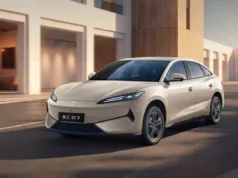
When the head of one of the world’s largest car companies gets behind the wheel of a rival’s newest vehicle, people pay attention. That is exactly what happened when Jim Farley, the global CEO of Ford Motor Company, recently tested the Chinese-built BYD Shark 6 during a visit to Australia.
What he had to say afterwards revealed a great deal about how seriously legacy automakers are taking the rising wave of electrified pickups coming from China.
Farley was in Australia for meetings and industry events tied to the country’s automotive sector, which plays a crucial role in developing global products such as the Ford Ranger and Ford Everest.

Image Credit: Forrest’s Auto Review/YouTube.
During that visit, he apparently also spent time sampling competitors that are targeting the same lucrative mid-size pickup segment dominated by Ford. Among the vehicles he tried was the plug-in hybrid Shark 6 from Chinese manufacturer BYD.
Advertisement
Advertisement
The experience clearly made an impression on Farley.
No Idea How They Make Money
Speaking with media after driving the vehicle, Farley admitted that he struggled to understand how the Chinese automaker can sell the truck at such a competitive price while packing in so much technology.
In blunt terms, he said he had “no idea how they make money” on it, a remark that reflects the growing anxiety among Western manufacturers about China’s cost advantages in electric and electrified vehicles.
The Shark 6 is not just another pickup entering the market. It represents a new approach to the traditional ute formula.

Image Credit: iMoD Official, CC BY 3.0, Wikimedia.
Instead of relying on a diesel engine like most work-oriented trucks, the BYD uses a plug-in hybrid system combining a 1.5-liter turbocharged petrol engine with dual electric motors.
Advertisement
Advertisement
Together they produce a combined output of about 431 horsepower and 480 lb-ft, while also delivering electric driving capability and improved efficiency compared with conventional diesel pickups.
The truck also introduces an electric all-wheel drive layout, with one electric motor driving each axle. This system allows the vehicle to achieve a claimed 0 to 60 mph sprint in around 5.7 seconds, a figure that rivals many performance SUVs rather than traditional work vehicles.
For the Australian market, the Shark 6 arrived at a starting price of about 57,900 Australian dollars (around US$41k) before on road costs. That pricing undercuts upcoming electrified competitors and positions the vehicle aggressively against established nameplates in the segment.
A Different Kind of Workhorse
Despite acknowledging its strengths, Farley pointed out that the Chinese pickup still differs from Ford’s own offerings in important ways.

Image Credit: Ethan Llamas – Own work, CC BY-SA 4.0, Wikimedia.
According to the CEO, trucks like the Shark appeal to buyers who want electrification but may not rely on their vehicle for heavy duty work every day.
Advertisement
Advertisement
He explained that once significant weight is placed in the cargo bed, the truck’s capabilities are not quite on the same level as a Ranger.

Image Credit: Chanokchon – Own work, CC BY-SA 4.0, Wikimedia.
Advertisement
Advertisement
That distinction matters in markets like Australia where many pickup buyers depend on their vehicles for towing, hauling and off-road tasks.
Even so, Farley made it clear that cars like the Shark are mementos of a major shift in the competitive landscape. Chinese manufacturers are rapidly entering segments that once generated reliable profits for legacy brands.
Medium sized body on frame pickups represent one of the most valuable segments globally, and Farley acknowledged that Chinese companies are now targeting it aggressively.
A Wake-Up Call for Legacy Automakers

Image Credit: Ethan Llamas – Own work, CC BY-SA 4.0, Wikimedia.
The emergence of electrified pickups like the Shark 6 comes as governments around the world are tightening emissions regulations and encouraging the adoption of low emission vehicles.
Advertisement
Advertisement
Plug-in hybrids and electric trucks are becoming increasingly important for automakers trying to meet those targets while still delivering the utility buyers expect.
For Ford, Farley’s experience upon sampling the Shark represents a moment of truth — a warning and a challenge. The company’s Ranger remains one of the most successful global pickups and a key profit generator.
Yet the arrival of technologically advanced and competitively priced rivals from China shows that the next era of the pickup market will look very different from the last.
Farley’s BYD Shark 6 test drive may have been brief, but it offered a glimpse into a rapidly changing automotive industry where innovation, electrification and aggressive pricing are reshaping the rules of competition.
Advertisement
Advertisement
Sources: The Drive
Read More