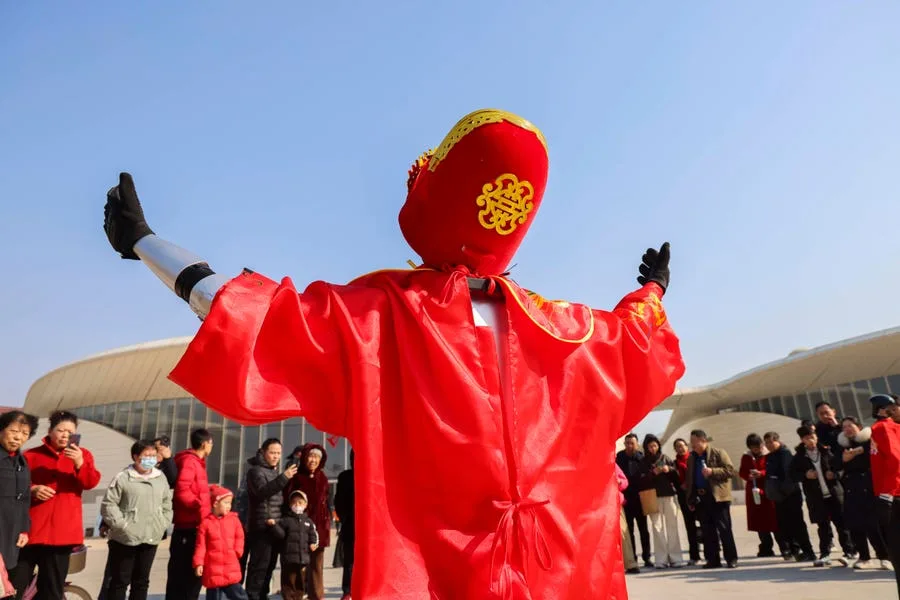

The show was difficult to overlook. During China’s latest New Year festivities, humanoid robots from firms such as Unitree, AgiBot, and LimX Dynamics showcased synchronized dances, executed backflips, and demonstrated martial arts maneuvers with seamless control, illustrating the rapid progress of China’s robotics sector.
This raises a trillion-dollar question for Tesla (NASDAQ:TSLA). The narrative surrounding the company’s valuation has transitioned from being primarily an electric vehicle manufacturer to establishing itself as the world’s foremost “Physical AI” enterprise focused on robotaxis and humanoid robots. In early 2026, Tesla executed a significant shift, discontinuing its flagship Model S and Model X to allocate factory space for the Optimus humanoid robot. Elon Musk has redefined Tesla’s identity from a car manufacturer to an AI robotics platform. In the contest for a leading humanoid robot, is Tesla’s expected “Optimus moat” less substantial than its $1 trillion valuation implies? What precisely are investors valuing the company at approximately $1.3 trillion for?
We believe the answer rests on the differentiation between the “body” and the “brain.”
China’s Swift Hardware Advancements
There’s no doubt that Chinese manufacturers are addressing the hardware shortfall in robotics. The recently showcased dancing robots highlight advanced mechanical engineering, refined motor control, and solid designs. The movements executed by these robots suggest that these companies have developed sophisticated dynamic balance and powerful actuation systems that rival or even surpass Optimus’s current skills. These recent advancements indicate that the physical challenges of creating a capable humanoid form are gradually being resolved.
Chinese firms have also managed to produce these robots at scale, with China reportedly accounting for over 80% of the market share in the humanoid robot sector last year. China’s well-established manufacturing ecosystem offers a significant advantage. The global supply chain for essential robotic components—actuators and sensors—is predominantly situated in the region. This enables Chinese startups to iterate swiftly, converting prototypes into small-scale production within months, and potentially outpace Western competitors in hardware scaling. While Tesla aims for a future price of $20,000 for Optimus, Chinese companies like LimX are already marketing base models at competitive prices of around $22,000.
Tesla’s Asserted Strengths
It’s important to note that performing choreographed routines is significantly different from actual “work.” The demonstrations from Chinese robots indicate that they excel at movements largely pre-programmed or trained for designated tasks.
However, the true value may not stem from the body but rather from the intelligence that drives it. Investors are wagering that Tesla’s real differentiator is not the robot’s physical form, but the sophisticated AI “brain” that powers it. The prevailing belief is that Tesla’s advantage comes directly from its highly advanced FSD (Full Self-Driving) neural network design, which, according to the latest reports, has finally achieved a high level of reliability and exceptional smoothness. Tesla possesses several key differentiating factors.
Tesla has moved away from conventional, rules-based robotics programming. Optimus utilizes the FSD v15 neural architecture, a singular “vision-only” system. Just as Tesla vehicles navigate roads without LiDAR, Optimus employs a collection of cameras and networks to create a thorough 3D understanding of its surroundings. This could enable the robot to learn continuously and execute tasks in unstructured, dynamic environments without explicit pre-programming for each situation.
One of Tesla’s most significant advantages is its vast computing infrastructure, which encompasses its Dojo and H100 clusters. Instead of needing to train a robot physically for thousands of hours to master a new task, Tesla can virtually simulate that task millions of times within minutes in a factory environment. Importantly, the physics within this simulation is based on real-world FSD data collected from millions of Tesla vehicles.
By early 2026, Tesla also began integrating Grok, the advanced AI created by Elon Musk’s xAI, into the Optimus system. This introduces a vital “reasoning layer” to the robot’s capabilities. While the FSD stack manages the lower-level motor functions like walking, grasping, and perceiving, Grok offers the high-level comprehension and contextual reasoning. Consequently, Optimus should be capable of interpreting subtle verbal instructions, grasping implied meanings, and making decisions that require a level of common sense that current hardware-focused robotic systems often lack.
Challenges and Limitations
So will Tesla’s recent achievements with FSD and robotaxis result in a substantial victory in the robotics arena? If people have confidence in Tesla at 70 mph, executing factory tasks should, in theory, be simpler, right? Can Nvidia surpass Tesla in physical AI?
We cannot assume that to be the case. While driving revolves around “navigation” (maintaining lanes), robotics focuses on “manipulation” (interacting with and moving objects). A vehicle effectively has only three “degrees of freedom” for the AI to oversee—steering, acceleration, and braking. Optimus has numerous joints (arms, wrists, fingers, neck, hips, knees, and ankles) that must all coordinate flawlessly. Additional elements such as precision and tactile feedback are essential for robots to master.
The competition will also be formidable. Chinese companies are showcasing a clear advantage in manufacturing advanced, agile robotic hardware at scale. In addition to the hardware, Chinese companies are quickly catching up in AI by utilizing vast open-source ecosystems and vision-language-action models, which could enable them to commoditize robotic “brains” almost as rapidly as the “bodies.” Alibaba has recently open-sourced RynnBrain, a robotics foundation model specifically designed for robots to perceive and understand 3D space. These shared datasets and collaborative efforts could enable the whole ecosystem to progress together, exponentially increasing advancements.
Smart Investing Starts With Portfolios
Stocks can rise or fall—the key is remaining invested. A diversified portfolio enables you to navigate market fluctuations, enhances gains, and mitigates the risks associated with single stocks.
The Trefis High Quality (HQ) Portfolio, featuring a selection of 30 stocks, has shown a consistent ability to outperform its benchmark that includes all three—the S&P 500, S&P mid-cap, and Russell 2000 indices. What accounts for this? The HQ Portfolio has delivered over 105% in cumulative returns since its inception, with lower risk compared to the benchmark index, as evidenced by HQ Portfolio performance metrics.