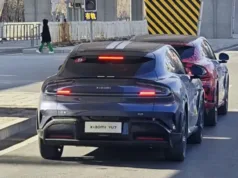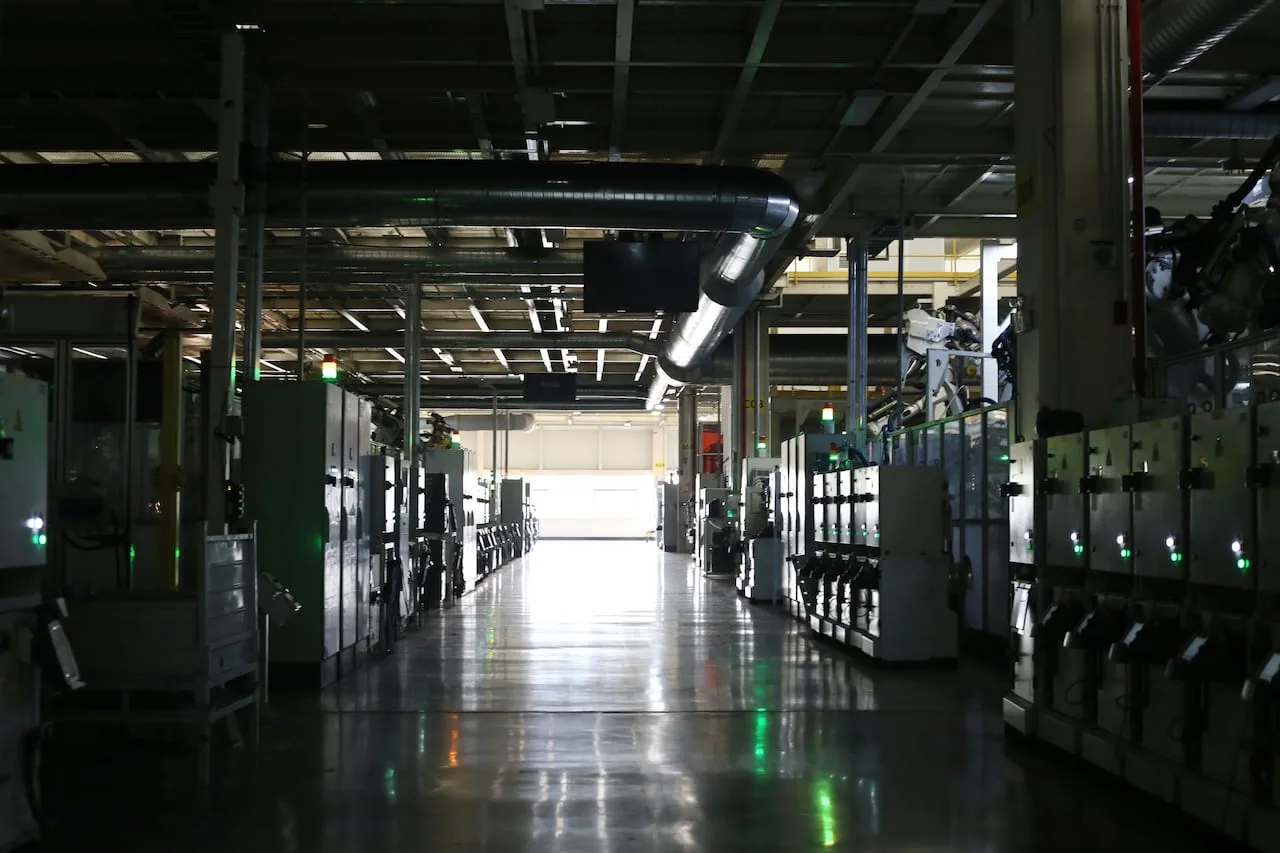
Hundreds of robots hum on a factory floor in Ningbo, just south of Shanghai, their long arms swooping and twisting, welding together different models of custom-ordered electric vehicles (EVs).
Robots also move briskly in the corridors delivering parts to different areas of the plant, playing elevator music to alert the few humans who work there to their presence.
This “dark factory” — where the lights don’t need to be on for the work to be completed, such is the extent of its automation — produces Zeekr vehicles, a luxury EV line owned by Geely, which is also the parent company of Volvo and Polestar.
With a steady, unending rhythm, the robots produce about 300,000 cars a year. The plant employs about 1,600 humans, who mostly work in robot maintenance or quality control.

“The automated manufacturing process has obviously improved our production efficiency and helped reduce costs significantly,” said Xu Naiping, general manager of the Zeekr factory, in an interview with CBC News. “While automation does lower costs, its primary purpose is to ensure product quality.”
The factory, along with the wider EV ecosystem being developed across China, give a glimpse of a massive transformation of the automotive industry that could one day come to North America.
And as Canada opens the door to Chinese electric cars following a trade deal earlier this year, it’s also leaving space for this kind of Chinese innovation to enter, too. While some say this comes with big rewards in terms of boosting EV uptake and infrastructure in Canada, others are raising concerns over the threat to North American automakers and data security.
Trade thaw brings Chinese EVs to Canada
While China is the world’s undisputed EV leader, producing 70 per cent of the global total, and has exported its technology to various parts of the world including Europe, Africa and other parts of Asia, the possibility of its cars coming to Canada has been remote — until recently.
Two years ago, Canada followed in the footsteps of then-U.S. president Joe Biden in slapping 100 per cent tariffs on Chinese-made EVs. China hit back with counter-tariffs on Canadian canola, seafood and pork.
The tit-for-tat continued until Donald Trump became U.S president and, in destabilizing trade relations with a series of tariffs, pushed Canada toward diversifying its trade partners — including the world’s second largest economy, China.
In January, Prime Minister Mark Carney met with Chinese President Xi Jinping in Beijing and secured tariff relief for Canadian agricultural sectors, in exchange for allowing 49,000 Chinese EVs into the country at a reduced rate of 6.1 per cent.
“China’s strengths in the electric vehicle sector are undeniable,” Carney said at the time. “In order for Canada to build its own competitive EV sector, we need to learn from innovative partners.”

Recliner seats and 3-minute battery swaps
That Chinese innovation has driven a boom in sales in the country, with EVs comprising half of all new car purchases in September 2025.
The adoption is evident on city streets. Green licence plates indicating an EV are everywhere. Streets are quieter with fewer gas engines. The vehicles themselves are slick, with built-in automation that allows them to, say, park itself in an empty spot. Many of the larger, executive-style cars have recliner-style seats with built-in massage functions.
While riding in one such vehicle, CBC News talked to a driver who goes by the surname Han. After 20 years of driving passengers around Beijing, he said, he switched over from a gas-powered Buick eight months ago.
“When I drove [my previous] car, I felt sore all over the next day,” he said in Mandarin. “This is very comfortable. My body isn’t tired anymore. And it’s all controlled by my voice.”
The ecosystem China has built around EVs, intended to bolster manufacturing and spur adoption, is the result of sizeable (and controversial) government subsidies amounting to $230 billion since 2009.
One beneficiary is EV maker NIO, which received a $5 billion injection from the Hefei municipal government in 2020, and is now cornering the market in battery-swapping stations — touted as a quicker way to recharge EVs.
NIO now has upwards of 3,000 battery-swapping stations across China, including many at the side of highways.

In a parking lot in downtown Shanghai, drivers back in one after another into one such station, which looks somewhat like a car wash.
Among them is Cao Xingyu, who is watching a show on his phone as the battery swap takes place.
Once his car is backed in, the floor of the structure opens up and a robot swaps out his car’s depleted battery for a fully charged one from underneath. There’s a timer on the station: the whole process takes about three minutes and then he’s back on his way to work.
“It’s better than charging my battery because it saves more time,” said Cao, who added that he chose an EV as his first car because the local government has restrictions on owning a gas car.

While battery-swapping is an emerging competitor, traditional charging is still an expanding market. The largest provider of EV chargers in the country is TELD, which has about 900,000 terminals across China.
TELD vice-president Wang Kunpeng likens EVs and the charging system to “two legs walking together.”
“For EVs to develop, charging infrastructure must come first,” he told CBC News. “Once the infrastructure is well built, the EV industry will thrive even more. This is a mutually reinforcing, complementary process.”

Canadian concerns
Potential advantages of welcoming Chinese EVs into Canada include having their innovation on display and boosting EV adoption in Canada. EV drivers and environmental groups have long pushed for more choice that would spur competition and drive down prices.
But at the same time, the Canadian auto industry is incensed by the arrival of a competitor to its own EVs, at the same time as it faces a crisis brought on by Trump’s tariffs.
Doug Ford, the premier of Ontario, the hub of Canada’s auto industry, has been routinely critical of EVs from China. Following Carney’s meeting with Xi, he criticized the federal government in a news conference with auto industry stakeholders and called on Canadians to “boycott the Chinese EV vehicles.”
“Support companies that are building vehicles here. It’s as simple as that,” he said.
Ford has also referred to EVs from China as “spy cars,” tapping into a fear that the vehicles will collect drivers’ data and hold it in China — a concern refuted by some in the industry.
“It’s completely wrong. You have data centres there [in Canada],» said Sun Xiaohong, a retired senior expert at the Automobile Internationalization Committee of the China Chamber of Commerce in Beijing. “[The data won’t] come back.”
Security experts in Canada have also said data-security concerns are probably inflated, as Chinese-owned apps widely used by Canadians, such as TikTok, have already been collecting users’ data for years.
Small door, big implications
While the Canadian auto market officially opened to Chinese-made EVs on March 1, it might be a while before Canadians can buy cheaper models from BYD, Chery or Geely, with exporters likely to prioritize more expensive models among the relatively small quota of 49,000.
Though no Chinese companies have outright said they’re interested in sending their cars to Canada, there are signs some are preparing — including reports that BYD is looking at opening dealerships.
Zeekr, meanwhile, trademarked its name in Canada last year. And in December, Geely opened a sprawling safety testing centre near its Zeekr plant so its vehicles can meet global standards.

Entering the Canadian market would serve as a litmus test of sorts, said Zhang Xiang, secretary-general of the International Intelligent Mobility Association in Shanghai.
“If they can enter Canada, it proves their vehicles can meet the strictest regulatory standards in the world. With that success in Canada, it becomes much easier for them to sell cars in other countries — even markets that were previously hard to enter.”
While the 49,000 cars about to enter Canada represents less than three per cent of the country’s market, Zhang said it is a hugely significant number in a different sense.
“Chinese cars have already been sold in many parts of the world — Europe, Asia, Africa — but they have never really been able to enter North America,” he said.
“The U.S. has basically been blocking access. Now, Canada has opened a small door.”
That door may be necessary to keep China’s EV sector going, considering domestic demand is stagnant and sales have started to dip.
While Zhang says Chinese automakers will likely not be making a profit from exporting their vehicles to Canada due to the huge investment — including establishing dealership networks and partners — it could pay off in the long term.
“For example: if NIO cars are seen on Canadian roads, their goal has already been achieved. It’s an advertisement for them,” he said.