

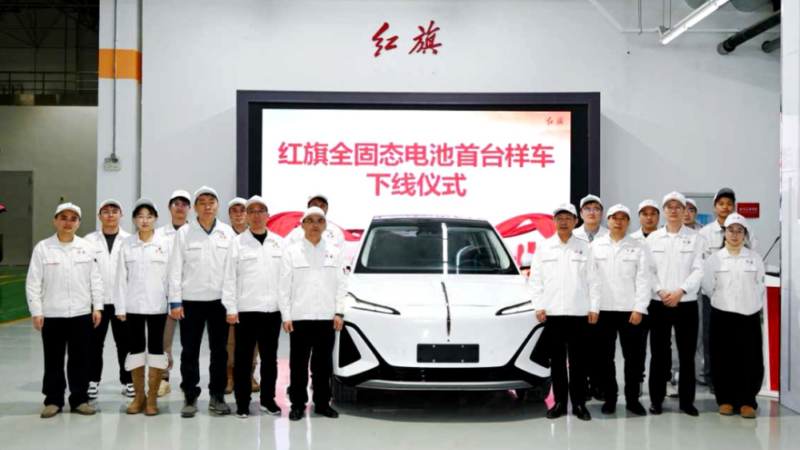
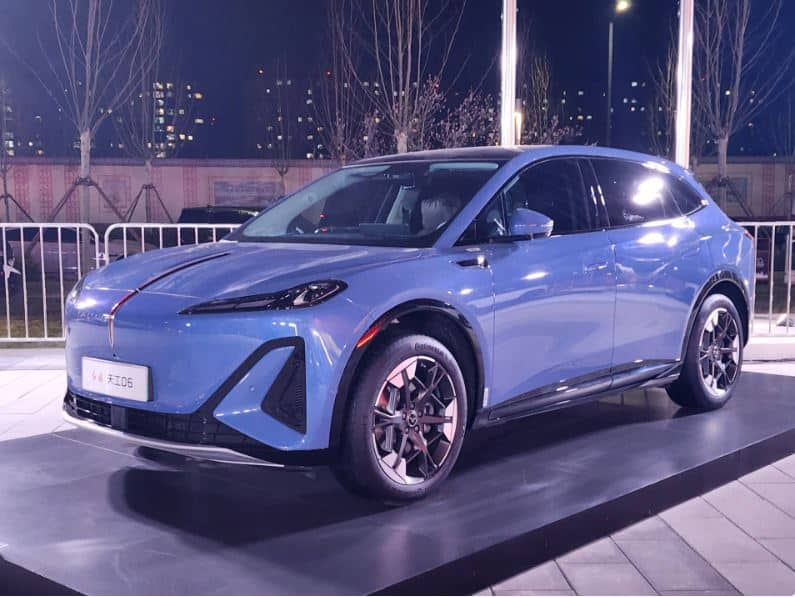
China’s FAW Group has announced that its Hongqi successfully produced its first vehicle prototype equipped with all-solid-state battery technology. The prototype, which is a Hongqi Tiangong06, rolled off the production line recently, representing Hongqi’s transition from laboratory validation to the real-vehicle testing phase for this next-generation battery technology.
The breakthrough comes after a 470-day research and development effort by FAW’s R&D Institute, which achieved advances in sulfide electrolyte technology, high-voltage packaging, and system integration. These developments have established a foundation for planned mass production by late 2027.
The solid-state battery technology employed in the prototype uses sulfide-based electrolytes with ionic conductivity exceeding the industry benchmark of 10mS/cm, significantly improving ion transmission efficiency. According to Chinese media mydrivers, the 66Ah battery cells achieve an energy density of 380Wh/kg, substantially outperforming conventional liquid lithium-ion batteries that typically range from 180-250Wh/kg.
The battery has passed extreme thermal abuse testing at 200°C without thermal runaway risks, addressing one of the key safety concerns with current battery technologies.
According to FAW’s roadmap, 2026 will focus on rigorous testing of the battery system’s reliability and durability across various road conditions, temperatures, and charging scenarios. The company plans to begin small-batch production in late 2027, with the technology first appearing in Hongqi’s flagship sedan and SUV models.
By 2030, FAW aims to complete the technological groundwork for mass production, gradually expanding the technology to mid and high-end models while reducing costs by over 50%.
Editor’s comment
Approximately two weeks ago, Yiche reported that Hongqi had rolled out its solid-state battery test vehicle. However, it was only today that the state-owned Xinhua News Agency confirmed this information, adding new details. The newly disclosed information reveals that the battery’s energy density is 380Wh/kg, which is higher than the 350Wh/kg currently being tested by Dongfeng. Furthermore, the charging speed of Hongqi’s solid-state battery remains unknown.
Even according to FAW’s roadmap, the mass production of vehicles equipped with solid-state batteries is not expected until 2030.
Speaking of which, China FAW (First Automobile Works) was the first automobile enterprise established after the founding of the People’s Republic of China, with Dongfeng being the second. Dongfeng was formerly known as Second Automobile Works, and its Dongfeng trucks were among its early flagship models. While both companies hold the same hierarchical status, there’s undeniably a chronological order to their establishment. Perhaps FAW believes its solid-state battery energy density surpasses that of its “younger brother,” making it worthwhile to re-issue the related news.

Follow us for ev updates


