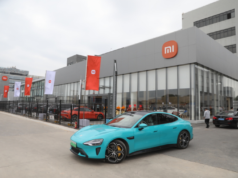
A Seagull electric vehicle from Chinese automaker BYD outside a showroom in Beijing in April, 2024. Upfront costs of purchasing, maintaining and insuring an EV remain a deterrent for many Canadians, but higher fuel prices are changing those considerations, writes Mariya Postelnyak.Ng Han Guan/The Associated Press
Rising fuel costs and the prospect of Chinese electric vehicles entering the Canadian market are reigniting consumer interest in EVs, with data showing a surge in sales and online search interest.
After months of stagnation, the number of EV insurance quotes jumped 40 per cent year over year in March, according to a Rates.ca report released Monday. Search volume for electric vehicles on online car retailer Clutch, meanwhile, grew 94 per cent from January to late March.
While the upfront costs of purchasing, maintaining and insuring a vehicle remain the biggest deterrent for a majority of EV-interested Canadians, higher fuel prices resulting from the Iran war are changing those considerations.
“EVs are becoming more accessible, they’re becoming more affordable,” said Rates.ca insurance expert and broker Daniel Ivans. “And as gas prices hit the level where they’re at now, consumers who are on a budget, they’re almost forced to consider other options.”
What’s the future of Canada’s electric vehicle industry? Submit your questions
With fuel prices reaching a national average of $1.78 per litre this week, it costs about 32 per cent more to fill up a gas-powered vehicle than just a month ago, according to data from energy analysts En-Pro. Meanwhile, some estimates show that EVs save drivers about $3,000 a year in equivalent fuel costs.
On the other hand, higher repair and replacement costs for things such as batteries still mean EV insurance premiums for many models tend to be 30 to 35 per cent higher than for an average gas-powered vehicle, Mr. Ivans said. Data from auto claims technology company Mitchell showed that in early 2025, battery-electric vehicles averaged about $7,026 per repair compared to $5,345 for gas vehicles.
The cost of an EV itself can be out of reach for some, with the average listing price of a used EV on AutoTrader hovering at $45,841, compared with $36,816 for all used vehicles, including EVs.
But cost pressures may soon be easing with the introduction of cheaper Chinese models into the Canadian market and new government rebates.
After provincial and federal EV rebates expired in 2025, the Carney government introduced a new $2.3‑billion Electric Vehicle Affordability Program earlier this year to help with the high cost of vehicles.
“A zero-emission vehicle rebate coming back into the market brings another $5,000 to most [EV] consumers,” said Daniel Ross, senior manager of industry insights and residual value strategy at Canadian Black Book, the industry data and analytics publication.
Battle over Ottawa’s new vehicle regulations heats up
Importantly, consumer choice when it comes to EVs is also set to increase. Canada’s trade deal with Beijing, announced in January, is expected to open the gates to an initial 49,000 Chinese-made EVs into the Canadian market with a tariff rate of 6.1 per cent — down from the 100-per-cent duty Ottawa maintained on Chinese EVs in 2024.
The import cap is set to tick up gradually every year, reaching 70,000 in five years.
The deal might speed Canada along the path toward $35,000 electric vehicles as it designated part of the quota for EVs with price tags at that figure or less. According to Global Affairs Canada, these low-cost vehicles will add up to half of China’s allotment by 2030.
Electric carmaker BYD Auto Co. has already expressed intent to open as many as 20 dealerships in Canada within a year, positioning itself among the first Chinese automakers to sell in Canada.
BYD’s Seagull sells for as little as US$12,000 in China, but BYD vehicles would likely go for closer to the high-$30,000 range in Canada. Among those interested or unsure about EVs, 56 per cent of respondents to the Rates.ca survey said they would consider a Chinese-built model if it’s more affordable.
The recent uptick in EV vehicle interest extends to Europe as well. Advert views for new BYD models in Britain spiked 77 per cent year over year, some reports suggest, while BYD vehicles were up more than 375 per cent.
The picture, however, is very different in the United States.
“Our EV demand remains really low,” said Thomas Libby, an auto analyst with S&P Global Mobility. Under the current administration, the U.S. has been rapidly retreating from emissions rebates and credits while assembly plants once converted to building batteries used in EVs have been converted back, Mr. Libby said.
On this side of the border, would-be buyers put off by Tesla CEO Elon Musk’s jabs at Canada’s sovereignty, cuts to electric-vehicle subsidies and federal rebates, along with continuing concerns around vehicle range and charging infrastructure, contributed to plummeting electric vehicle sales in recent years.
But shifting consumer sentiment is already translating into purchasing decisions. EV sales on Clutch have roughly doubled since early January from about 5.3 per cent of the company’s total sales to nearly 10 per cent in the past two weeks.
“The rationale behind an EV purchase has been at a roadblock,” Mr. Ross said. “That roadblock is starting to fall down.”