Ford has held preliminary talks with Chinese electric vehicle maker Xiaomi about a possible manufacturing partnership in the US, the Financial Times reported citing four people familiar with the discussions.
According to those people, Ford has explored setting up a joint venture with Xiaomi to build EVs in the US.

Discover B2B Marketing That Performs
Combine business intelligence and editorial excellence to reach engaged professionals across 36 leading media platforms.
The Detroit carmaker has also spoken with BYD and other Chinese manufacturers about potential cooperation in the country, the FT said.
Any such move would be highly contentious in Washington. John Moolenaar, Republican chair of the House China committee, told the FT that Ford would “be turning its back on American and allied partners, and it will make our country further dependent on China”.
He added: “Joint ventures with Chinese companies frequently end poorly for American companies, and this new one would be a deal only Xi Jinping could love.”
Ford has rejected the report outright. The company said: “This story is completely false. There is no truth to it.”
Xiaomi did not respond to a request for comment, while BYD declined to comment, according to the FT.
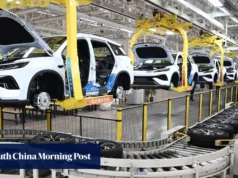
Xiaomi, whose core business is consumer electronics, surprised the global car industry with a high-profile EV launch in 2024. Its entry added to mounting pressure from Chinese manufacturers that are scaling up globally with lower-cost electric and hybrid models.
Ford chief executive Jim Farley has previously issued stark warnings about Chinese competition.
Last year he described Chinese carmakers as an “existential threat” to Western groups and said they had enough capacity in China alone to “put us all out of business”. He has also said Chinese companies are “absolutely coming” to the US.
Ford already has a sensitive China-related partnership through its battery strategy. It licenses technology from CATL to produce battery cells in the US.
The Pentagon has designated CATL as a company with alleged links to the Chinese military, a claim CATL denies. The House China committee has repeatedly criticised the arrangement.
US trade policy has further raised barriers to direct Chinese auto imports. In 2024, the Biden administration effectively shut the door to Chinese-made vehicles by imposing 100% tariffs on car imports from China.
President Donald Trump has kept those tariffs in place, along with Biden-era limits on Chinese software and hardware in internet-connected vehicles.