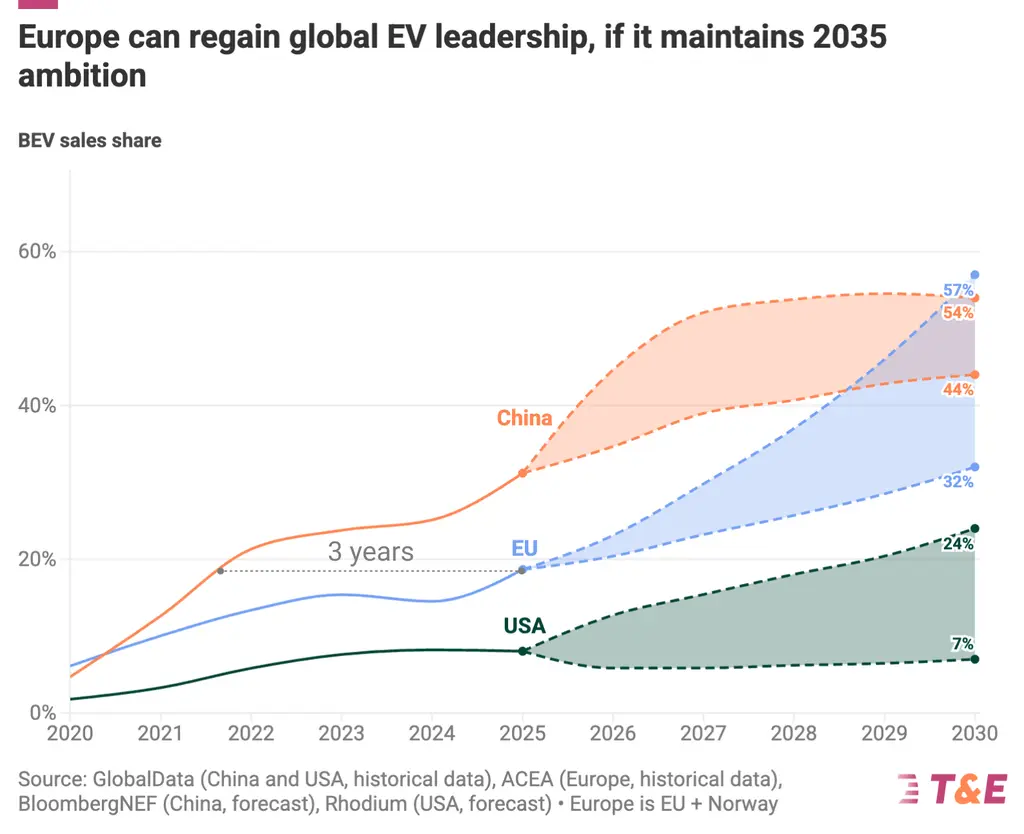
Europe is narrowing the gap with China in electric vehicle (EV) sales, new research from Transport & Environment (T&E) shows. While Europe and China were neck-and-neck in 2020, weaker European car CO2 standards after 2022 allowed China to pull ahead. Thanks to stronger targets set in 2025, the EU is now only three years behind, and a faster transition could close the gap entirely before 2030.
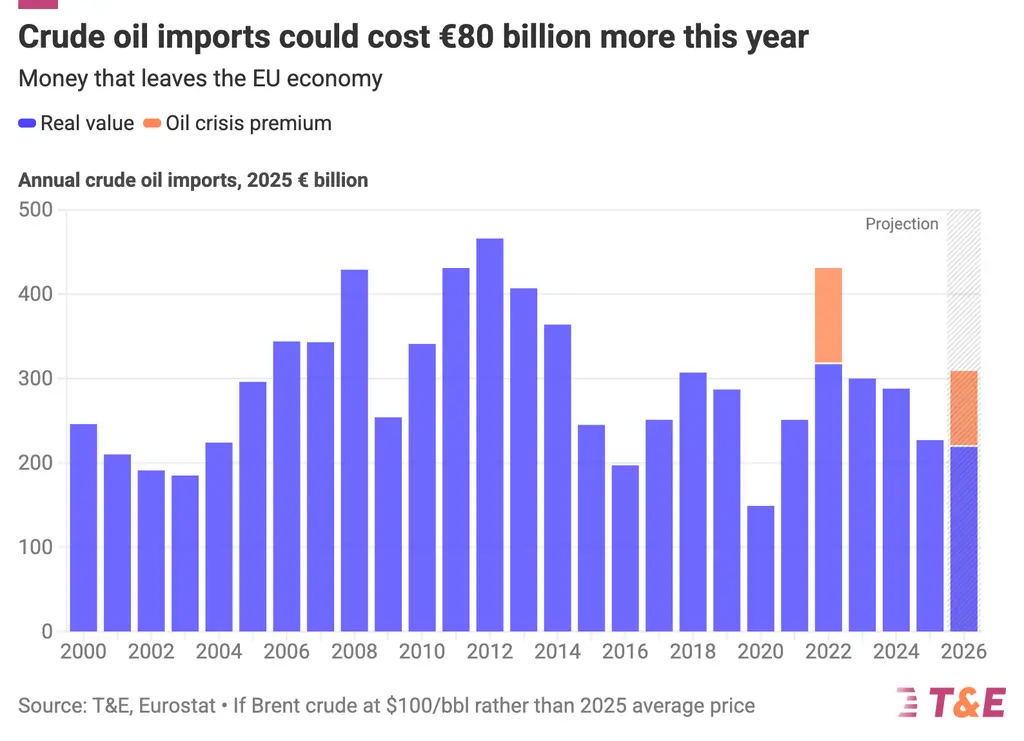
The T&E report highlights the broader stakes: EVs are a “super-lever” for reducing Europe’s dependence on imported oil. With oil imports expected to hit €300 billion in 2026—including an €80 billion premium due to the ongoing energy crisis—accelerating EV adoption could deliver major savings. Europe’s 8 million electric cars already cut around 46 million barrels of oil in 2025.
William Todts, Executive Director of T&E, emphasized the urgency: “EVs are the super-lever for ending Europe’s dependence on imported oil. The idea that Europe is too far behind China and must weaken CO? rules to compete is fundamentally wrong. These regulations are what keep Europe in the race to lead the global battery electric car market. We need to accelerate, not capitulate.”
The report shows that while countries with high EV uptake, such as Denmark and the Netherlands, are seeing strong reductions in vehicle carbon emissions, other countries—including Spain—lag behind. Slow EV adoption is prolonging Europe’s reliance on oil.
Meanwhile, China is surging ahead in cleantech, producing 60% of the world’s electric cars and 20 times Europe’s battery output. Europe, however, is rapidly transforming its own battery industry, with domestic and international partnerships boosting production capacity. Analysts say the right policies and financing could unleash Europe’s full potential in the sector.
Todts concluded, “The State of European Transport sends a stark message. Europe’s Green Deal is not just a climate plan—it is a blueprint for energy security and a cleantech economy of the future. Yet, it faces opposition from automakers prioritizing short-term profits over long-term sustainability. The EU must resist pressure to weaken regulations further.”