The European Union has unveiled new “Made in Europe” regulations to help bolster its manufacturers in the face of competition, including from China. While the bloc’s industry chief has heralded the move as a major shift in economic doctrine, it risks fuelling criticism from Beijing over perceived protectionism.
Issued on:
3 min Reading time
Advertising
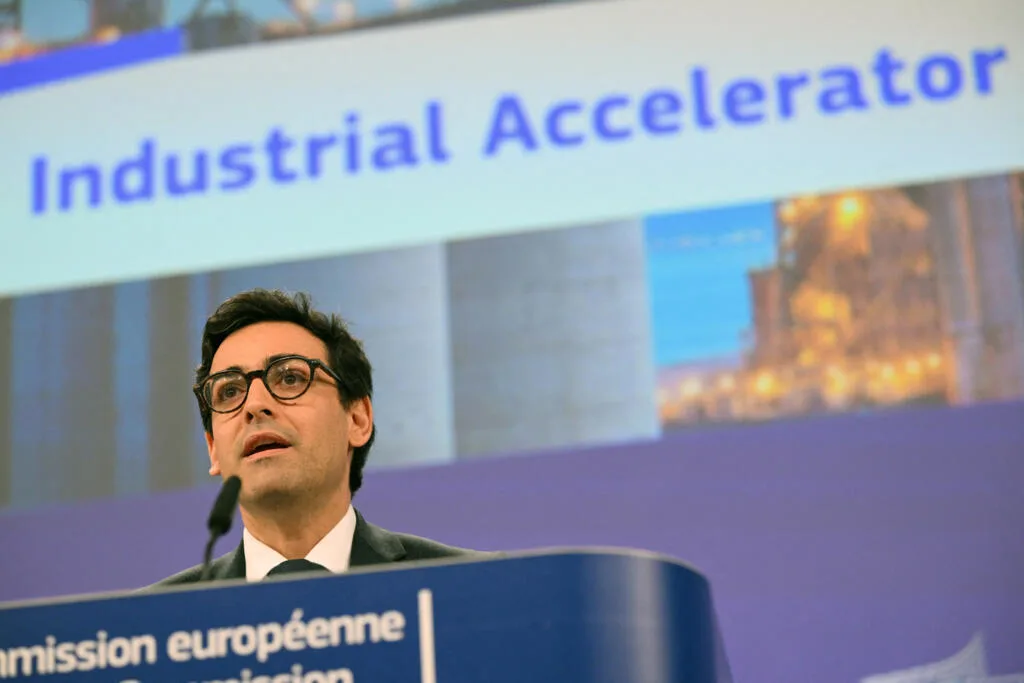
“What I am presenting you today is more than just a change in procedures, it is a change in doctrine,” European Commission vice president for industrial strategy, Stephane Sejourne, told a press conference in Brussels.
The new regulations – officially known as the Industrial Decarbonisation Accelerator Act (IAA) – aim to ensure that public and foreign investments support manufacturing inside the 27-nation bloc, explained an EU official.
To that end, they stipulate that companies that want public money must meet minimum thresholds for EU-made parts. Large investments from dominant foreign firms will also be subject to conditions that include employing EU workers.
EU leaders push to rescue European economy challenged by China and US

The act, originally planned for December 2025, designates up to €500 billion in subsidies over the next decade for electric vehicles, solar panels, batteries and quantum technologies.
Local-content rules require at least 55 percent components that are manufactured within the EU, so as to strengthen European manufacturing and decrease dependence on products imported from non-EU supply chains.
The text does not name China in this regard, although its measures address Beijing’s current clean tech export dominance.
Its proponents point out that rival manufacturers such as the United States, China, Brazil and India already have rules on local content in place, and that similar requirements could help fill the EU’s massive investment gap.
However, the “Made in Europe” measures, strongly backed by France, were pushed back several times due to disagreements, with some arguing they run counter to the EU’s pro-free trade spirit.
Much of the discord also revolved around the geographical scope implied by «Made in Europe». Sceptics – including Germany, the EU’s largest economy – argued trade partners should be included in the definition under a «Made with Europe» approach.
EU moves to reduce reliance on China for rare earth supplies
Concerns across the Channel
Earlier this week, the British Chambers of Commerce warned the new EU regulations could have an adverse effect on the UK economy, saying in a statement that: «As the UK is now a third country supplier, [the IAA] could squeeze British firms out of supply chains, as well as increasing costs and bureaucracy.»
China has not responded to Wednesday’s announcement, but reactions have surfaced over previous weeks via state media and officials, in response to leaks and drafts.

Beijing accuses EU of slapping unfair restrictions on Chinese firms
China’s state Xinhua news agency has labelled similar EU moves “hypocritical mimicry” of China’s industrial approach. The Global Times warned that “Europe preaches open markets but erects barriers”.
Wang Lei of the China Council for the Promotion of International Trade said local-content clauses would “discriminate de facto” against Chinese firms, on top of existing EU electric vehicle duties.
Beijing retains leverage via rare earth export curbs – key for EU batteries and turbines – and imposing tariffs on European goods such as French cognac.
The IAA extends the EU’s de-risking efforts alongside the Net-Zero Industry Act and Critical Raw Materials Act. The European Parliament and individual EU governments will now start negotiating the final text of the “Made in Europe” rules, before a final draft can be written into law.