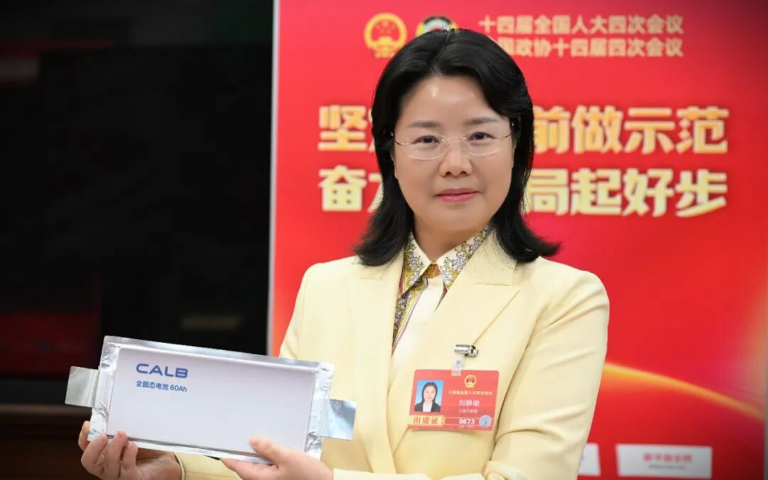
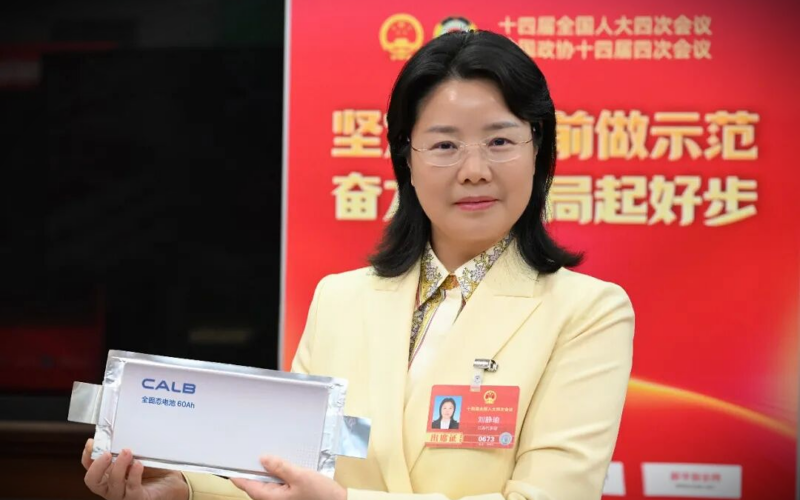
National People’s Congress (NPC) representative and CALB Chairwoman Liu Jingyu showcased the company’s new 60 Ah solid-state battery (SSB) during the ongoing 2026 Two Sessions in Beijing. According to Sina Finance, the large-capacity cell features an energy density exceeding 450 Wh/kg and is positioned as a primary solution for passenger vehicles requiring ranges of 1,000 km or more.
Hardware Specifications and Weight
The 60 Ah prototype features a physical footprint similar to a desk calendar and weighs less than a 500 ml bottle of water (approximately 490 g). This represents up to a 75% reduction compared to today’s LFP cells of the same capacity, which typically weigh over 2.0 kg.
This hardware represents a transition from CALB’s previously announced “Wanjie” (Limitless) solid-state platform toward a production-ready automotive format. During the 2025 CALB Global Partner Conference, the company confirmed the pilot production of sulfide-based solid-state electrolytes, which it reports offer 15% higher ionic conductivity than existing semi-solid oxide alternatives.
Industrialization Roadmap
The Two Sessions (or Lianghui) is an annual political event in which the National People’s Congress (NPC) and the Chinese People’s Political Consultative Conference (CPPCC) meet to establish national policy. For the automotive sector, this includes the debut of strategic roadmaps from industry leaders such as Xiaomi‘s Lei Jun and Geely‘s Li Shufu. The 2026 sessions are focused on formalising the 15th Five-Year Plan (2026–2030), which prioritises “New Quality Productive Forces” and high-tech self-reliance in battery technology.
CALB plans a bifurcated rollout for its solid-state technology. The company intends to deliver 450 Wh/kg cells for humanoid robots and eVTOL aircraft in Q4 2026, followed by small-batch automotive integration in 2027. This timeline is supported by the expected release of China’s first national solid-state battery standards in July 2026, which will provide the regulatory framework for road certification.
This schedule places CALB in a similar development window as BYD, which has also confirmed a 2027 pilot production window for its sulfide-based SSB. While both manufacturers target 2027 for high-end demonstration fleets—such as BYD’s Yangwang brand—industry consensus indicates that full mass-market scaling is not anticipated until closer to 2030.
Performance and Commercial Constraints
The cell architecture utilises a high-nickel cathode paired with high-capacity lithium-metal or silicon-composite systems. CALB reports that the platform supports a 6C+ charging rate, theoretically enabling a 10% to 80% charge in approximately 7 minutes. However, Chairwoman Liu noted that commercialisation remains hindered by a 100% cost premium over liquid electrolytes. Current SSB costs are estimated at 0.85 yuan/Wh (0.12 USD/Wh).
| Model/Platform | Technology | Energy Density | Targeted Launch |
| CALB “Wanjie” | Solid-State | 450 Wh/kg | 2027 (Pilot) |
| CALB Top-tier | Semi-Solid | 300 Wh/kg | 2026 (eVTOL) |
| BYD Blade 2.0 | LFP (Long Blade) | 190 Wh/kg | 2025 (Mass) |
Market pricing for these high-density cells has not been announced. CALB anticipates that scale-driven parity with NCM liquid batteries will not occur until after 2030.
Editor’s Comments
CALB’s 60 Ah solid-state battery weighs under 500 g, about 75% lighter than today’s 2.0 kg LFP cells. The leap comes from replacing bulky graphite anodes with high-capacity lithium-metal or silicon-composite systems.
But EVs remain heavy because packs carry an “energy tax”: armoured casings, firewalls, and liquid cooling. Sulfide-based solid-state tech changes this math. By enabling simplified “dry” packs, analysts project potential savings of 200–300 kg in long-range sedans. For performance brands like Xiaomi and GAC Aion, where weight loss restores dynamics heavy batteries usually kill, arguably more valuable than the range itself.

Follow us for ev updates