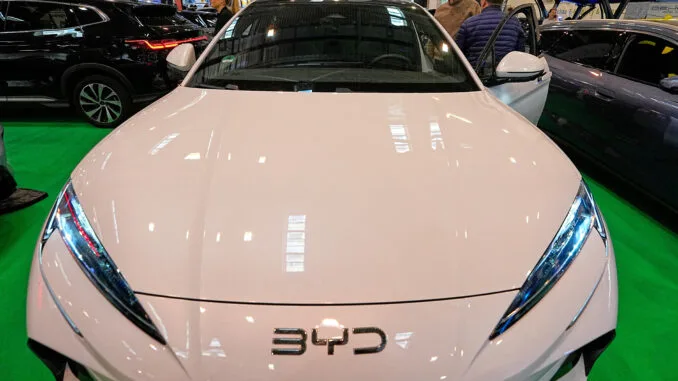
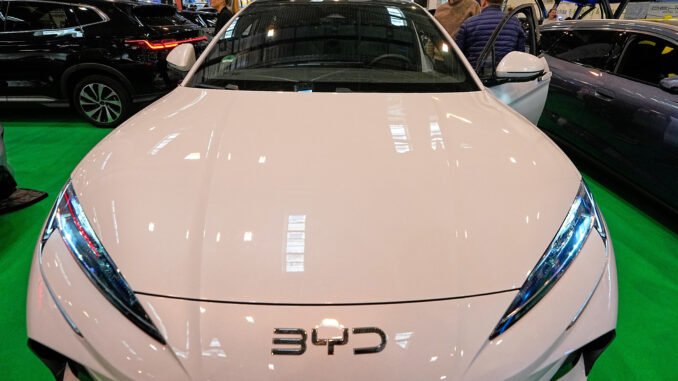
DETROIT — Chinese automakers have been making inroads around the world with growing sales of their high-tech, stylish and affordable electric vehicles. That has had competitors concerned even before Canada this week agreed to cut its tariffs on Chinese EVs in exchange for concessions on Canadian farm products.
Experts now say an easier path into Canada could be a big boost for Chinese carmakers looking to dominate the global market — particularly as their domestic market weakens. That poses a threat to other auto manufacturers, particularly American companies.
U.S. officials acknowledged that in remarks at an assembly plant for Jeep-maker Stellantis in Toledo, Ohio, on Friday. Transportation Secretary Sean Duffy said the Chinese Communist Party invests in its auto industry to “control this industry.”
“Why? They want to take over the auto industry. They want to take away these jobs,” Duffy said. As far as the Canadian trade deal, he added, “They will live to regret the day they partner with China and bring in their vehicles.”
Others say the shift is inevitable.
“This is telling us that Chinese automakers continue to be really popular and are doing better and better and not just something that’s sold in global markets that are more marginal or less important to U.S. automakers,” said Ilaria Mazzocco, deputy director and senior fellow with the Trustee Chair in Chinese Business and Economics at the Center for Strategic and International Studies.
What makes Chinese vehicles stand out?///
Chinese-made vehicles are high-quality, stylish and inexpensive, experts say.
“It’s clear that the vehicles made by Chinese brands come at a very competitive cost but are also technologically quite desirable,” Mazzocco said. “They tend to be connected vehicles, so they have a lot of additional software capabilities that consumers seem to like. But the price point and the competitiveness are really big selling points.”
These vehicles can cost as little as $10,000 to $20,000; in the U.S., new vehicles are running close to $50,000 on average, and EVs even more so.
“They’ve found a way to make small and mid-sized cars — cars that people want — at a reasonable price,” said Sam Fiorani, vice president at AutoForecast Solutions. “These are the segments where GM and Ford and almost everybody else have abandoned.”
Why are Chinese EVs such a threat to U.S. automakers and others?///
Much of the global auto market is electrifying, an ideal opportunity for advanced Chinese automakers to capitalize on. China saw 17% growth in plug-in hybrid and electric vehicles in 2025, according to data released by Benchmark Mineral Intelligence this week, and Europe saw a 33% increase.
Meanwhile, U.S. sales of electrified cars grew just 1% last year. As the rest of the world advances, U.S. automakers have weakened their once-ambitious, multibillion-dollar electrification plans, instead opting for more efficient hybrid electric and gasoline vehicles amid the Trump administration’s shift away from EV-friendly policy.
Tesla lost its crown as the world’s bestselling electric vehicle maker last year, delivering only 1.64 million vehicles in 2025 to Chinese rival BYD’s 2.26 million.
Chinese automakers will have to meet standards required for the Canadian auto market for the latest trade arrangement to be successful — standards that are similar to those in the U.S. — which is likely to incentivize Chinese auto manufacturing investment in Canada.
The firm predicts Chinese brands will account for 30% of the global market by 2030.
“They’ve already started in Europe,” Wakefield said. “They started in South America. Now Mexico and Canada.”
American carmakers “don’t want to end up as a Brazil with your ethanol-based cars that aren’t sellable anywhere else in the world and … like Britain or Australia that used to matter in the auto world and no longer really matter.”
Why have others sought to regulate Chinese EV makers’ expansion? ///
Countries have attempted to regulate Chinese EVs from entering their markets for several reasons.
“China has become this overwhelming machine making inexpensive vehicles,” Fiorani said. “And the fear is that if you give them an inch, they’re going to take a mile. The other issue is technology. These vehicles are data centers … and the idea that a state-owned company in China could have access to where a high portion of drivers are going gives them leverage for all kinds of outlets.”
The European Union hiked tariffs on Chinese EVs last year, though the two have been resolving that at the start of this year.
“The advance of Chinese manufacturers is inevitable,” Fiorani added. “It will happen eventually. Everybody is negotiating to put up the roadblocks to figure out: What data is being processed, how much market share you’re going to allow Chinese manufacturers to have.”