Two decades ago, a California company called Tesla Motors almost single-handedly created the electric vehicle as we now know it. Elon Musk’s company has dominated the industry across the globe ever since. But last year, for the first time in a long time, the world’s biggest seller of EVs wasn’t Tesla. It was the Chinese auto giant BYD.
The secret to BYD’s success is simple: The company makes high-tech electric and hybrid cars and sells them at incredible prices. The tiny BYD Seagull costs as little as $8,000 in China, and it’s a megahit in several countries. The Chinese car industry—not just BYD but also its many competitors that also make affordable cars—is quickly taking over the world. In Europe, Chinese models make up nearly 10 percent of new-car sales, in large part because they’re typically thousands of dollars cheaper than options from homegrown Volkswagen and Renault. And in Mexico, about 20 percent of new cars are made in China.
But you won’t find the Seagull or any other cheap Chinese models in the United States. The Biden administration levied steep 100 percent tariffs on Chinese EVs and then essentially banned them for reasons of national security. (U.S. officials have said that the cars could transmit sensitive data back to Beijing.) For its part, the Trump administration has continued to keep out Chinese imports and push American-made gas cars instead.
Recently, however, the wall around Chinese cars has started to crack. Earlier this month, in a speech at the Detroit Economic Club, President Trump expressed enthusiasm for letting Chinese automakers build their vehicles in the United States: “If they want to come in and build the plant and hire you and hire your friends and your neighbors, that’s great,” he said. Then, last week, Canadian Prime Minister Mark Carney announced that his country would open the door to China’s cheap cars, slashing the tariff rate from 100 percent to just 6 percent. Canada’s car industry is deeply intertwined with America’s; those 100 percent tariffs were enacted in solidarity with Washington. If Chinese imports can gain a foothold in America’s neighbor to the north, then perhaps it is only a matter of time before they do so in the U.S. as well. “It’s the first step,” Dan Hearsch, an auto-industry analyst at the consulting firm AlixPartners, told me. “It’s an inevitability that Americans will buy Chinese cars.”
These developments don’t mean that a Xiaomi YU7 will be in millions of American driveways by the end of this year. But the road map for how Chinese cars could come to the U.S. has never been clearer. The deal to spin off TikTok, finalized just yesterday, proves that any cybersecurity concerns around Chinese EVs are surmountable if policy makers want the cars badly enough. Similar to how TikTok is now run by a U.S. entity, Chinese-designed cars could be manufactured in factories in Michigan or Ohio—even with American-made parts. And today, Reuters reported that the Trump administration has pushed out the Commerce Department official whose office spearheaded the ban on Chinese car tech. (The personnel change “should not be read that deeply into as reflective of broader Administration thinking or decision-making,” Kush Desai, a White House spokesperson, told me in an email.)
The global auto industry seems to think that the floodgates could open. At CES earlier this month, the Chinese auto giant Geely Auto previewed new SUVs and signaled that it might announce a U.S. debut in the next two or three years. (A Geely spokesperson told me in an email that the company “continues to monitor market opportunities in North America.”)
As the rest of the world gets behind the wheel of Chinese cars, it’s hard not to feel like Americans are missing out. And the upside to cheaper cars becomes harder to ignore as the average sticker price for a new car in America hovers around a staggering $50,000. Chinese EVs almost certainly wouldn’t cost $8,000 in the U.S.—especially if they’re made with American labor. But China’s advanced manufacturing techniques, or simply the companies’ desire to price these cars so they can entice buyers to try new brands, mean that they would almost certainly be cheaper than the competition. There is a long history of Americans going for foreign newcomers because they’re the cheaper and more efficient option: Volkswagen, Toyota, Honda, Hyundai, and Kia all got their start in the U.S. that way.
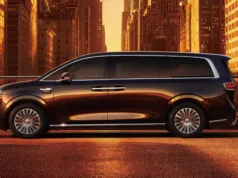
China’s automakers don’t always hit home runs right away. Nio, a luxury brand known for its battery-swapping EVs, largely fell flat in Europe with models priced similarly to those from BMW and Mercedes-Benz. But Chinese car companies are good at figuring out what the locals want. Take BYD: The auto giant has debuted a plug-in hybrid station wagon in Europe, a boxy electric micro-car in Japan, and a rugged hybrid truck in Mexico. The cars that Geely showcased at CES, in Las Vegas, were large SUVs with big wheels, opulent interiors, and three rows of seats—not unlike a Ford Explorer. When I saw them, the first thing I thought was that they looked like cars Americans would buy.
Chinese cars built in the U.S. could be a win-win, Hearsch said: Decades ago, when Toyota and Honda came to the U.S., “they created jobs, they brought the manufacturing here, and they raised the overall level of quality through competition.” China’s automakers, he added, “may have a similar effect.” Or at least that’s the rosy view. For the American car industry, competing against China is a terrifying proposition. Not only are Chinese automakers edging out traditional car companies elsewhere in the world, such as in Europe and Latin America, but they’re also what Chinese people now prefer to buy—meaning that Western companies can’t count on the massive profits they once scored in China. Ford’s CEO, Jim Farley, never misses an opportunity to warn of the threat that American automakers now face from China. “They’re really impressive companies, as I have said many times publicly,” he told me in an interview last week. Ford is now preparing some countermeasures. In August, the company announced that it would build a $30,000 electric pickup truck to try to keep up with Chinese automakers.
Efforts like that had better work out if Ford has any hopes of staying relevant. If Chinese EVs arrive here soon, U.S. automakers will have few defenses. The Trump administration spent much of last year rolling back policies meant to boost electric cars. Automakers have been all too happy to double down on what they know how to build, and build profitably: gas-powered cars. Just yesterday, General Motors announced that the revived $30,000 Chevrolet Bolt EV won’t stick around after next year, in order to free up factory space for gas-powered crossovers. Maybe Americans truly prefer gas cars—or maybe the EVs they’ve been offered have simply been too expensive or just not that great. It’s hard to imagine that Americans will want to keep buying $50,000 gas-guzzling SUVs if they have the option of buying high-tech Chinese EVs for half the price.
All of this could devastate an American auto industry that has already shrunk a lot over the decades. GM was the world’s largest private employer as late as the 1970s, but now its footprint is only a fraction of its former size. And Ford has largely thrown in the towel against Toyota and others on nearly everything but pickup trucks and SUVs. But at the rate the Chinese automakers are moving, even that might not be enough to guarantee a future.