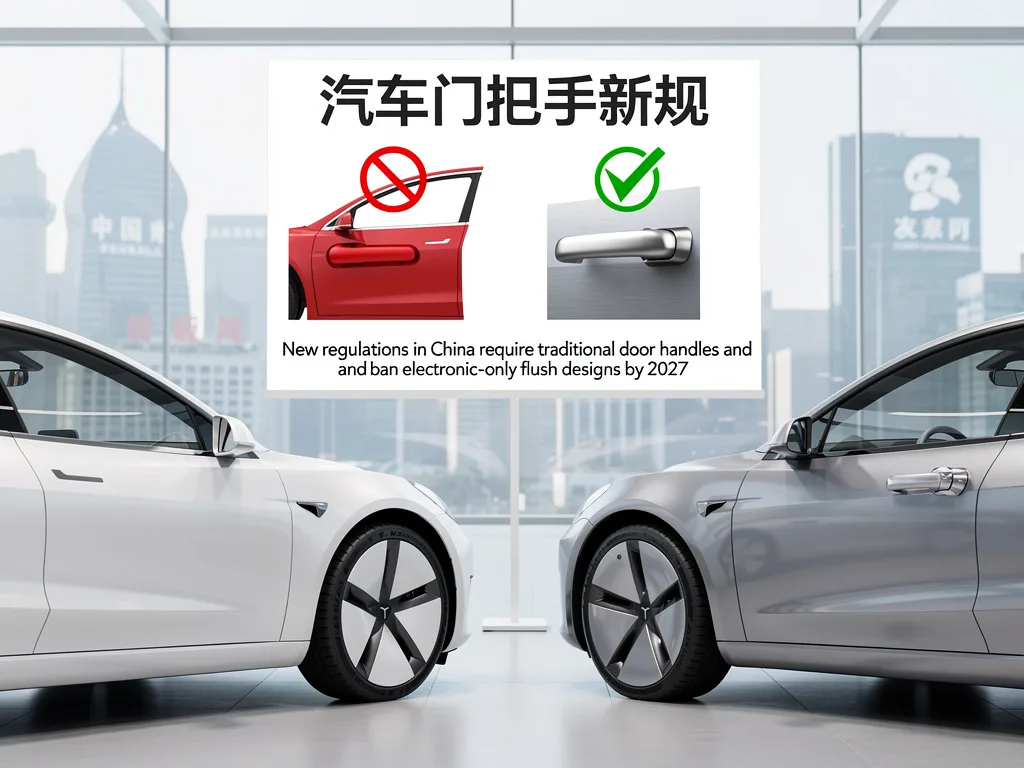
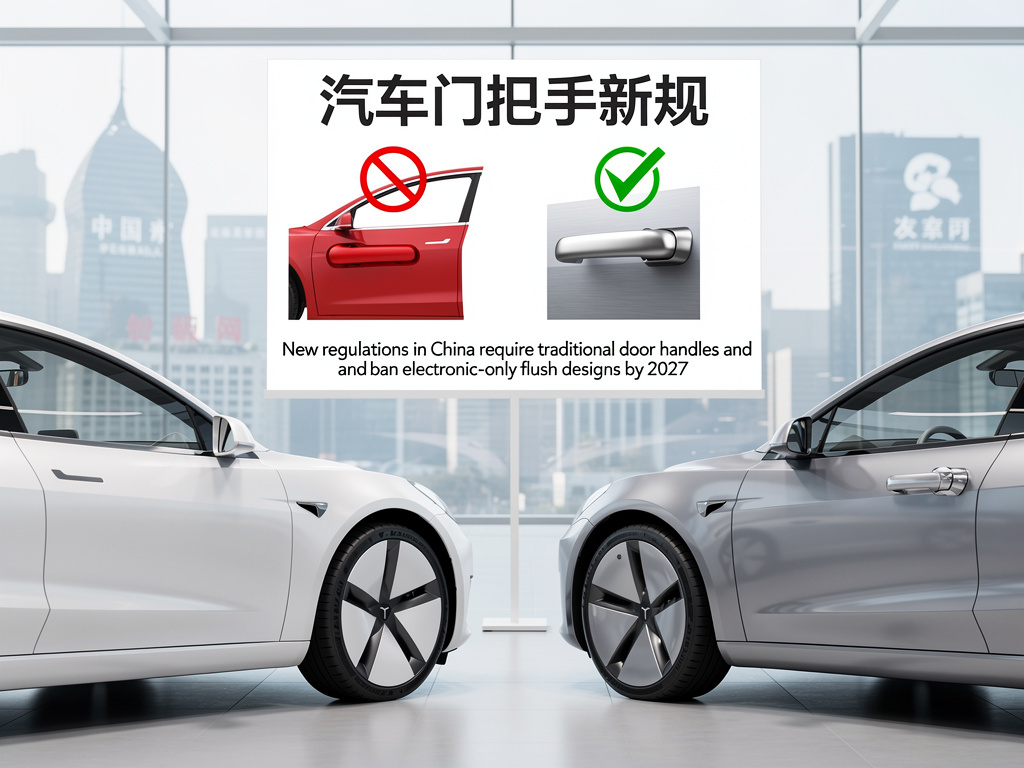
China’s automotive regulatory authority has drawn a line in the sand against one of Tesla’s most distinctive design features, mandating that all vehicles sold in the country after January 2027 must abandon flush or retractable door handles in favor of traditional mechanical alternatives. The decision, which targets Tesla’s signature pop-out handles along with similar systems from other manufacturers, represents a significant intervention in automotive design philosophy and raises questions about the balance between aesthetic innovation and practical safety considerations in the rapidly evolving electric vehicle sector.
According to The Verge, the new regulation stems from concerns about emergency egress situations, particularly scenarios where vehicle electrical systems fail or occupants face time-sensitive evacuation needs. The mandate specifically requires that door handles be “easily identifiable and operable without electrical power,” a standard that Tesla’s current flush-mounted, electronically-activated handles cannot meet. While the regulation applies to all automakers operating in China, Tesla faces the most significant design challenge given its extensive use of the technology across its Model S, Model X, and Model 3 product lines sold in the market.
The timing of China’s regulatory action carries particular weight given the country’s position as the world’s largest automotive market and Tesla’s second-biggest revenue source after the United States. Tesla’s Shanghai Gigafactory, which began production in 2019, has become the company’s primary export hub and a cornerstone of its global manufacturing strategy. Any design changes mandated for the Chinese market will likely ripple through Tesla’s production systems, potentially affecting vehicles destined for other regions where manufacturing efficiency depends on platform standardization.
Engineering Elegance Meets Regulatory Reality
Tesla introduced its flush door handle design with the Model S in 2012, positioning the feature as both an aerodynamic advantage and a statement of futuristic minimalism. The handles automatically present themselves when a driver approaches with the key fob, then retract flush with the door panel when the vehicle is locked or in motion. The company has claimed that this design reduces aerodynamic drag, contributing to extended range—a critical metric for electric vehicle performance and consumer acceptance. However, the system’s reliance on electrical actuation has generated persistent criticism from safety advocates and frustrated users who struggle with the non-intuitive operation during emergencies.
The Chinese regulation joins a growing body of international scrutiny around Tesla’s design choices. European safety organizations have previously raised concerns about the learning curve associated with Tesla’s door mechanisms, particularly for passengers unfamiliar with the vehicles. First responders have reported challenges accessing Tesla vehicles during accident scenarios, leading to specialized training programs focused on understanding the brand’s unique entry systems. The National Highway Traffic Safety Administration in the United States has received numerous complaints related to door handle failures, though the agency has not issued formal guidance restricting their use.
Market Implications and Manufacturing Challenges
The mandate presents Tesla with a complex engineering and business challenge. Redesigning door systems requires more than simply bolting on conventional handles—it necessitates modifications to door panel structures, weatherproofing systems, and potentially the vehicle’s aerodynamic profile. These changes must be implemented while maintaining manufacturing efficiency at the Shanghai facility, which produced over 950,000 vehicles in 2023. Industry analysts estimate that retooling for such modifications could cost tens of millions of dollars and require several months of engineering work, though Tesla has not publicly commented on the financial impact.
Beyond Tesla, the regulation affects other premium electric vehicle manufacturers that have adopted similar design philosophies. Chinese domestic brands including NIO and XPeng have incorporated flush or semi-flush door handles in their premium offerings, viewing them as markers of technological sophistication that appeal to status-conscious buyers in tier-one cities. These companies now face the same mandate to revert to more traditional mechanisms, potentially diminishing one of the visual cues that differentiate electric vehicles from conventional automobiles in showrooms.
Safety Data and Emergency Access Concerns
The regulatory decision appears rooted in specific incident data, though Chinese authorities have not publicly released comprehensive statistics on door handle-related emergencies. Anecdotal reports from Chinese social media platforms have documented instances where Tesla owners or passengers struggled to exit vehicles during minor accidents or electrical malfunctions. The vehicles include manual release mechanisms—typically a mechanical cable or lever—but these backups are often concealed and not immediately obvious to occupants unfamiliar with their location, particularly during high-stress situations.
Fire safety experts have expressed particular concern about scenarios involving battery thermal events, where rapid egress becomes critical. While modern electric vehicle batteries include multiple safety systems to prevent thermal runaway, incidents do occur, and the seconds required to locate and operate a manual release mechanism could prove consequential. The Chinese regulation essentially mandates that the primary door opening mechanism must function independently of the vehicle’s electrical system, eliminating the potential confusion between electronic and mechanical release methods.
Design Philosophy Under Pressure
The Chinese mandate represents a broader tension in automotive design between innovation and regulation, between aesthetic purity and functional pragmatism. Tesla’s design philosophy, heavily influenced by CEO Elon Musk’s preference for minimalism and technological showcase features, has consistently pushed against conventional automotive wisdom. The company eliminated traditional dashboard instruments in favor of central touchscreens, removed physical gear selectors for touchscreen controls, and minimized physical buttons throughout its interiors. Each decision has generated both devoted admirers and vocal critics.
This regulatory intervention suggests that Chinese authorities view certain design elements as non-negotiable safety requirements, regardless of manufacturer preferences or brand identity considerations. The decision aligns with China’s increasingly assertive approach to automotive regulation, particularly regarding electric vehicles where the country seeks to establish itself as both a dominant market and a standard-setter for global industry practices. Previous Chinese regulatory actions have mandated specific battery safety standards and data localization requirements that have forced foreign automakers to adapt their products and practices.
Industry-Wide Ramifications
The ripple effects of China’s door handle mandate extend beyond immediate compliance requirements. Automotive designers across the industry are likely to reconsider the risk-benefit calculus of flush door handles and similar electronically-dependent systems. If the world’s largest automotive market determines that such features pose unacceptable safety risks, other regulatory bodies may follow suit, potentially creating a patchwork of requirements that complicate global vehicle platforms. The European Union and United States have not indicated plans for similar mandates, but the Chinese precedent provides a regulatory framework that safety advocates in other markets may reference.
For Tesla specifically, the mandate arrives during a period of intensifying competition in China’s electric vehicle market. Domestic manufacturers including BYD, Geely, and emerging brands have captured significant market share by offering feature-rich electric vehicles at competitive prices, often undercutting Tesla’s pricing while matching or exceeding its technology offerings. Any perception that Tesla’s design choices prioritize aesthetics over practical safety could provide competitors with ammunition in marketing campaigns aimed at safety-conscious Chinese consumers, particularly families purchasing their first electric vehicle.
The Path Forward for Automotive Innovation
Tesla has not publicly announced its compliance strategy, though the company has historically demonstrated ability to rapidly implement design changes when faced with regulatory requirements. The 2027 implementation date provides a multi-year runway for engineering work, supplier coordination, and manufacturing adjustments. Industry observers anticipate that Tesla will develop a door handle solution that attempts to maintain some aesthetic differentiation while meeting the mechanical operation requirements—potentially a semi-flush design that protrudes slightly from the door panel but operates through mechanical linkage rather than electronic actuation.
The broader question facing the automotive industry concerns the appropriate boundaries of design innovation in safety-critical systems. Door handles, seatbelts, and emergency exits represent fundamental vehicle access points where user intuitiveness and reliability under stress conditions arguably outweigh aesthetic considerations. The Chinese regulation essentially establishes that position as regulatory policy, potentially setting a precedent for other vehicle systems where electronic control has replaced mechanical operation. As vehicles become increasingly software-defined and electronically controlled, regulators worldwide are grappling with questions about appropriate fail-safes and backup systems for critical functions.
The Tesla door handle mandate ultimately reflects the maturation of the electric vehicle industry from a niche market tolerant of experimental designs to a mainstream sector subject to conventional safety scrutiny. As electric vehicles transition from early-adopter products to family transportation, regulatory authorities are applying the same rigorous safety standards that govern conventional automobiles. For Tesla and other manufacturers pushing design boundaries, the Chinese decision serves as a reminder that innovation must ultimately satisfy not only consumer preferences and engineering objectives but also regulatory requirements rooted in worst-case scenario planning. The coming years will reveal whether this represents an isolated regulatory intervention or the beginning of a broader recalibration of acceptable automotive design practices in the electric era.