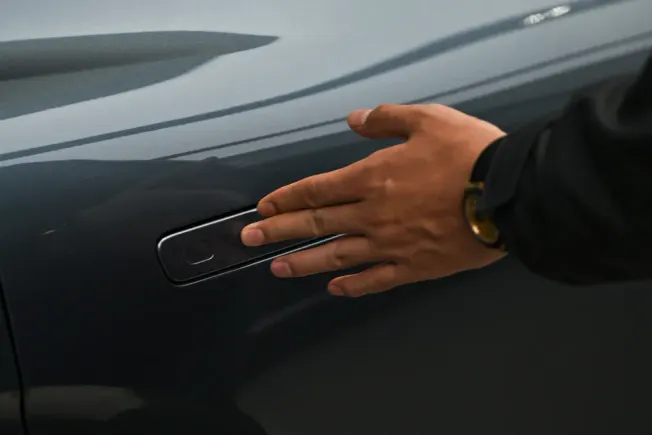
China’s ban on hidden door handles, of the sort that are especially popular in electric vehicles, will be sending auto designers into a frenzy of unplanned modifications, according to industry analysts.
The move follows a spate of fatal accidents that have seen rescuers unable to access passengers from burning vehicles when electrically operated handles do not operate.
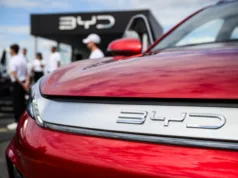
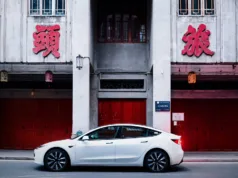
The handle design, made popular by Tesla products, now feature on a range of EVs including legacy automakers like BMW and newcomer Xiaomi, the telecoms giant.
Two fatal incidents involving Xiaomi vehicles have been cited by safety watchdogs where electric power failures are thought to have prevented the opening of doors when the vehicles were on fire.
In a Sep. 15, 2025, report, the U.S. National Highway Traffic Safety Administration said it opened a probe into Tesla’s electric-powered door handles following reports that they suddenly stopped working, leaving children trapped in the cars.
The NHTSA said it had received nine complaints about the handles in Tesla’s 2021 flagship, the Model Y. In four of the cases, car owners had to resort to breaking windows to access passengers.
China’s move stipulates that only cars with a mechanical mechanism for releasing the door, both from the outside and the inside, will be allowed to be sold from as soon as Jan. 1, 2027, according to a Feb. 3 report in the China Daily newspaper.
The news comes as Europe’s car safety testing body, Euro NCAP, gets ready to launch a change to its latest test protocols that specifically highlights the dangers of only-electrically-operated door handles, it said in a Nov. 26, 2025, release.
New protocols covering a wide range of changes include measures that ensure “electrically powered exterior door handles remain operable after an impact.” Euro NCAP plans to demonstrate the new protocols to media over two days from Mar. 17.
In comments emailed to WardsAuto, the agency’s technical director, Richard Schram, stressed that so far, its protocols are not legally binding but will affect a vehicle’s ability to reach top safety star ratings.
“While we do not publish specific statistics on this issue, from a safety perspective it is widely recognized that occupants and first responders must always be able to access the vehicle following a collision,” said Schram. “Ensuring doors can be opened from both the inside and outside remains a fundamental principle of post-crash safety.”
Analyst reaction
However, there are global implications to China’s ban, according to Alexandre Parente, head of global analysis and reporting at Jato Dynamics.
“I think China’s decision is going to create some real work for EV makers,” said Parente. “Anyone relying on electric‑only handles will have to revisit their designs pretty quickly to meet the 2027 deadline, and that inevitably adds cost and pressure, especially for cars already on the market or close to launch.”
He said Euro NCAP’s updating of its crash safety protocols is at the vanguard of a broader industry trend. “It wouldn’t surprise me if automakers increasingly start to align designs across markets to avoid region‑specific variants,” Parente said.
On the upside, suppliers could reap the benefits of the hasty redesign of EV door handle mechanisms. “There’s going to be renewed interest in mechanical systems, so companies with strong mechanical know‑how may suddenly find themselves in demand again,” he said.
These comments were echoed by Chris Liu, senior analyst for automotive at Omdia, who said the effects on the industry will be felt globally. It will also affect premium-level EVs disproportionately where retractable door handles are treated as a design and aerodynamic statement.
He cited the BMW iX3 as an early adopter of retractable handles leading to showcasing its Neue Klasse vehicles without conventional door handles and replacing them with small grab points near the window.
“That direction now leaves BMW and similar OEMs facing potentially costly redesigns or retrofits, especially as China-hosted global debuts such as long-wheelbase models at the April Beijing Auto Show increasingly dictate global EV design decisions,” Liu added.
As EVs mature in the market away from just early adopters to become a mass-market product, fail-safe designs will be increasingly seen as a baseline standard rather than a discretionary feature, said Michael Fisher, market analyst at fintech company Tradingpedia in an email response to WardsAuto.
“Any design issues affecting door operability could have outsized implications for consumer trust, safety ratings and ultimately sales performance, not only for Tesla but for competitors with similar electronic-only handle designs,” Fisher said.
Manufacturers will need to integrate mechanical fail-safes alongside electronic handles to ensure doors remain operable in the event of power loss, he said.
“This could slightly increase production costs and, by extension, vehicle prices, particularly for premium models. However, these costs are likely to be offset by the reputational and competitive benefits of demonstrating a strong commitment to safety,” Fisher concluded.