China is executing a national-scale science project that transforms entire regions into living hydrogen powered laboratories. In 2021, Beijing grouped dozens of cities into massive China Hydrogen City Clusters, challenging them to prove where fuel cell trucks and buses in China operate effectively on real routes. This initiative represents the largest hydrogen mobility experiment on Earth, featuring performance-based funding, public reporting, and thousands of daily refueling events.
Beyond the mechanics of these clusters and their performance incentives, comparing fuel cell and battery electric options offers sharp insights into market viability. Achieving the full potential climate benefits requires successful deployment of pipelines, electrolyzers, and rigorous leak management.
Key Data: Targets, Subsidies, and Infrastructure
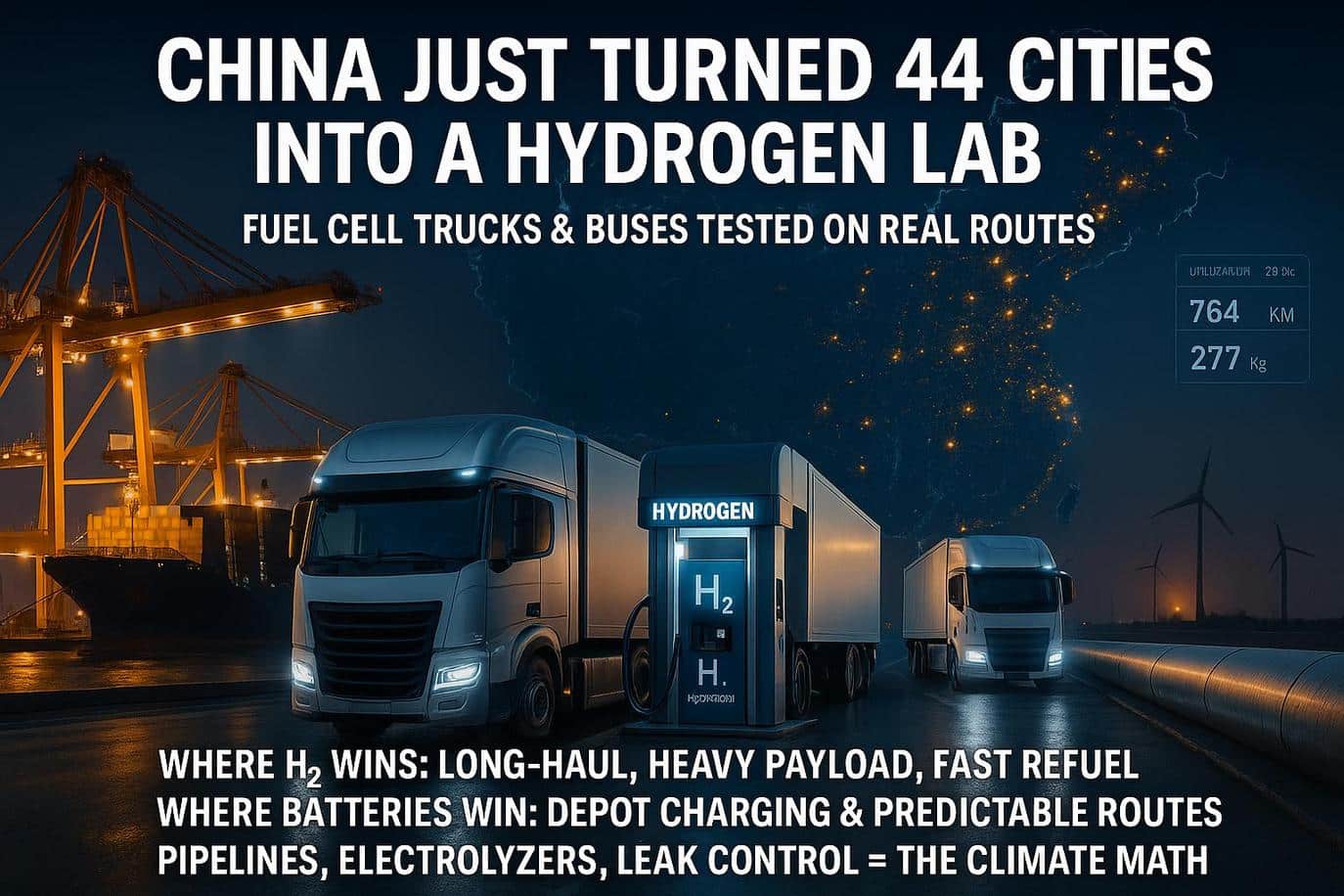
- China launched a Hydrogen Fuel Cell Vehicle City Cluster program in 2021 that groups 44 cities across 14 provinces into five demonstration clusters. This approach is documented by a comprehensive mapping study which transforms regions like Beijing-Tianjin-Hebei and the Yangtze River Delta into coordinated testbeds.
- Central support is performance-based, with each cluster eligible for up to roughly 1.5-1.7 billion yuan depending on verified outcomes such as vehicle deployment, hydrogen throughput, refueling stations, and component localization.
- In April 2025, the Ministry of Finance released a third-round allocation of 2.34 billion yuan, pushing three-year funding above $700 million for demonstration fleets and infrastructure. The Ministry of Finance allocation for April 2025 expanded the program’s budget significantly.
- National planning targets call for 50,000 fuel cell vehicles by 2025 alongside 100,000-200,000 tonnes per year of low-carbon hydrogen to meet early supply goals.
- Battery electric trucks are growing faster than fuel cell trucks; BEV heavy trucks reached about 22% share in H1 2025, while fuel cell heavy trucks remained near 1% in monthly snapshots.
- China is planning a hydrogen backbone, including a 1,038-1,438 km pipeline spine. Detailed China pipeline analysis indicates it will connect production bases to coastal demand, moving roughly 1.6-1.7 million tonnes per year at full buildout. This infrastructure is critical for China to compete effectively in the growing global hydrogen trade.
- Hydrogen leakage has non-negligible climate impacts that can increase life-cycle emissions for multiple production pathways by up to about 15% if not controlled, which is why leak-tight design and monitoring matter.
Defining the China Hydrogen City Clusters Model
Consortia, Not Pilots
China’s hydrogen city clusters function as massive, multi-city consortia—a significant step up from traditional pilot projects. These groups deploy buses, logistics trucks, and special vehicles while simultaneously building refueling stations and local supply chains. The program launched in 2021 and spans a four-year demonstration period to validate real-world performance across vehicles, stations, and value-chain manufacturing.
Five Clusters, Forty-Four Cities
The clusters organize 44 cities in 14 provinces into five major groups, linking coastal ports, inland manufacturing hubs, and large metros into shared freight corridors and technology networks. That design lets ports handle hydrogen drayage while inland cities trial long-haul and industrial routes. An open study on freight dynamics confirms that this collaboration network accurately reflects the actual movement of freight in China.
How the Money Flows
Instead of paying per vehicle at purchase, Beijing pays for outcomes. This performance-based model forces clusters to compete for awards tied to verified operational metrics.
- Kilometers Driven: Vehicles must log active service distance.
- Hydrogen Consumed: Fuel usage verifies real-world deployment.
- Stack Performance: Efficiency and durability must meet technical standards.
- Station Availability: Infrastructure uptime is a key funding criterion.
- Domestic Content: Localization targets drive the local supply chain.
Successful clusters can unlock up to about 1.5-1.7 billion yuan over the period. Cities then channel these funds to operators, OEMs, and infrastructure partners. The subsidy model matches the fuel cell vehicle subsidy design that focuses on the entire value chain used in this program.
The Performance Checklist
- Vehicles in Operation: Buses, medium and heavy trucks, and special vehicles must hit deployment and utilization thresholds.
- Hydrogen Throughput: Stations log dispensed kilograms to verify real service levels.
- Technical Milestones: Fuel cell stack power density, durability, and system efficiency targets must be met.
- Localization & Learning: Projects are expected to raise domestic content in stacks, compressors, and balance-of-plant components.
Why Cities Are the Right Unit
Cities control bus fleets, sanitation vehicles, and station permitting, positioning them as the ideal integrators for hydrogen trials. Clusters link multiple cities to share ports, OEM bases, and suppliers so that lessons travel along freight corridors rather than remaining isolated in single municipalities. This strategy aligns with a corridor policy design that prioritizes integrated corridor systems.
Market Scale: Fuel Cell Trucks vs. Battery Electrics
Where Fuel Cell Vehicles Stand Today
Fuel cell vehicles are still a small slice of China’s enormous commercial vehicle market. Data from ICCT heavy-duty vehicle tracking indicates that BEV heavy trucks reached roughly 22% sales share, while fuel cell heavy trucks hovered near 1% in monthly snapshots. This disparity signals that hydrogen targets specific niches where fast refueling, high uptime, or payload sensitivity matter most.
Why Commercial Fleets Came First
The quick refueling and long range of hydrogen appeal to duty cycles where vehicles cover many kilometers daily and cannot sit on chargers. Clusters prioritize city buses, port drayage, steel and chemical corridors, cold-chain logistics, and mountainous routes with heavy loads because hydrogen’s quick refueling and long range appeal to duty cycles where vehicles cover many kilometers daily and cannot sit on chargers. Light-duty adoption realities are shaped by hydrogen car technology trends, which helps explain why clusters prioritize commercial fleets.
A Reality Check Against Battery Momentum
Battery trucks gained traction due to cost and efficiency, particularly where depot charging and predictable routes simplify operations. Certain modes are already shifting toward batteries, such as many regional rail applications where studies indicate that battery electric trains are cost-effective over long service lives.
Infrastructure: The Hydrogen Pipeline Backbone and Supply
Electrolyzers and Clean Power Set the Ceiling
Green hydrogen depends on abundant clean electricity and electrolysis capacity. China leads on electrolyzer manufacturing and is scaling capacity quickly as part of its broader clean-energy strategy. China’s broader strategy, outlined in its national hydrogen development plan, targets 50,000 fuel cell vehicles by 2025 and 100,000-200,000 tonnes per year of low-carbon hydrogen. Renewable offshore wind will power future hydrogen hubs that support both transport and industry.
Pipelines will Decide Scale and Cost
Moving hydrogen efficiently requires dedicated midstream infrastructure. China’s proposed hydrogen pipeline spine aims to connect Inner Mongolia’s wind and solar resources with industrial demand near Beijing and coastal hubs. Eventually carrying well over a million tonnes per year if built to plan, the network also supports coastal hubs such as Rizhao that are exploring seawater-based production combining seawater processing with hydrogen production. Early cross-provincial projects are already approved, setting the stage for clusters to draw from lower-carbon hydrogen instead of relying on grey supply, as the global hydrogen supply chain transitions from pilots to scalable hubs.
Why Leakage Management Matters
Hydrogen itself does not trap heat like carbon dioxide. However, leaks can change atmospheric chemistry in ways that raise net warming through methane and ozone effects. Peer-reviewed analysis in Nature Communications finds that including these indirect warming effects can raise life-cycle emissions for several hydrogen pathways by up to about 15%, depending on leak rates and production methods.
MIT research on pipeline and storage leakage reaches similar conclusions for pipelines and storage, reinforcing the need to prevent leaks as networks expand. For city clusters, this means station design, truck connectors, and maintenance protocols are climate infrastructure, not mere logistics.

Environmental Impact: Leakage and Low-Carbon Certification
Grey, Blue, and Green Hydrogen in the Clusters
Most of the hydrogen available to Chinese fleets today is still fossil-based or obtained as a by-product from industrial processes. Consequently, the climate value of a fuel cell bus or truck relies entirely on the hydrogen production method, not just zero-emission tailpipes.
Beijing’s Hydrogen Industry Development Plan (2021-2035) introduced early targets for 50,000 fuel cell vehicles by 2025 alongside 100,000-200,000 tonnes per year of low-carbon hydrogen, a signal that cleaner supply must scale with vehicles, not after the fact. To integrate supply and demand over time, city clusters are paired with new production bases and corridors that move hydrogen from resource-rich regions to coastal demand.
Hydrogen Leakage and Indirect Warming
Hydrogen itself is not a greenhouse gas, yet leaks change atmospheric chemistry in ways that increase warming by extending the life of methane and boosting ozone. Recent modeling in Nature Communications finds that including these indirect warming effects can raise life-cycle emissions for several hydrogen pathways by up to about 15%, depending on leak rates and production methods based on peer-reviewed analysis.
Independent MIT research on pipeline and storage leakage reaches similar conclusions for pipelines and storage, reinforcing the need to prevent leaks as networks expand. For city clusters, this means station design, truck connectors, and maintenance protocols are climate infrastructure, not mere logistics.
From Targets to Accounting: What Counts as Low-Carbon
To ensure real climate gains, cluster awards and local procurement rules should require transparent accounting of hydrogen’s origin and measured leakage along the route from plant to nozzle. Cities can reference emerging certification practices and favor electrolytic hydrogen tied to new renewables. They then connect clusters to trunk lines that deliver cleaner molecules at scale. The development of China’s emerging hydrogen pipeline backbone and the global green hydrogen supply chain explains how production sites will connect to demand hubs.
Operational Use Cases: Heavy Corridors vs. Urban Fleets
Heavy Corridors, Ports, and Steel Towns
Hydrogen is most competitive where vehicles run long distances daily, carry heavy payloads, and need fast refueling to protect uptime. These competitive areas include port drayage, steel and chemical corridors, and cold-chain logistics.
Market snapshots show fuel cell heavy trucks remain a small share overall, yet they are concentrated in these heavier-duty use cases while battery trucks take the broader market. When clusters co-locate bus depots, logistics yards, and refueling stations, they create the demand density needed to keep stations busy and costs under control, facilitated by advancements in freight operation tracking that optimize routing and uptime.
Battery Trains, City Buses, and the Limits of Hydrogen
Batteries dominate where routes are predictable, dwell times support charging, and energy efficiency wins total cost comparisons. Consequently, many city buses and regional rail lines are shifting to batteries, often at lower lifetime cost. Evidence from battery-train deployments highlights infrastructure and maintenance advantages that stack up over time. For urban bus fleets with overnight depots, depot charging and smart scheduling usually beat gaseous supply on both price and complexity.
Total Cost of Operation: Depot Charging Versus Gaseous Supply
Total cost of operation hinges on energy price per kilometer, vehicle utilization, payload sensitivity, and the availability of shared infrastructure. Battery trucks excel where operators control the depot, electricity is inexpensive, and routes are fixed. Hydrogen can be the better fit where time spent charging would destroy asset productivity or where weight-limited routes benefit from lighter onboard energy.
Recent reports show zero-emission freight in China is being pulled forward by rapid battery truck adoption, while fuel cell trucks are still proving out their high-duty niches. This zero-emission competition occurs even as fleets explore sustainable fuel alternatives for legacy diesel vehicles.
Policy Shift: From NEV Subsidies to Hydrogen Industrial Strategy
NEVs Saturate, Hydrogen Steps onto the Stage
An independent policy review notes that China ended its central purchase subsidies for new energy vehicles at the end of 2022, moving to mandates, tax policy, and usage incentives at the city level. The commercial market then accelerated based on its own economics, with battery-heavy trucks reaching around a fifth of monthly sales by 2025 in some datasets. Fuel cell heavy trucks stayed near one percent, which a recent market report confirms is due to electric trucks already changing diesel and LNG demand in China’s freight sector.
Industrial Strategy, Not Just Climate Strategy
Hydrogen sits inside a bigger industrial realignment. In 2024, clean-energy industries contributed more than 10 percent of China’s GDP, driven by EVs, batteries, solar, and grids. This scale, confirmed by recent economic analysis, drives China to build hydrogen corridors alongside electrification rather than in competition with it. Coastal power can feed both the grid and future green hydrogen hubs, consistent with system efficiency modelling that demonstrates China can reach high clean-power targets while cutting system costs.
Global Implications: Takeaways for International Policymakers
What City Clusters Have Already Taught Us
China’s program offers several critical takeaways for global policymakers. Two concepts remain universally applicable: paying for verified performance rather than upfront promises and clustering demand to share infrastructure.
- Reward Actual Performance: China’s program pays for verified kilometers, hydrogen throughput, and technology milestones, which filters out projects that look good on paper but fail under real operations.
- Let Technologies Find Use Cases: Real-world data show batteries dominate mass passenger and many urban routes, while hydrogen targets heavy, time-sensitive freight.
- Count Molecules and Leaks: The climate value of hydrogen relies on production pathways and rigorous leak control from plant to nozzle.
Cities that mix both technologies avoid picking a single winner before the numbers are in. Life-cycle methods that include indirect warming are essential for credible climate accounting.
A Practical Checklist for Cities and Regions
Before launching hydrogen fleets, confirm four basics: clean supply, clustered demand, measured leakage, and a plan for when batteries are cheaper. If these boxes are not checked, start with battery buses and trucks and pilot hydrogen only where duty cycles clearly demand it. Integrated planning aligns pipeline backbones with global supply chains that connect production bases to ports and cities.
The Future of China’s Hydrogen Strategy
As the China Hydrogen City Clusters approach their 2025 targets, the focus shifts from mere deployment to verified utilization. The true test will be whether the projected 50,000 fuel cell vehicles accumulate high annual kilometers on the Hydrogen Pipeline Backbone or remain idle in depots.
This strategy reflects a macro focus on large-scale distribution, contrasting with developments in alternative hydrogen storage. Cities must transparently account for their hydrogen source mix and prioritize Green Hydrogen Electrolysis to ensure that the shift away from diesel translates into genuine climate progress rather than a shift in emissions sources.
Market dynamics between Hydrogen vs battery electric trucks will ultimately define the sector’s ceiling. If battery-heavy trucks continue to capture market share through superior total cost of ownership, hydrogen may retreat to a specialized role in heavy-duty, long-haul corridors. Current export data suggests the export wave remains battery-led, so observers should watch for the emergence of export-grade fuel cell heavy trucks and the successful integration of renewable-rich regions with coastal demand hubs as the definitive signals of long-term viability.
Frequently Asked Questions About China’s Hydrogen City Clusters
What Defines a Hydrogen City Cluster?
A city cluster is a multi-city consortium that deploys fuel cell vehicles, builds stations, and localizes components under performance-based awards. The concept was formalized in 2021 to turn regions into living laboratories for trucks and buses.
Why Prioritize Trucks and Buses?
Hydrogen makes the most sense where fast refueling and long range protect utilization. Passenger cars rarely need those features daily, while logistics trucks and city buses often do.
Is the Hydrogen Supply Low-Carbon?
It depends on production, electricity sources, and leak control. The national plan calls for low-carbon supply growth alongside vehicles, and cities can favor cleaner molecules through procurement rules and certification.
What Lessons Apply Globally?
Two ideas travel well: pay for verified performance instead of upfront promises, and cluster demand so stations and trucks share infrastructure. Many lessons apply to battery fleets too, especially depot charging and route planning.
Will Batteries Replace Hydrogen?
Unlikely in the near term. Battery-heavy trucks are scaling quickly in China on cost and efficiency, while fuel cell trucks are targeting specific heavy-duty corridors. Batteries currently lead across general freight, with hydrogen playing a targeted role.
Source: intelligentliving.co