Most of the legacy global players have operations in China,
largely through joint ventures. These operations face significant competition
from domestic manufacturers. Having operated largely with older technology
transferred from developed markets as recently as the 2000s in some cases,
China is now the largest market in which new technologies are likely to be
developed and applied first and fastest, but this adoption is more by domestic
rather than international companies. This has been the case most obviously in
EVs but would also appear to be the case for example with new extended range
EVs, which is a technology in which Europe is playing catch-up behind China;
Stellantis’s Chinese partner Leapmotor is one of the many Chinese companies at
the forefront of EREV technology.
New entrants such as Xiaomi are not just taking market share from established players but they are also leading changes in the way in which vehicles are produced
Automation, gigacasting and the economics of scale
New entrants such as Xiaomi are not just taking market share
from established players but they are also leading changes in the way in which
vehicles are produced. Xiaomi had been taken by surprise by the success of its
first EV, the SU7. Having developed a vertically integrated factory, which
makes extensive use of the gigacasting process, automation is at the core of
the factory’s efficient operation. Far from focusing solely on low-cost labour,
which was China’s undoubted advantage in the early years of industrialisation,
Chinese companies like Xiaomi are looking at robotics as the way to achieve
leadership and differentiation.
For example, Xiaomi has one aluminium gigacast part which
replaces 72 separate parts, which would have in turn required 840 weld points.
This one part saves half the production time compared to that required for the
individual parts. Production quality is checked automatically using lidar
sensors to identify faults or imperfections and employs artificial intelligence
to improve this process. AGVs transport components from the gigapresses to
inspection stations, after which the vehicle bodies are welded automatically. After
the body has been painted, parts are brought to robotic stations which complete
the vehicle assembly process rather the vehicles moving along a conveyor belt
driven system as on a conventional line; Xiaomi is able to make 1,000 vehicles
a day using this system. Although automation is key, the plant still uses 1,000
workers per shift in a two-shift-a-day arrangement, with the workers performing
assembly tasks which Xiaomi has not yet automated.
Advertisement
The level of demand for Xiaomi’s vehicles – which feature
some of the most advanced connected technologies and displays – has led the
company to quickly build a second factory (located next to its first) to meet
demand. It has also acquired land nearby for a third facility. The success of
the first Xiaomi vehicle, the SU7 sedan, is clear, having sold more than
250,000 units in its first year; this beat the 200,000 sales of Tesla’s Model
3, against which Xiaomi benchmarked the SU7. The Chinese company expects to
repeat this success with its second model, the YU7 SUV; this will be
benchmarked against the Tesla Model Y. Both Xiaomi vehicles are priced just
below the equivalent Tesla models.
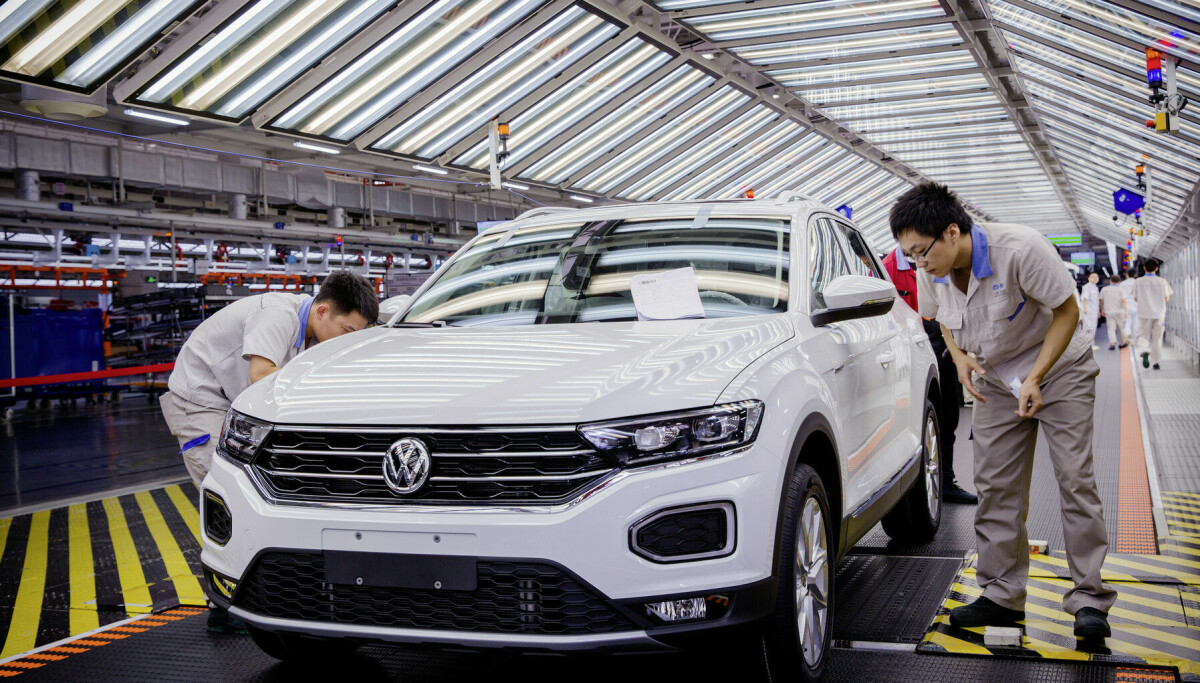
Volkswagen, which has a long-established presence in China with a number of joint venture factories and does not need any more production capacity, is developing a China-specific platform
Changing investment patterns in China’s vehicle factories
Meanwhile, legacy companies are mostly focused on refinement
and optimisation of their Chinese operations rather than all-new investment and
expansion. For example, Volkswagen, which has a long-established presence in
China with a number of joint venture factories and does not need any more
production capacity, is developing a China-specific platform (China Main
Platform [CMP]) for electric vehicles and the locally developed China
Electronic Architecture (CEA) for software-defined vehicles. China is also where
Volkswagen is developing range-extender powertrains (and these will likely be
added in Europe in due course), and the group is also launching a new
China-specific AUDI brand. To differentiate from the established Audi brand,
the new brand does not include the famous four-ring logo but instead features a
capitalised AUDI in its place as a means of developing a China-specific brand.
Toyota is also refining its China strategy, first through
its adoption of “China Speed” as discussed in the next section, and through
selective partnerships outside the vehicle companies themselves. For example, in
the case of fuel cells, a market-technology which is still nascent, Toyota has
decided to continue its development here in China rather than at home in Japan.
Recognising that this is an area in which the Chinese are some way ahead of the
rest of the world, Toyota announced in July 2025 that it would invest (an
admittedly modest) US$139m in a joint venture with Shudao Investment Group in a
fuel cell manufacturing plant in Chengdu, in Sichuan province. This will be
primarily for heavy duty vehicles, and the production facility will produce
fuel cell systems and stacks, using locally produced hydrogen gas, which
essential to produce green electricity. This new JV will be the third hydrogen
technology JV which Toyota has developed in China.
China Speed – how China is impacting global product
development practice
Increasingly European and Japanese vehicle companies refer
to “China Speed” when describing to how they plan to improve their product
development process. These companies have recognised that Chinese vehicle
companies have been able to develop and launch vehicles much more quickly than
the so-called legacy companies and this has given the Chinese a clear
competitive advantage.
Toyota specifically reference the “advanced and mature” supply chain, logistics and workforce in the area, adding that all of this will enable it to develop Lexus products at “China Speed”
International companies’ responses involve changes to their
operations in China and at home. Toyota, for example, has announced a new wholly
owned subsidiary in Shanghai, which will make electric cars and batteries for
its Lexus brand. This is the first case of Toyota operating in China without a
local partner. The new factory will see US$2 billion invested and it will open
in the Shanghai area in 2027 with an initial capacity of 100,000 units a year,
employing 1,000 to start with, but with the expectation that as production
rises (one report suggests that production could reach 500,000 in due course),
so will employment. Announcing this, Toyota specifically reference the
“advanced and mature” supply chain, logistics and workforce in the area, adding
that all of this will enable it to develop Lexus products at “China Speed”, i.e.
much faster than a similar model would take in Japan. Two years from
announcement to production start-up would be unheard of in Japen, at least
until now.
In the US, Europe and Japan, new products have typically
taken five years to bring to fruition, yet the Chinese, led by BYD, have
managed to do this in as little as 18 months. Toyota recognises it needs to
accelerate its own product development process and to do so first in China, and
spread the learning outwards from there, is clearly logical and sensible. There
is a view that the likes of BYD adopt a “good enough” approach when moving
through automotive gateways, rather than seeking to perfect the vehicle at each
stage of development.
Advertisement
Vertically integrated EV plants and smart component sharing
The idea of China Speed is also applied when Chinese
vehicles are being ‘Europeanised’. For example, the Omoda 5 SUV, from Chery,
was initially deemed unsuitable for Europe by local dealers, so the Chinese
company turned around a revised version with modified steering, suspension,
brakes and traction control deemed to European drivers’ expectations. Meanwhile
Zeekr, the new Geely brand, uses AI to search for potential components in the
Geely group’s 20 years of design and development rather than developing cars
with all-new parts. BYD does much of this and is also more vertically
integrated that European and US manufacturers especially, producing as much as
75% of its components in-house. International vehicle makers have spent a great
of time and effort de-verticalising, selling off component operations to
independent companies. It might well be that, especially in view of the chip
shortage affecting the industry, European and Japanese vehicles companies will
consider reversing this policy.
“China Speed” has reportedly been a driving force at
Volkswagen in recent times, with the European ID Polo and ID Cross models having
been developed in 36 months; not as quick as the Chinese but a vast improvement
nonetheless on traditional development times at Volkswagen. This approach has
been applied to the ID Every1 which will be produced in Portugal in 2027, with
the development of this programme also taking 36 months. In China itself,
Volkswagen has said it will launch more than 30 models in China, for China, by
the end of 2027, with aim of developing these vehicles inside 34 months each,
if not less. Many of these will be all-electric. Concept vehicles, ID Code, ID
AURA (developed with FAW), ID ERA (development with SAIC and expected to be the
first VW EREV hybrid vehicle) and ID EVO (developed by Volkswagen Anhui), have
all been shown at recent motor shows.
The idea of “China Speed” is spreading widely, and not just
at the vehicle companies. Marelli, the Italian-Japanese supplier, has said that
it too will bring new products to market at “China Speed”. In this case,
Marelli plans to cut new product lead times from three years just one year. It
showed several new products at the Shanghai motor show in April and claimed
that it has developed 30 products in this way, including pixel rear lamps and a
micro laser projector, which it co-developed with Infineon. This can project
images on the windshield, console, dashboard and other interior surfaces. For
all its claimed success here, as of April this year, none of these products
have been adopted on a production vehicle but this is likely to be only a
matter of time.
Advertisement