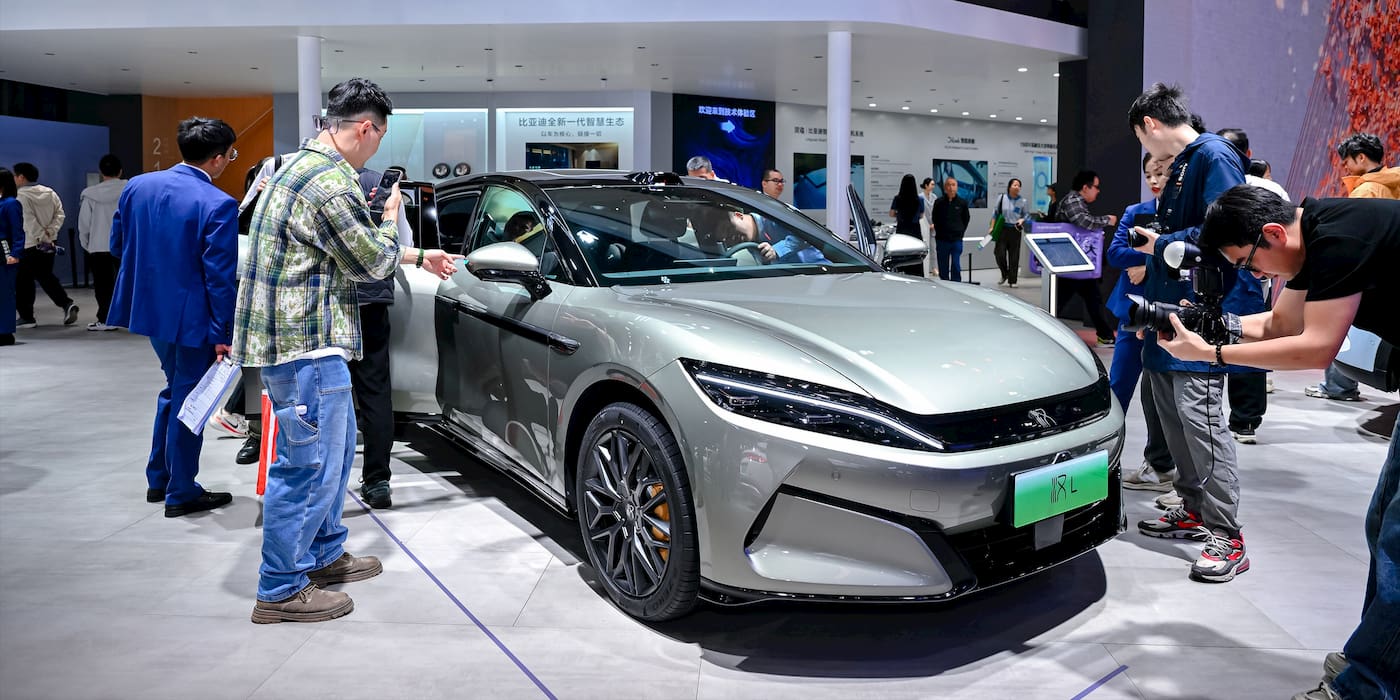
BYD will hold a press conference on March 5 unveiling several new versions of its technologies, including new batteries, ADAS software, and a 1,500kW charger that has already been spotted in the wild.
The charger was spotted by Autohome, which also reported the upcoming press conference and some information on BYD’s announcements. You can see photos of the charger on their post.
The photos show a charging station with overhead cables, hanging from a T-shaped structure. The intent is to allow cables to reach further so that various types of vehicles can be accommodated, but also stop the cables from being dropped on the ground, where they can be run over, get dirty or otherwise damaged.
More interestingly, the label on the charging unit describes how much power its capable of pushing – and it’s quite a lot. The label was covered up, but whoever took the photos pulled away the cover to get a shot of what was underneath.
It shows that this is a unit manufactured by BYD in January 2026, capable of 1000V and 1500A. Multiply those out, and you get 1,500kW – a power level that’s unheard of outside of heavy duty applications.
BYD previously showed off a 1,000kW charger, so this would be another 50% faster if this report is correct. And another leak earlier this month suggested that a 2,100kW charger is in the works.
At this rate, an EV could add 2km (1.2 miles) of range per second, according to “technical reports” cited by CarNewsChina (which suggest a peak output of 1,360kW). Or in other words, around 400km (248mi) in 5 minutes (accounting for slowdown as a battery fills up).
But it could be that these stations are splitting power between multiple charging heads, so we can’t be certain yet whether each individual plug will be able to access the full 1,500 or 2,100kW.
Of course, cars will have to be able to take that much power in order to charge that fast, but the fact that chargers now exist that can charge that quickly means that cars will be able to max out their charging speed, and will push automakers to offer faster charging vehicles.
And even if you don’t need 5 minute charging (which, frankly, I usually don’t – if I’m stopping for a meal, a 20-30 minute charge is perfectly fine), this can help increase throughput at chargers, especially in urban areas where people may be using this as their main method of filling up, instead of being able to charge overnight at home.
BYD’s March 5h press conference will reportedly also include a second-generation BYD blade battery with much higher density and charge/discharge rates. There will be two versions of the battery – one with higher energy density (~210Wh/kg) and up to 3C charging rate, and one with less-high density of 160Wh/kg and much faster 8C charging. Both are higher density than BYD’s first-gen blade battery, and supposedly will last 3,000 charge cycles. It will also announce upgrades to its “God’s Eye” driver assist software.
Electrek’s Take
I’ve long said that deploying ubiquitous charging is more important than range. You rarely need an enormous battery, and this just adds more weight, cost, complexity, supply chain difficulty, and so on to a car for the one time a year you’ll ever really have to drain the battery down to the bottom.
Better to have ubiquitous overnight charging where people park their cars for long periods, and fast charging for the rarer times you might need it.
Some have said that EVs are useless to them “until they can fill up as fast as gas cars,” but this ignores the fact that most EVs charged overnight already do fill up faster than a gas car – because you plug it in and then head inside and forget about it. You haven’t actually spent more than a few seconds actively charging, just as is the case with your phone, which charges overnight when you’re not thinking about it.
And yet, here we are – an EV charger that fills up as fast as a gas car. What’s the next excuse in line?
Charge your electric vehicle at home using rooftop solar panels. Find a reliable and competitively priced solar installer near you on EnergySage, for free. They have pre-vetted installers competing for your business, ensuring high-quality solutions and 20-30% savings. It’s free, with no sales calls until you choose an installer. Compare personalized solar quotes online and receive guidance from unbiased Energy Advisers. Get started here. – ad*