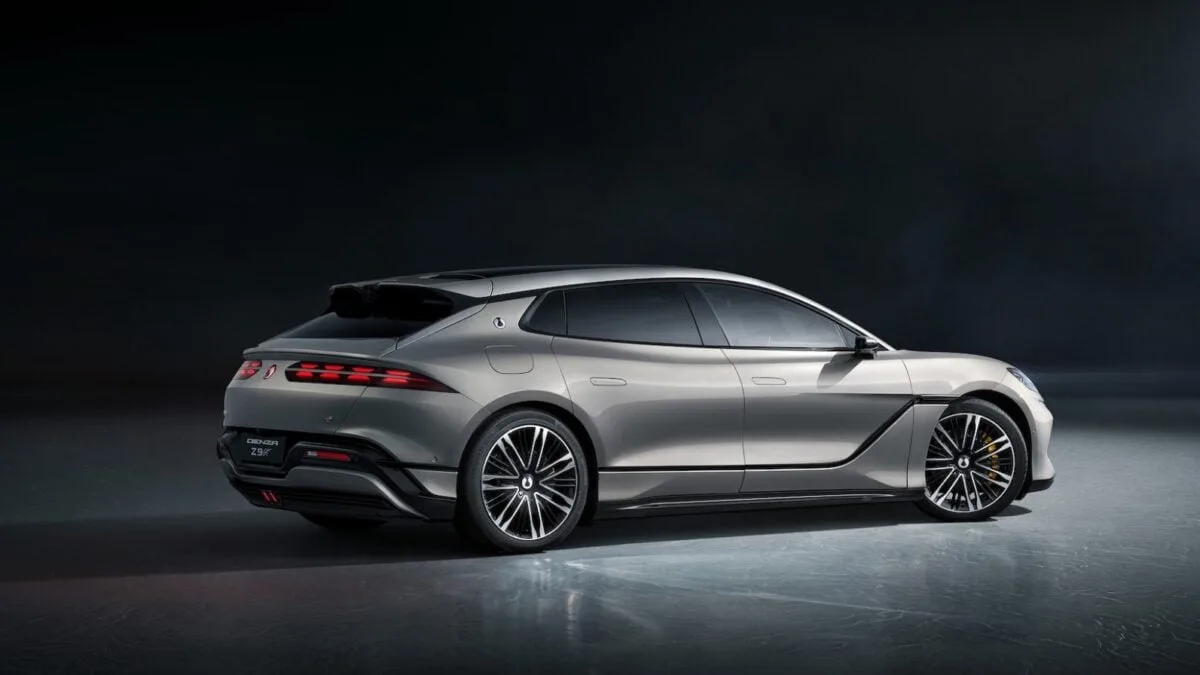

BYD’s luxury brand, Denza, previewed what it calls “the world’s longest pure electric driving range vehicle” this weekend, as U.S. automakers fall further behind in the global EV race.
In posts on Chinese social media, Denza said the new Z9 GT can travel up to 1,036 km (644 miles) on a single charge under China’s CLTC testing standard. That’s roughly a 64% increase over the current Z9 GT, which can reach up to 630 km (391 miles).
The long-range Z9 GT is set to debut on March 5 at a BYD event, Electrek reports. And that might not even be the ceiling for too long. According to Electrek, a regulatory filing last month revealed that an upcoming standard Z9 sedan could offer an even higher range of up to 1,068 km (664 miles).
So how do American EVs stack up? Tesla’s Model S is rated for up to 405 miles based on EPA estimates. Chevrolet’s Silverado EV can reach 478 miles. And the Lucid Air Grand Touring tops out at 512 miles.
While the price of the new Denza Z9 GT hasn’t been announced, the current model starts at 354,800 yuan (about $51,500), tens of thousands of dollars less than comparable American EVs, which all start at least $90,000.
This is just the latest example of American automakers losing ground in the EV race. Now, the U.S. industry faces a major dilemma. They can either invest more in electric vehicles that many Americans still aren’t fully embracing, or risk falling even further behind China. The problem has only further increased after President Donald Trump cancelled federal EV subsidies.
Ford CEO Jim Farley said last year that the rollback of these subsidies could cut demand for EVs in half. In response, several automakers in the U.S. have delayed or cancelled their previous EV plans and are quietly shifting that money back into internal combustion vehicles. Ford itself said late last year that it was cancelling its production of an all-electric version of its iconic F-150 pickup truck and scrapped plans for a new electric van, shifting its focus to more affordable and hybrid options.
It doesn’t help that it seems most Americans are not yet interested in EVs. A survey by Deloitte found that only 7% of Americans want their next car to be electric. Respondents said that their top concerns with EVs were driving range, charging time, and premium prices.
Sales of EVs in the U.S. already dropped last year. Tesla, which dominates the U.S. market, reported that deliveries for 2025 fell 9% to 1,636,129 vehicles. Meanwhile, BYD overtook Tesla as the world’s largest EV seller, delivering 2.26 million electric vehicles in 2025, up 28% from 2024.
While the U.S. has kept Chinese EVs largely out of its market with a 100% tariff, they are set to start making their way into North America soon. Canada recently announced a new strategic partnership with China, partly in response to aggressive trade policies from Washington. The deal would allow up to 49,000 Chinese-made EVs into the Canadian market.
If things stay the same, the U.S. auto industry could see itself ceding even more ground to China in the coming decades.
“It’s not impossible that in 10 years we wake up and see that we actually don’t have a domestic industry in the sense of something that does significant research and development,” Susan Helper, a professor at Case Western Reserve University and former chief economist at the Commerce Department under President Barack Obama, told The New York Times.
![BYD pulls the cover off its stunning flagship electric SUV for the first time [Images]](https://automundochina.com/wp-content/uploads/2026/03/byd-pulls-the-cover-off-its-stunning-flagship-electric-suv-for-the-first-time-images-238x178.webp "BYD pulls the cover off its stunning flagship electric SUV for the first time [Images]")


![BYD pulls the cover off its stunning flagship electric SUV for the first time [Images]](https://automundochina.com/wp-content/uploads/2026/03/byd-pulls-the-cover-off-its-stunning-flagship-electric-suv-for-the-first-time-images-100x75.webp "BYD pulls the cover off its stunning flagship electric SUV for the first time [Images]")