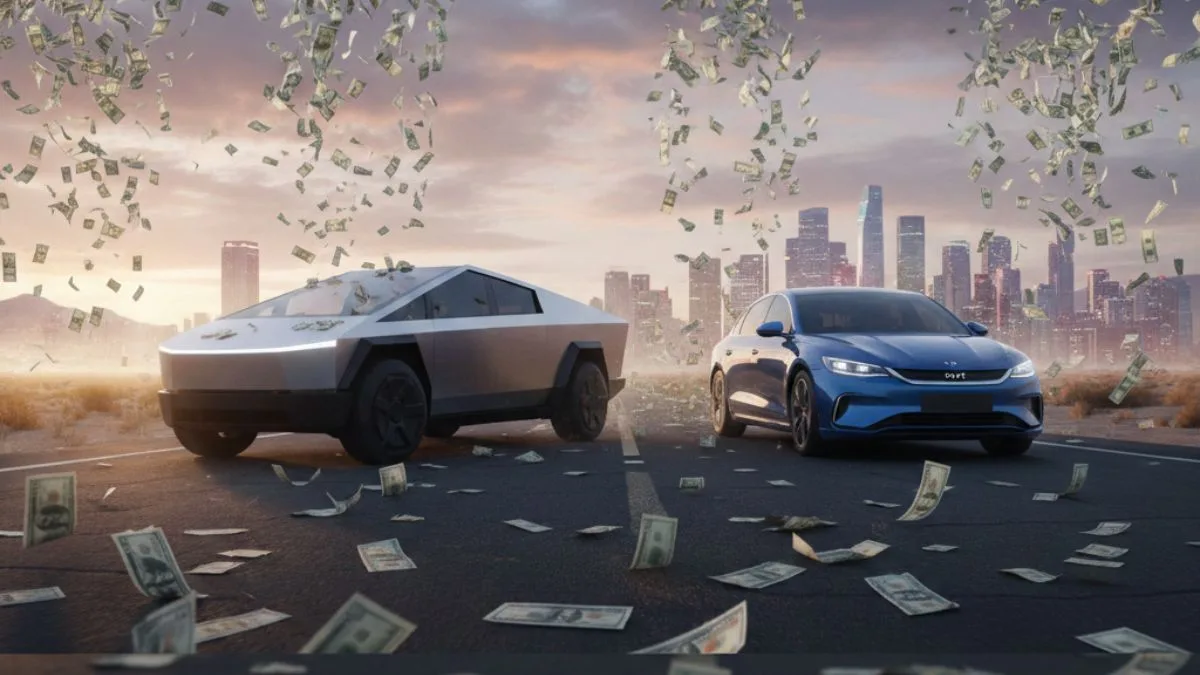

For the first time in history, China’s BYD has dethroned Tesla as the world’s top electric vehicle (EV) manufacturer. After two consecutive years of declining sales, Tesla has officially been surpassed in both annual production and global deliveries, marking a major turning point in the fast-evolving EV industry.
ALSO READ. Elon Musk’s net worth: Tesla approves $1 trillion payout to keep him as CEO
How many EVs did BYD and Tesla sell in 2025?
The numbers speak for themselves: BYD produced 4.3 million vehicles in 2024, up from 3.02 million the previous year. In contrast, Tesla delivered only 1.64 million vehicles in 2025, a significant drop from 1.79 million in 2024. That’s a year-over-year decline of 8.6% for Tesla.
In Q4 2025 alone, Tesla’s deliveries plunged to 418,227 units, down 15.6% from 495,570 in Q4 2024. Market analysts had expected 434,487 deliveries, but Tesla fell short of that projection as well, according to Visible Alpha.
Meanwhile, BYD has benefited from rapid international growth, especially in Europe, where it is steadily gaining ground and outpacing Tesla.
Why did Tesla’s sales decline in 2025?
One of the major setbacks for Tesla came from the end of the $7,500 federal EV tax credit in the U.S., a decision made by the administration of President Donald Trump in September 2025. This policy change created a sharp drop in demand from American consumers and weighed heavily on Tesla’s core market.
Data from J.D. Power shows that EVs made up just 6.2% of U.S. retail vehicle sales in Q4, down from 9.8% a year earlier. Adding to the challenge, the average transaction price rose by nearly $6,000, hitting $53,300 USD, further discouraging buyers.
What explains BYD’s rapid growth?
BYD’s success is no accident. The company is executing a robust global expansion strategy, with overseas sales reaching 1 million vehicles in 2025, a 150% increase from 2024. BYD has also announced its intention to sell up to 1.6 million vehicles outside of China in 2026, reinforcing its ambition to dominate the international EV market.
Unlike Tesla, which is facing stagnation and rising competition in Europe and North America, BYD is capitalizing on its cost-effective manufacturing and competitive pricing to win over new markets.
Who has more employees and production capacity?
BYD’s operational scale far exceeds Tesla’s. In 2024, BYD employed 968,900 workers worldwide, compared to Tesla’s 125,700. This workforce supports its massive production capabilities: BYD manufactured 4.3 million vehicles, while Tesla managed only 1.8 million.
Does Tesla still lead in brand value and market capitalization?
Yes—Tesla remains the leader in brand power and stock market value. According to the BrandZ 2025 rankings, Tesla’s brand was valued at $86.04 billion USD, while BYD’s brand valuation was not available. However, BYD received a Brand Power Score of 552, indicating strong brand perception in emerging markets.
On the financial side, Tesla’s market capitalization reached $1.46 trillion USD by Q3 2025, recovering from $789.9 billion in 2023. BYD’s recent market cap was not disclosed, but it remains significantly below Tesla’s.
Which company earned more in 2024?
Despite being outperformed in sales and production, Tesla still leads in profitability. In 2024, Tesla posted a net profit of $12.56 billion USD, more than double BYD’s $5.82 billion.
That said, when comparing total revenue, BYD actually edged ahead: it reported €99.8 billion EUR (approximately $107 billion USD), compared to Tesla’s $97.7 billion USD.
Is Tesla shifting away from the car business?
Tesla’s leadership has hinted at a strategic pivot away from the car business, focusing instead on emerging technologies like robotaxis and humanoid robots. This transition could explain its slower growth in the automotive segment.
In October 2025, Tesla introduced budget-friendly “Standard” versions of the Model Y and Model 3, priced $5,000 below the base models. The move was aimed at defending its sales figures after the loss of the U.S. tax incentive and to compete with low-cost rivals like BYD in Europe.
What does this shift mean for the global EV market?
Tesla’s dominance is no longer guaranteed. The emergence of BYD as a global EV leader signals a broader shift in the industry, one driven by Chinese innovation, international expansion, and affordability.
While Tesla still commands investor confidence and brand prestige, its weakening hold on global EV volume sales raises red flags—especially if BYD continues its aggressive push into Western markets.
Information from Reuters and Statista⇒ SUBSCRIBE TO OUR CONTENT ON GOOGLE NEWS