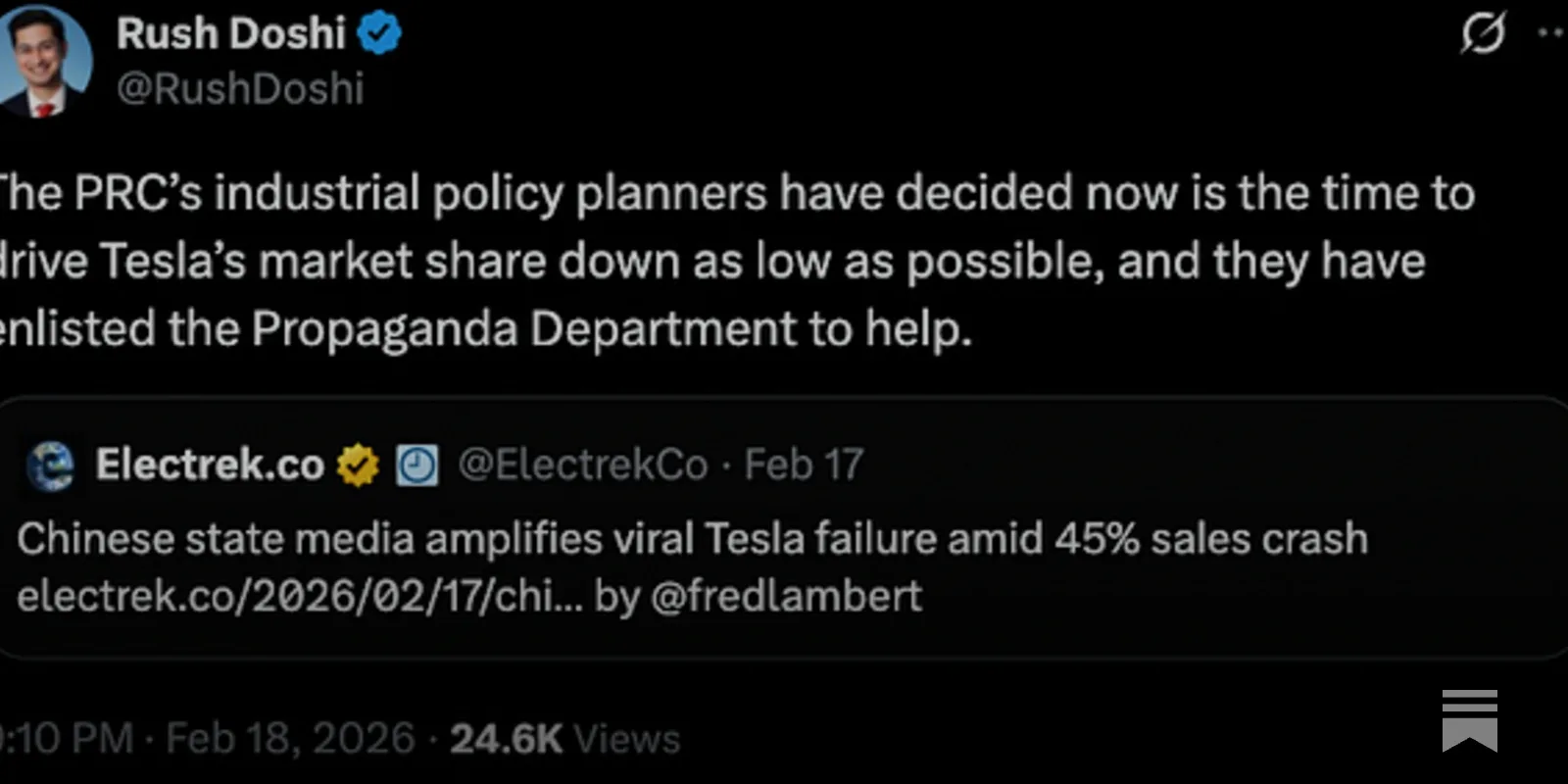
This piece was triggered by two quote-retweets this week—one by Rush Doshi, former Deputy Senior Director for China and Taiwan at the U.S. National Security Council (2021–2024), and the other by Noah Smith, an influential commentator.
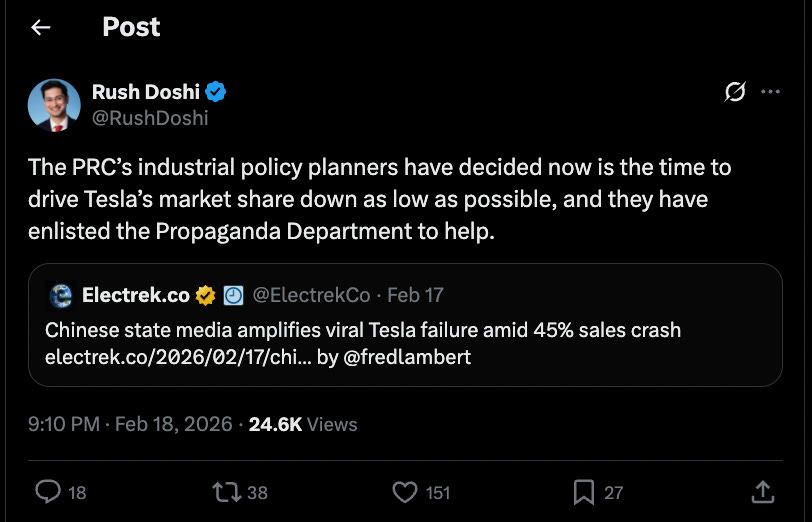
“The PRC’s industrial policy planners have decided now is the time to drive Tesla’s market share down as low as possible, and they have enlisted the Propaganda Department to help.”
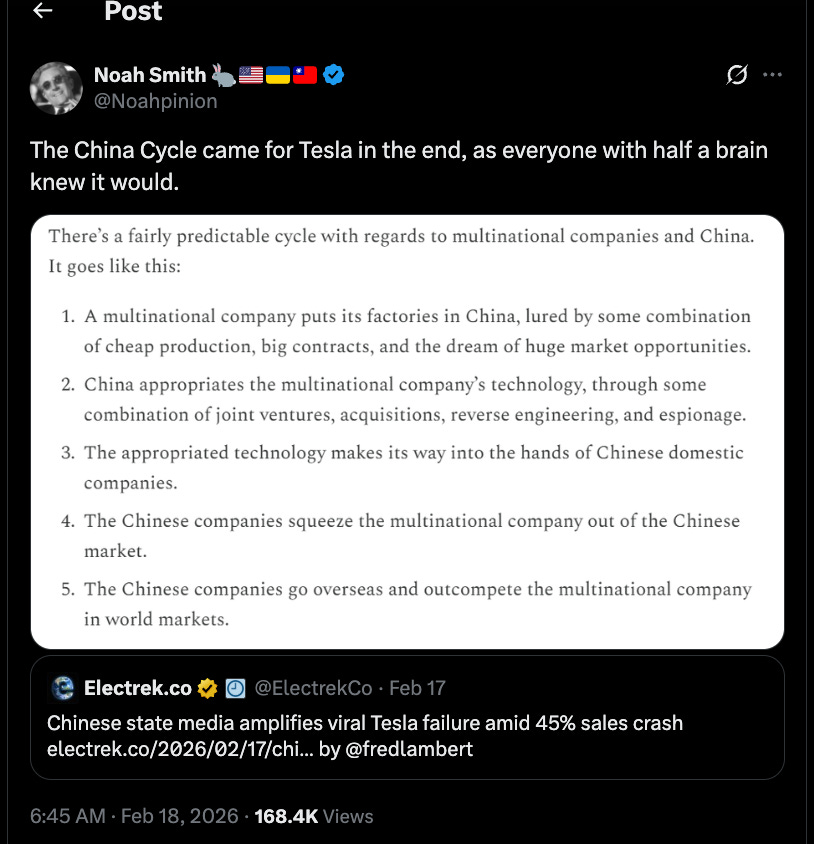
Both were reacting to a story from Electrek, one of the most popular electric car news sites, headlined, “Chinese state media amplifies viral Tesla failure amid 45% sales crash.”
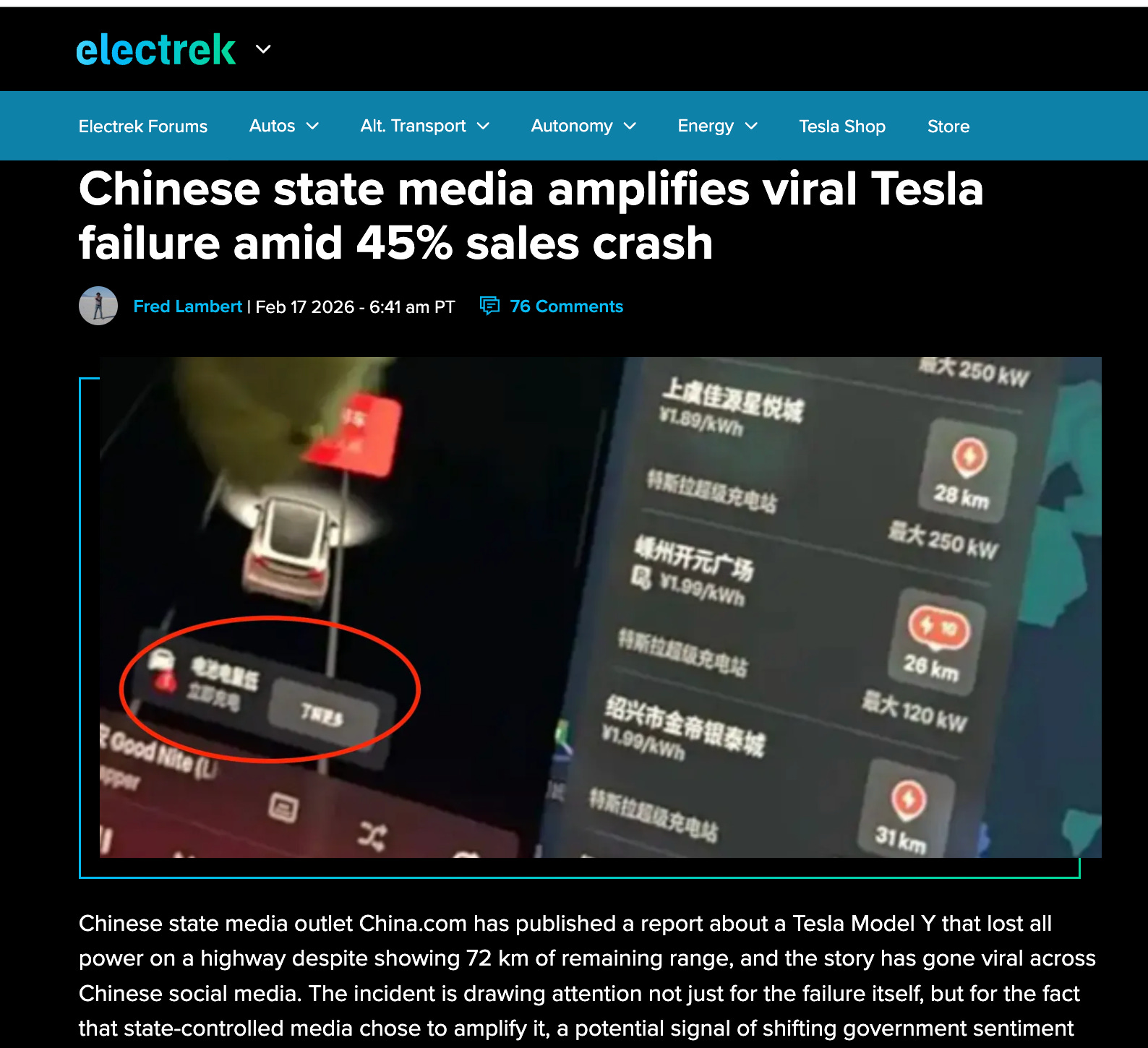
The article points to a brief China.com post about a Tesla Model Y that allegedly lost power on a highway despite showing roughly 72 km of remaining range. The Electrek argument is not really about the malfunction itself; it’s about what the author presents as a political signal—“state-controlled media” choosing to amplify a Tesla failure story, supposedly suggesting shifting government sentiment toward Tesla.
The key claim—the one doing almost all of the work—is Electrek’s assertion that the Chinese report was published by China.com, “which operates under China’s State Council Information Office.”
That attribution is incorrect. And once it falls apart, the “tea-leaf reading” needs to be rebuilt from the ground up.
China.com is not China.com.cn. The latter outlet, also known in English as China.org.cn, describes itself as being led by the State Council Information Office. China.com is a different domain and entity with no publicly known affiliation to the Chinese government’s press office.
There is also a quick, low-drama way to sanity-check claims like this. China’s internet regulator, the Cyberspace Administration of China (CAC), maintains an official list of “central key news websites”. China.com.cn is on that list. China.com is not.
By now, this case against the popular EV news site and two influential voices has already been made. But I want to dig a bit further, read on.
The second problem: the China.com page in question is not even China.com’s reporting.
Click through the China.com story that Electrek cites, and you’ll see the original source labeled: Sina. In other words, the China.com page is explicitly presenting itself as a repost.
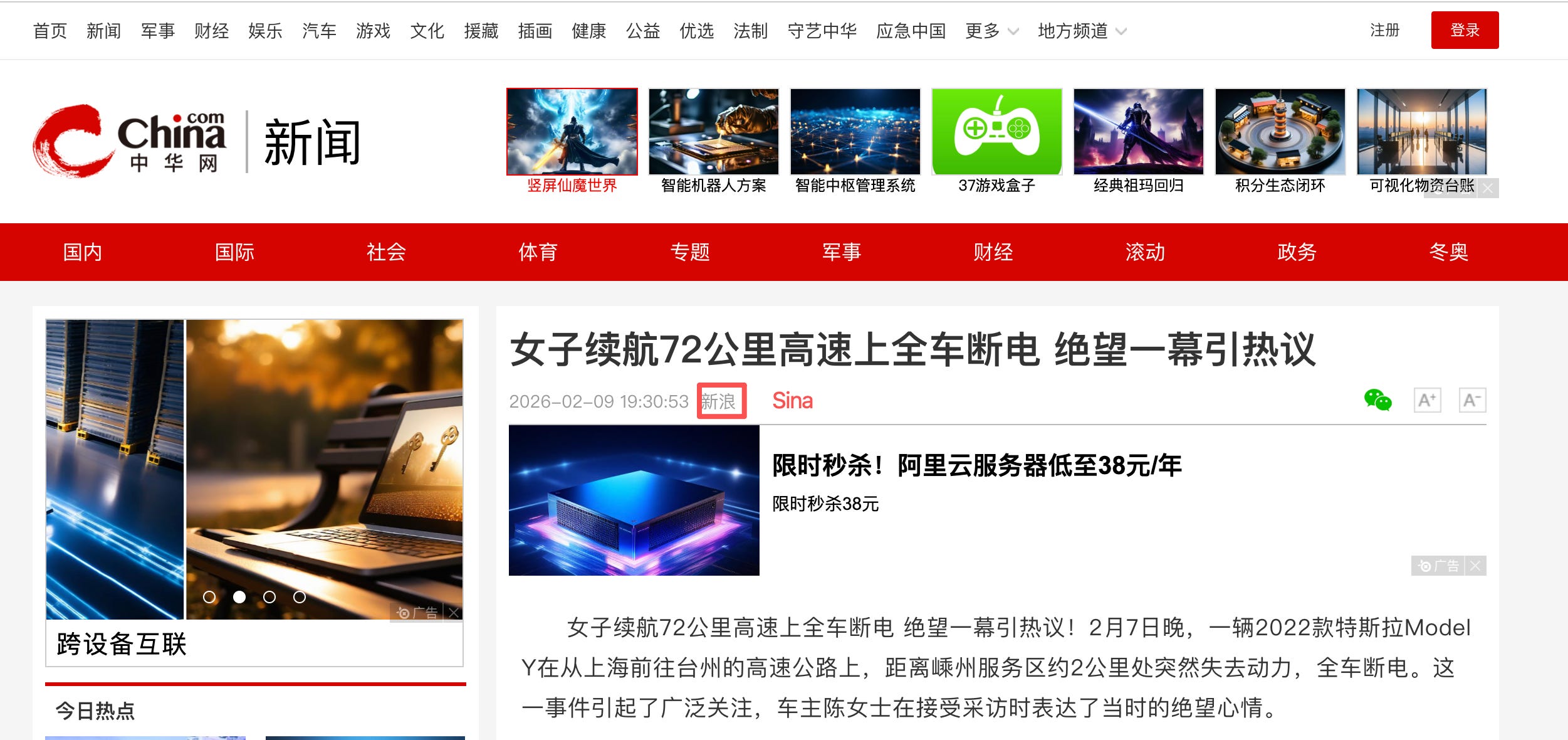
In other words, it is a repost from content on Sina, one of China’s biggest “internet portals.” For many years, until internet-connected smartphones gained traction in the early 2010s, the dominant gateways for Internet users in China were commercial, non-state-run portals—Sina, Sohu, and NetEase—where aggregation was the core product and third-party content was the norm.
But the China.com webpage doesn’t include a link. So, after some keyword search, I quickly landed on a plausible Sina webpage, which says its source is New Yellow River.
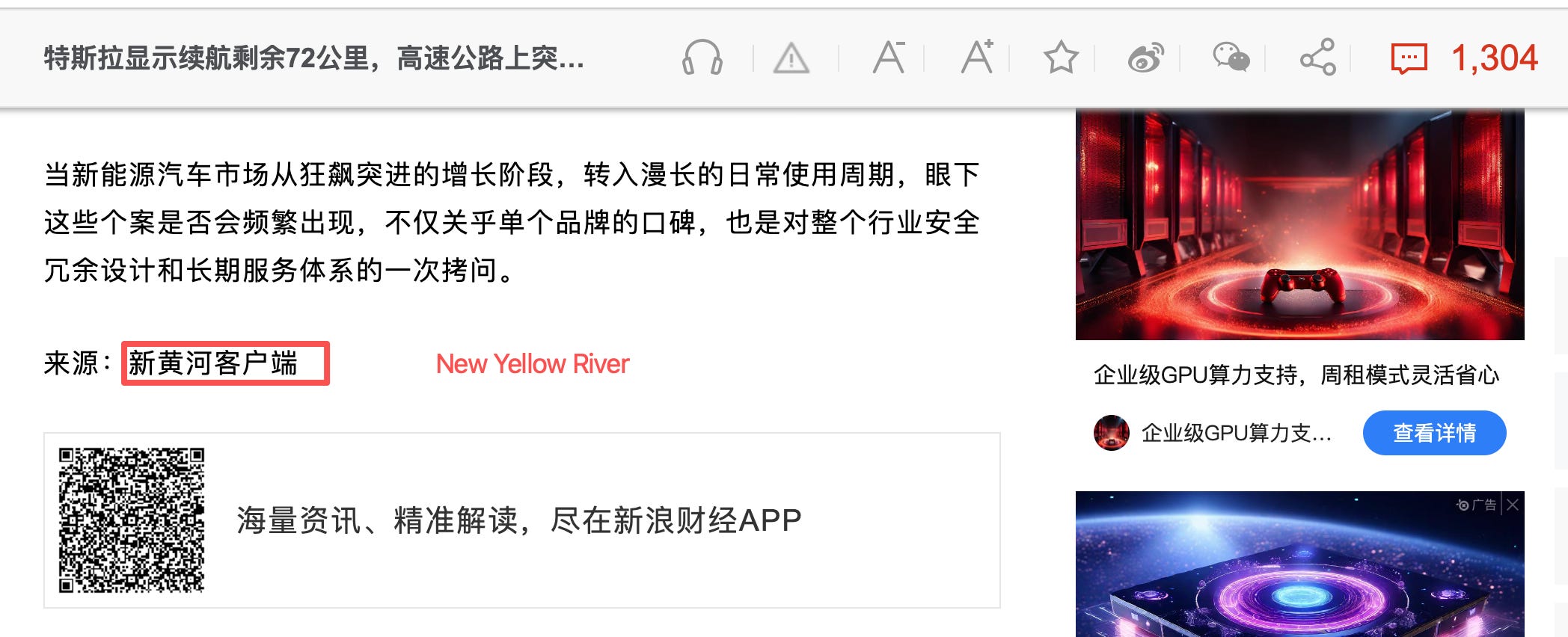
This is exactly the kind of detail that gets lost when everything is flattened into “Chinese state media.” What looks from the outside like an intentional, centrally directed editorial push can, in reality, be a story moving through multiple distribution surfaces—each adding a thin layer of repackaging.
The New Yellow River, for what it’s worth, is indeed a state-run local outlet within a party-led press group system – Jinan Daily Press Group in Jinan, the Communist Party newspaper of the capital of eastern Shandong Province. But that is not the same thing as a central “Beijing signal,” still less a central government-directed propaganda action aimed at Tesla.
In a way similar to the Southern Weekly of a bygone era, New Yello River reads differently in today’s Chinese media ecosystem. As one of a small number of state-run media outlets that have caught public attention in the past several years, New Yellow River was probably the only Chinese institutional media outlet to speak up for Liu Hu, a prominent journalist briefly detained by police – and subsequently released – earlier this month.
Its New Year message for 2025 opened with a line that roughly translates as: “Do not shy away from hardship; do not give up resilience.” It went on—unusually, by current standards—to describe the prevailing social mood as “hardship,” and to write sympathetically about anxiety, exhaustion, and the everyday strain of ordinary life.
Anyone who follows Chinese media closely will recognize why that tone stood out.
Electrek tries to reinforce its “political winds” argument by citing an Associated Press investigation last year that found Tesla has aggressively sued critics in China and has won a strikingly high share of civil disputes—alongside a broader chilling effect on negative coverage.
Tesla has profited from the largesse of the Chinese state, winning unprecedented regulatory benefits, below-market rate loans and large tax breaks. With a few pointed exceptions, Tesla has enjoyed ingratiating coverage in the Chinese press, and journalists told AP they have been instructed to avoid negative coverage of the automaker.
Tesla’s windfall has extended to the courts — and not just in legal actions Tesla has brought against customers. In a review of public court documents, AP found that Tesla won nearly 90% of civil cases over safety, quality or contract disputes brought by customers.
If you apply that same context to the New Yellow River report, a different reading becomes at least as plausible. That is, a local newsroom, with a record of actually practicing journalism, just doing its job on a corporate bully within the space it believes it can still occupy.
It is easy—even for very sophisticated observers—to take a clean, secondary foreign narrative at face value when it seems to “fit” a broader model of how China works. But China-watching rewards an unglamorous habit: verify the institution; verify the attribution; then interpret. In this case, the basics don’t hold—and the interpretation should change accordingly.
One last thought. If “industrial policy” is the lens, it’s worth applying that lens consistently. When AP last year extensively documented the extent of Tesla’s preferential treatment—regulatory benefits, financing advantages, tax breaks, and a media-and-courts environment in which Elon Musk’s U.S. company repeatedly prevailed—there was far less rush, at least in mainstream commentary, to frame that as a Chinese industrial policy.