Support CleanTechnica’s work through a Substack subscription or on Stripe.
Argentina has been the Latin American EV laggard for as long as I’ve been following the regional transition: it was the last country to surpass 0.1% market share, then one of the last to get to 1%. It also had almost zero presence from the region’s most popular brands, with nearly all EVs being either compliance cars from Legacy Auto or from local EV champion Tito Corradir. And a quick review of Argentinian social media provides evidence of significant skepticism regarding the transition to EVs as a reliable means to replace ICEVs. With a sizeable market of around half a million yearly units, having Argentina so firmly in the ICEV grip was disappointing to say the least.
Alas, it seems we’re witnessing the end of an era.
Argentina’s EV adoption is rapidly ramping up, with BEV sales in the first two months of 2026 (1,086) almost at the level of the entire year 2025 (1,269), and with PHEVs more than doubling BEV sales, total EV market share has risen to 3.6% so far this year, up from less than 0.5% a year ago and less than 0.1% just a couple years ago.
And it doesn’t end there. Argentina’s BYD headquarters has just placed a massive order with Brazil’s Camaçari plant for the year 2027: if fulfilled, BYD alone will account for almost 10% of Argentina’s vehicle market next year.
Let’s check it out.
BYD’s Announcement
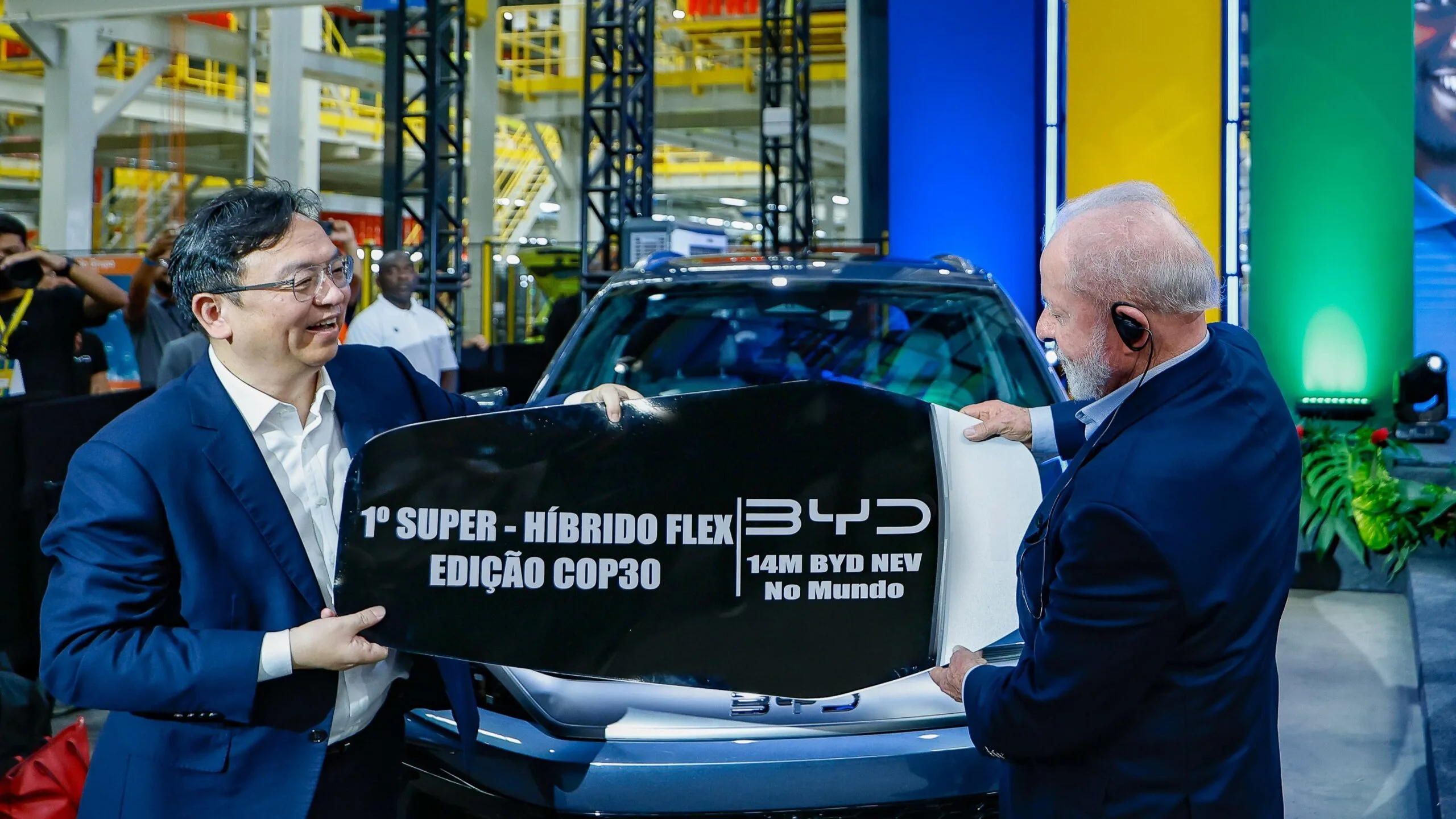
The announcement was made by Stella Li, president of BYD Americas, in Rio de Janeiro. She claimed that amidst high demand and high tariffs for Chinese-made EVs, BYD Brazil had received a massive 100,000 vehicle order, half from Mexico, half from Argentina. In the case of Mexico, this is a direct response to the tariffs that the country just imposed on Chinese-made vehicles in 2026, and lack of production within the country.
And in the case of Argentina, it seems this was a result of high growth expectations. The country has a tariff waiver for up to 50,000 imported hybrid and electric vehicles each year, but with HEVs gaining rapid ground, it would be expected that not many BEVs could get in the cut, whereas Brazil as a fellow Mercosur country can export as many vehicles as it wants into Argentina.
BYD’s plant in Camaçari was originally planned for a capacity of 150,000 yearly vehicles, and it was already close to capacity as 113,000 BYD vehicles were sold in 2025. Now, with another hundred thousand orders placed (and who knows how many more to come) and with rapid growth in the local market, the company is planning to increase production up to 600,000 yearly units.
Argentina’s Pivot
I did mention at some point that a lot of Argentina’s woes had to do with how insanely expensive EVs were in that market, and that this was a problem unlikely to be solved until the country started importing affordable EVs from Mercosur.
And it’s precisely this that we’re witnessing. BYD has led the charge, bringing the affordable Seagull (Dolphin Mini) from Brazil as well as the BYD Yuan Pro from China. The company is profiting massively from its first-mover advantage, as it now commands 80% of Argentina’s BEV market. Information on PHEV sales per model/brand is not available yet.
This brings home a principle many writers here at CleanTechnica have been repeating over and over: bring affordable, compelling EVs and mass adoption will follow. Argentina is now following a path laid by many others before, and since it does not rely on subsidies or any other type of direct government support, there’s little risk for the transition going sideways because of government changes or lack of public funds.
But I digress. This massive order, which if fulfilled will represent a tenth of Argentina’s vehicle market in 2027, was placed two weeks after the USA’s and Israel’s joint attack on Iran, perhaps as a direct response to what was perceived back then as the harbinger of an energy crisis that may pretty well shock the world’s economy to its core.
A Brave New World
We’re seeing the future being built in front of our eyes.
Brazil’s role in the regional transition is becoming increasingly clear as BYD turns its Camaçari plant into a regional hub and many other Chinese players aim to get a foothold and start local production. BYD is now producing the Dolphin Mini, King, and Song models, and will soon start producing the affordable Atto 2 (a PHEV version of the Yuan Up/Pro), which will probably prove a success in PHEV-heavy markets such as Argentina, Brazil, and Mexico.

And speaking about Mexico, it’s clear now that its closeness to the US has severely harmed it, as Chinese brands have been hesitant to invest in local production and Legacy Auto has pivoted away from EVs as a result from Trump’s tariffs and anti-EV measures. Latin America’s largest and most competitive vehicle manufacturer is thus forced to rely on Brazil for its EVs, instead of becoming the local hub many of us expected it to be.
Argentina, meanwhile, is transitioning rapidly, and if current trends continue, it could rise several positions, perhaps even surpassing Chile in the foreseeable future. But herein lies the issue: with the mess we’re seeing in the world right now, current trends are very unlikely to continue … and this will probably be in favor of EV adoption.
We’re now a month into the US’s latest imperial adventure in Iran, and things have pretty much gone as badly as they could’ve. Hormuz is blocked, Bab al-Mandab (the Red Sea strait) could soon follow, at least 10 million daily barrels of oil have evaporated from world markets, and the damage being done on LNG infrastructure could take years to repair. Oil prices have increased to over $100/barrel for WTI and $110 for Brent, but things could get much worse, as Jennifer Sensiba aptly points out.
This has resulted in higher fuel prices all over the world, and Latin America has been no exception, with fuel prices in Argentina already 30% above January’s levels. Naturally, more expensive gasoline has sparked further interest in electric vehicles at a time when local production is ramping up and competitive EVs are (finally) available, meaning there’s a far more fertile ground for EV growth than there was the last time oil presented persistently high prices for more than a couple months, back in 2022. If there’s a silver lining to the horrible tragedy happening right now all through the Middle East and all of its severe ramifications (of which the lack of fertilizer is perhaps the most worrying one), it’s this one.
Hopes for a quick resolution of this conflict are now over, and even if Trump somehow manages to de-escalate to a level where the bombings stop and Hormuz is reopened (which I doubt), disruptions will stay with us for a while, and it will compound the longer the war keeps on.
In this Brave New World, countries capable of locally generating their own energy independently for world markets are posed to benefit the most. Big oil or gas reserves can prove helpful to avoid financial crisis, but they won’t protect countries from spiking inflation, whereas solar, wind, hydro, and even nuclear will. Those capable of managing their own energy and locally sourcing their own electro-fuel will prove more resilient and better prepared to weather the consequences of the imminent Global Energy Crisis.
And, hopefully, it seems Argentina is pivoting to become one of these, at least as far as e-mobility goes.
Sign up for CleanTechnica’s Weekly Substack for Zach and Scott’s in-depth analyses and high level summaries, sign up for our daily newsletter, and follow us on Google News!
Have a tip for CleanTechnica? Want to advertise? Want to suggest a guest for our CleanTech Talk podcast? Contact us here.
Sign up for our daily newsletter for 15 new cleantech stories a day. Or sign up for our weekly one on top stories of the week if daily is too frequent.
CleanTechnica uses affiliate links. See our policy here.
CleanTechnica’s Comment Policy