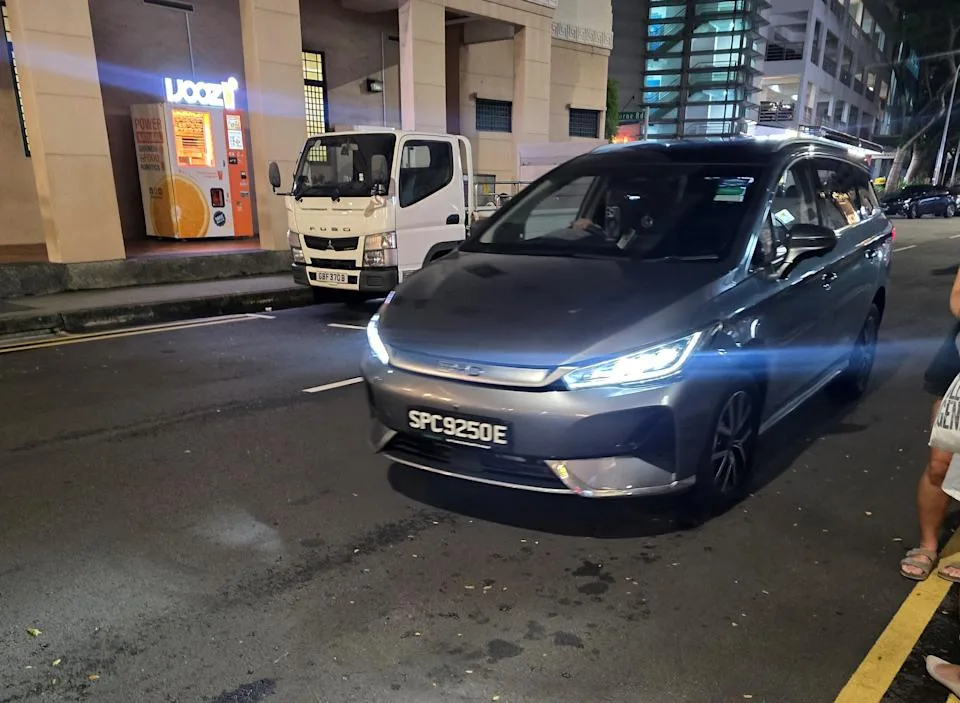
I had been waiting for my first ride in a BYD Co. taxi.
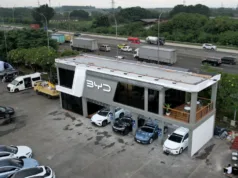
About a week into a recent trip to Singapore, I had ridden in several vehicles I was familiar with ― mostly Toyotas, and one purple Jaguar. But I’d seen BYD vehicles all over the city-state ― BYD delivery vans, taxis, personal cars and SUVs.
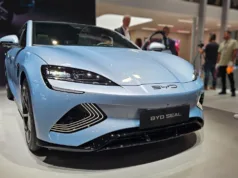
I can’t say BYD’s common presence was surprising. Leadership at Detroit automakers have warned for years that Chinese-made vehicles are a force to be reckoned with. And only a few weeks before my trip I had written about why BYD in particular has quickly grown to become the world’s largest electric-vehicle maker, outselling Tesla Inc. on a global scale in 2025.
Advertisement
BYD offers vehicles with advanced features like advanced driver assist systems and software integrations typically sold at much higher price points.
BYD’s vehicle sales in Europe have an average cost of what would be $45,083 in the United States, according to its website, though the company advertises compact electric models that start as low as $28,000. The top-selling BYD model globally is the BYD Song, which sold 788,003 vehicles last year, more than the Tesla Model Y, according to the website CleanTechnica.com.
The Chinese automaker sells its vehicles domestically at half the cost, with the average BYD vehicle going for $23,929 (U.S) in China.
I’d heard much about BYD’s quality and affordability from industry experts in the past year, but I hadn’t yet been inside an operating, street-legal Chinese vehicle.

Like riding in a computer
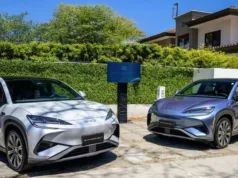
The interior of the small silver vehicle smelled nice, leather-like and soft to the touch. Singaporean roads are modeled after the English, so the driver’s seat was on the right. That meant the large screen showing our route was to his left, right above the company slogan “Build Your Dreams.” Much like my previous ride-hailing trips in Teslas, the vehicle’s silence and reliance on software made it feel closer to driving around in a computer than a car.
Advertisement
Advertisement
My driver smiled when I told him this was my first time riding in a Chinese vehicle.
“How do you like it?” he asked.
“It’s nice,” I replied. He chuckled and said, “That’s why Tesla isn’t doing so well here anymore.”
Most of my cab drivers provided mixed opinions on what drove the success of BYD, the fastest-growing new vehicle brand in Singapore. Some vocalized concerns that the vehicles may not meet the same crash safety standards as other foreign automakers. Much like the United States, the country lacks significant charging infrastructure, so electric cars remain something of an ownership gamble.
Advertisement
Advertisement
On the other hand, Singapore is far more strict when it comes to pedestrian and driver safety ― deploying advanced driver assist systems or fully autonomous vehicles without first undergoing rigorous evaluation is prohibited, one driver told me, meaning most every car is 100% driven by a human regardless of whatever hardware or software comes factory-standard.
The country plans to launch several AV initiatives this year, but only about 19 autonomous vehicles had been approved for public use in limited geofenced areas as of late last year in the country of roughly 6 million people, according to Channel News Asia.
Within minutes, I understood why BYD poses such a draw to the cash-conscious in the market. I liked it more than the Teslas I’d driven in before. Pared-down EVs feel, to me, about as sexy as dental equipment, but the BYD’s interior felt somehow less impersonal than other base models I had experienced. It was sleek, sure, but cozy, a distinction that could make all the difference in this unique market.

Vehicle cost of ownership is exorbitant in Singapore: The certificate of entitlement, obtaining a driver’s license, and vehicle maintenance and regulatory fees and import taxes can add about $100,000 Singapore dollars to any vehicle’s price tag. It makes even more sense here to trim ownership costs where you can, and a cheaper car with slightly more personality than the expensive American competitor is something of a no-brainer.
Advertisement
Advertisement
Just when I thought BYD was the only new player in town, the radio started playing an advertisement for another Chinese automaker, the Stellantis-backed Leapmotor, that emphasized the family-friendly design of a midsize electric SUV.
More: Here’s what it’s like riding in the Oscar Mayer Wienermobile
The ride was smooth, quiet and just … nice. I wasn’t blown away by the experience (I preferred the Jaguar) but still felt somewhat reluctant to exit the vehicle once we arrived at my hotel.
As I hopped out, my driver said he hoped I’d be able to ride in a BYD again sometime soon.
I found myself replying that I would like that, too.
Advertisement
Advertisement
USA TODAY autos reporter Keith Laing contributed to this report.
Jackie Charniga covers General Motors for the Free Press. Reach her at jcharniga@freepress.com.
This article originally appeared on Detroit Free Press: BYD taxi ride gave me a taste of why U.S. automakers feel threatened