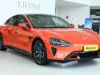
Volkswagen has begun series production of its first vehicle jointly developed with Chinese electric car manufacturer Xpeng. The ID.UNYX 08, a fully electric full-size SUV, has been rolling off the production line at the Volkswagen Anhui plant in Hefei since March 2026. For the German automotive group, this model is a crucial step to regain ground after massive losses in China.
Dramatic Collapse in China’s Auto Market
Volkswagen’s economic situation in China has deteriorated dramatically. The group reported a 44 percent profit decline year-over-year and announced the elimination of 50,000 jobs. Particularly painful: VW has slipped from market leader in China in 2023 to third place. Chinese competitors like BYD, now the best-selling brand in the country, and Geely have taken significant market share from the German traditional automaker.
The Xpeng partnership is Volkswagen’s response to this crisis. With locally developed technology and a development time of just 24 months, the ID.UNYX 08 is intended to demonstrate that VW can keep pace in the electric age.
The Strategic Partnership with Xpeng
In 2023, Volkswagen and Xpeng entered into a long-term strategic cooperation. The collaboration focuses on scalable product development and technological innovation, with both partners contributing their respective core competencies. Volkswagen invested in Xpeng and secured access to its advanced electric vehicle technologies and software expertise.
“Our partnership is based on mutual trust and close collaboration. This allows us to combine our respective strengths and create long-term value,” said He Xiaopeng, Chairman and CEO of Xpeng.
The cooperation has produced two fully electric models. Another jointly developed Volkswagen model is scheduled to make its market debut in 2026.
Technology and Development: “In China, for China”
The ID.UNYX 08 embodies Volkswagen’s new “In China, for China” strategy. The vehicle was developed by the Volkswagen China Tech Centre (VCTC) in Hefei, which was responsible for product design, technical validation, quality standards, and vehicle dynamics. The development utilized locally developed cutting-edge technologies:
- 800-Volt ultra-fast charging technology
- L2 Advanced Driver Assistance Systems (ADAS)
- Over-the-Air Updates (OTA) for continuous development
- Complete connectivity as Volkswagen’s first fully connected e-SUV
Together with CARIAD China and Xpeng, VCTC also developed the China Electronic Architecture (CEA), the Volkswagen Group’s first locally designed zonal electrical and electronic platform. This architecture is used in both electric vehicles and models with combustion engines.
Massive Electric Offensive Planned
The ID.UNYX 08 is just the beginning of an unprecedented product offensive. Volkswagen plans to launch more than 20 new electric vehicle models in China in 2026 alone. This means on average a new vehicle every two weeks, which Ralf Brandstätter, CEO of Volkswagen Group China, refers to as “China Speed.”
“The ID.UNYX 08 is the first Volkswagen model of a new generation of smart electric vehicles with which we will transfer our strengths into the electric age,” said Brandstätter.
By 2030, a total of 50 new electric models are to be introduced in China. Oliver Blume, CEO of the Volkswagen Group, emphasized: “The car was created in China for China. With German engineering expertise and local cutting-edge technology. Brought to market at rapid speed and at attractive prices.”
Market Launch and Outlook
The market launch of the ID.UNYX 08 is planned for the first half of 2026. With this model, Volkswagen aims to prove that the group is capable of competing in the fiercely contested Chinese electric car market despite recent setbacks. The combination of German engineering expertise, local technology expertise, and the speed of Chinese development processes is intended to pave the way for the traditional automaker to return to the top.
Whether the strategy will succeed will become clear in the coming months. One thing is certain: Volkswagen has a lot at stake in China. The group’s largest individual market has simultaneously become its toughest competitive environment.