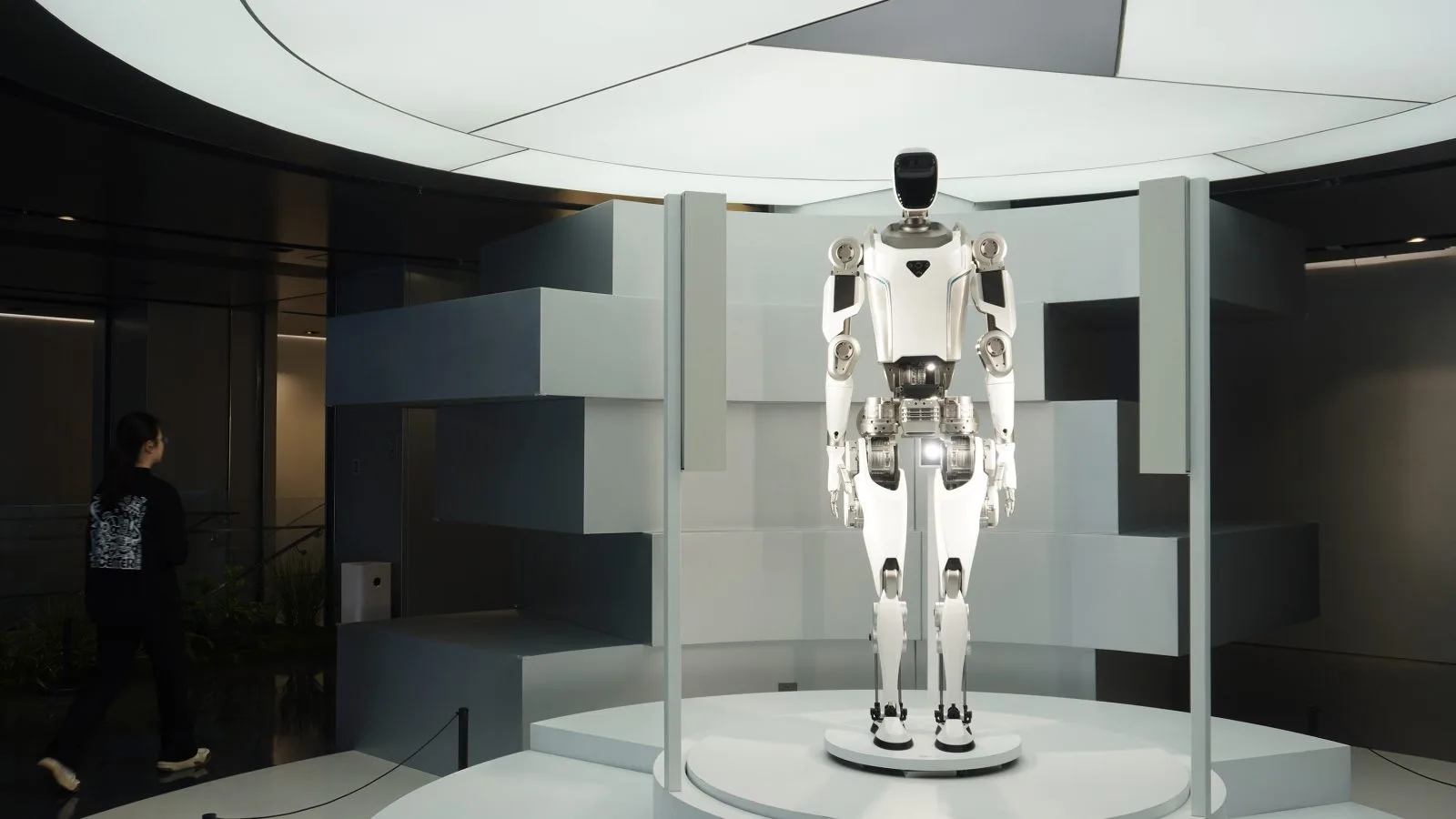

Since the start of the year, China’s humanoid robots have made waves at home and abroad — from the Consumer Electronics Show in Las Vegas to China’s Lunar New Year Spring Gala — fueling bold claims about a new industrial revolution that would make it impossible for the U.S. to catch up.
Chinese companies now dominate the humanoid robot market, capturing over 90% of global sales with thousands of units shipped last year. While Elon Musk maintains that Tesla will ultimately lead the industry, he recently acknowledged Chinese firms as his primary competition and noted that Tesla’s Optimus robots won’t be ready for launch until at least next year.
To unpack the claims and look beyond the viral robot performances, Lian Jye Su, chief analyst at tech consulting company Omdia and the author of its latest humanoid robotics report, spoke to Rest of World at a virtual event on February 25. Su broke down trends behind the sales figures, how China’s approach to developing humanoid robots differs from that of the U.S., why Tesla may still have a viable path forward, and which benchmarks truly matter when assessing progress in the industry.
The interview has been edited for length and clarity.
Why are there so many more Chinese companies producing humanoid robots compared to the U.S. or anywhere else?
The first reason boils down to the fact that China has been growing its high-end engineering manufacturing capability at a steady pace in the past decades. Ever since the various policies being announced by the Chinese government with regards to industrial manufacturing — like Made in China 2025 and the 14th five-year plan — that focus a lot on strengthening the industrial manufacturing capability, I think we are now seeing the fruits of those policies, which carries itself into not just robotics but also to the wider manufacturing capabilities from, for example, electric vehicles, the solar panel industry to the aviation industry.
This, coupled with a lot of the investment that the Chinese have encouraged when it comes to the software side of things. … Think of the AI capability all the way from the foundation model development to the actual AI chipset that can now be manufactured and shipped in China. The combination of both factors drives a lot of the current scale in producing humanoid robots.
There is a third force at play here, which is the demand that we are actually seeing from a lot of the state-owned Chinese enterprises when it comes to adoption of all these robots. That is, in many cases, probably absent in other markets. I think that helps to, in many ways, add as a catalyst and propel the production and the adoption of human robots in China.
American companies seem to have a different game plan. Tesla claims it wants its Optimus robots to be available in 2027. How realistic is this timeline?
Tesla has always been a champion in humanoid robots. … It’s actually very probable that Optimus can be made available next year.”
Tesla has always been a champion in humanoid robots, and has been a champion in fact when it comes to one of the earliest demos that came out from a private company. … It’s actually very probable that Optimus can be made available next year.
The question is how big that deployment size is going to be.
I think the challenge now, as I mentioned earlier, is with scale, and scale right now tilts more towards China’s advantage, just because of the broader manufacturing base and I think in the U.S. there are also definitely more muted responses from the manufacturers. That is also partially because the manufacturing bases are in Asia and not in the U.S., so we will probably see a slower adoption rate in the U.S. But that is by no means a bad thing for Tesla, or in fact for any U.S. humanoid robot startups. It will take time for them to build up their production bases and by the time they build it up, I think they will be ready for large-scale deployment.
So what’s the best way to benchmark which humanoid robot companies are in the lead?
If you look at what goes into humanoid robots, it requires really, really good hardware and really good software. It requires the company to have production capability and the scale of production as well. The company also kind of needs to have the right investment when it comes to their development team, be it software or hardware. Ideally, we also want to see strong partnership on the commercial side of things.
Particularly nowadays, when we look at the wider market landscape where most of the humanoid robotic companies are still in a startup phase, to do international rollout can be quite challenging. So in many cases, all these companies will at some point require either a system integrator or a reseller in other markets that helps them with expanding their global footprint. And at some point, they will probably also need some on-the-ground support from vendors in other markets to help them with installation, with deployment, with debugging, with maintenance. It does require a multifaceted criteria to assess the maturity of a human or robotic company.
At this point, what we are seeing is that obviously the Chinese vendors are a lot more advanced when it comes to the production scales, but the U.S. companies are actually very, very strong when it comes to the technical side of things, especially in the hardware and software department.
Are we witnessing a potential bubble in China’s humanoid robot sector, and could the current U.S. manufacturing lag make it difficult to compete once the market shifts to mass adoption?
The market is sort of still somewhat rational enough when it comes to the production and shipment of all these robots. The market does need a lot more robots for many reasons. I think the most important one is because we, in general, don’t have existing or publicly available data sets to train or fine-tune these robots on.
Fundamentally, we are able to experience really good technology on the AI side of things because of a lot of the public data that we have in open-source data sets or public forums, like Wikipedia and Reddit.
We just don’t have that in the robotics domain or rather in the general physical AI domain. This is because all this interaction that we do in the physical world are very complex scenes and environments. This means that we do need to collect as much data as possible before we can fully trust the robotic system to be general enough to be deployed across multiple use cases.
So having all these robots being deployed out there means that the robotics vendor will be able to collect the right and the best data that they can take on, and that will help them massively in building out.
Now, you probably argue that in that case, it is a loss-making business. But if you think of how AI started in the early days, actually right before ChatGPT, it was also a capital-intensive business. I think it will take some time for the market to “correct itself” or be able to present to the investor a more positive return on investment. But I think this step [now] is kind of necessary before we reach that stage.