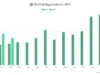
Sales in February fell even more sharply than in January, when deliveries had already declined by 30 per cent. The latest figures mark the sixth consecutive month of falling sales. Domestic demand in China remains under pressure, most recently due to reduced state subsidies and the impact of the Chinese New Year holiday period.
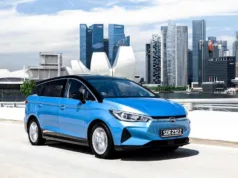
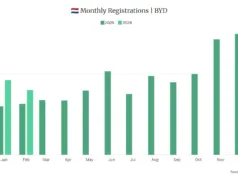
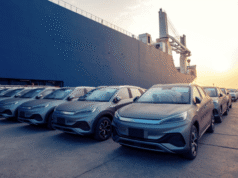
At the same time, BYD recorded strong growth in international markets. Overseas sales increased by 41.4 per cent year on year to 100,151 vehicles. As a result, the manufacturer delivered more vehicles outside China than in its home market for the first time in a single month. Expanding its presence abroad has been a central pillar of BYD’s strategy for several years.
The total of 190,190 vehicles delivered in February comprised 187,782 passenger cars and 2,408 commercial vehicles. The passenger car segment included 79,539 battery-electric vehicles and 108,243 plug-in hybrids. Commercial vehicle sales consisted of 334 battery-electric buses and 2,074 vans and trucks, covering both BEV and PHEV variants.
The powertrain split underlines that BYD’s portfolio extends well beyond purely battery-electric models. Plug-in hybrid volumes once again exceeded those of BEVs. This development is also reflected in Europe, where attention has recently shifted more strongly towards PHEVs in response to additional tariffs on electric vehicles. BYD’s line-up therefore mirrors China’s New Energy Vehicle (NEV) framework, which includes both battery-electric and plug-in hybrid drivetrains.
BYD also provides a breakdown of its 187,782 passenger car sales across its four brands. The core BYD brand continues to account for the majority of volumes. The SUV-focused Fang Cheng Bao marque, which has not yet entered the European market, also posted notable deliveries.
In addition, the premium brand Denza – scheduled to launch in Germany in the near future – contributed to the total, alongside the high-end Yangwang brand. The latter has already attracted attention with performance benchmarks, including record-setting runs on the Nürburgring Nordschleife. An overview of the brand split follows:
- BYD: 165,013 units
- Fang Cheng Bao: 17,036 units
- Denza: 5,501 units
- Yangwang: 232 units
The downturn appears less pronounced when measured against January 2026 rather than year on year. Compared with the 210,051 vehicles delivered in the previous month, sales declined by 9.5 per cent.
cnevpost.com, carnewschina.com, bydglobal.com (PDF), bydglobal.com (infographic in Chinese)