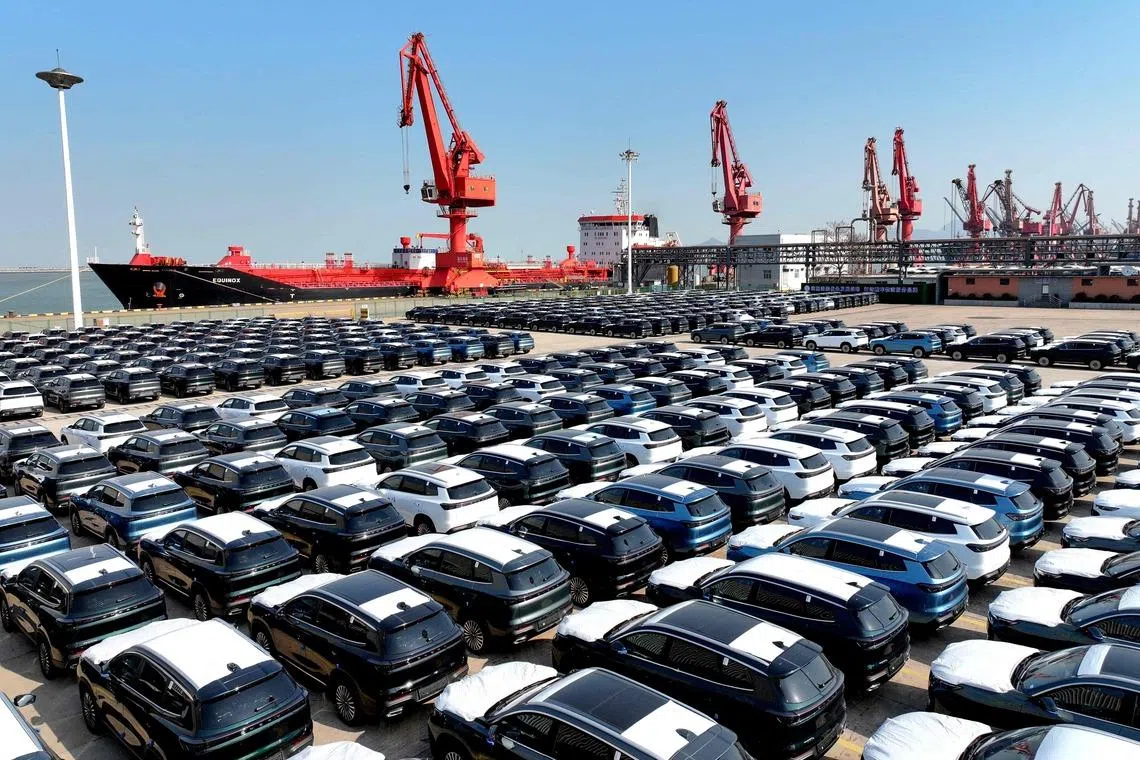
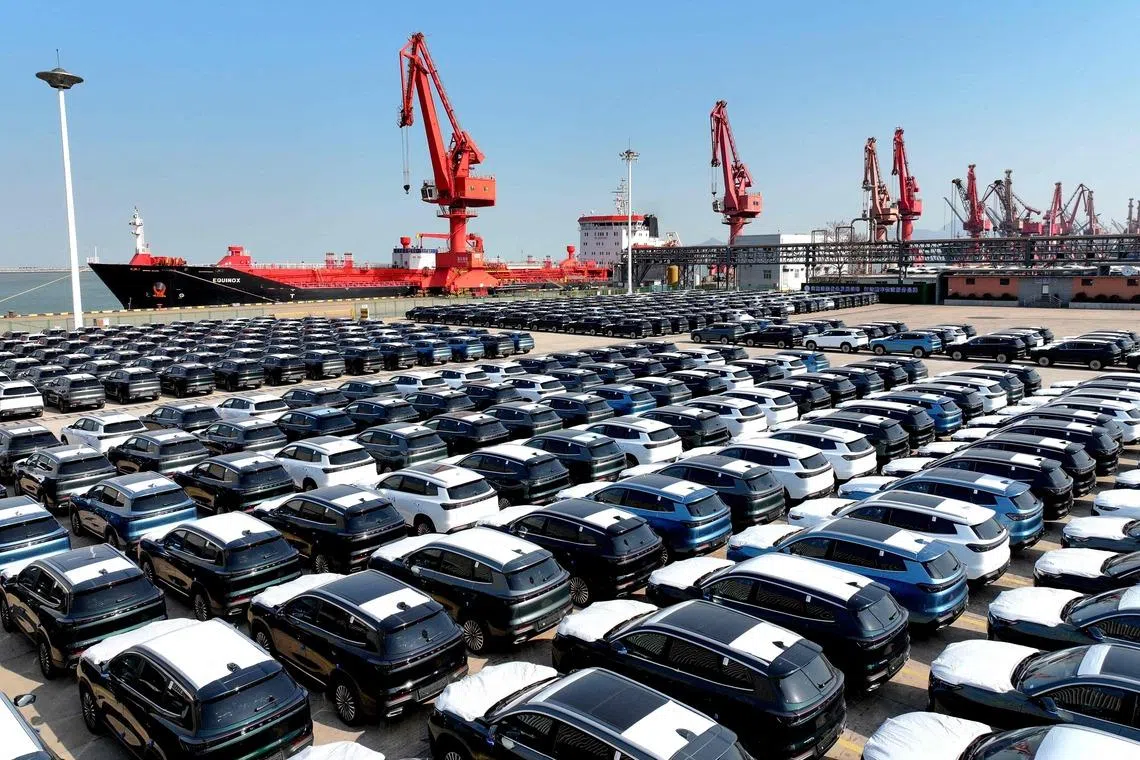
SHENZHEN – A fresh wave of factories in South-east Asia will begin churning out Chinese electric vehicles (EVs) in 2026, as Chinese carmakers build assembly lines around the region in a broader push to expand overseas.
The result of a saturated market back home in China and incentives from host countries, these factories may be a boost to these countries’ economies but the jury is still out on how much local workers will benefit in terms of job opportunities, analysts say.
EV giant BYD is expected to start production at its new Indonesia facility in the first quarter of 2026, and at an assembly plant in Malaysia later in the year, reports indicate, adding to
an existing factory in Thailand
and a smaller one in Cambodia.
Another Chinese carmaker, Chery, is reportedly slated to open a plant in Vietnam in the second half of 2026.
It also aims to complete construction in 2026 on a new Malaysian production base that will make EVs, hybrids and traditional petrol cars.
The duo are part of a swell of Chinese EV makers stepping up their manufacturing footprint in South-east Asia, as regional governments court investments to boost their car industries.
The production capacity of four-wheeled light vehicles in ASEAN’s six largest economies is poised to rise by 1.55 million units or 26 per cent – from 5.9 million to 7.45 million – between 2024 and 2030, according to estimates by PwC, an advisory firm.
Most of the increase comes from Chinese EV makers, said Mr Patrick Ziechmann, a partner and Asean automotive leader at PwC Malaysia.
These players, with their EV technology, are entering the field and fighting incumbent automakers for market share, he said. “This is a massive addition to the current capacity, which is already partially underutilised.”
Apart from incentives from host countries, Chinese carmakers are chasing sales overseas because of
cut-throat competition at home
that is squeezing their growth prospects in a saturated market.
The outlook in China is further clouded in 2026 by pared-back consumer subsidies and the re-introduction of a purchase tax. Domestic sales of EVs in January have already fallen almost a fifth from 2025.
“Overseas markets will become structurally more important for Chinese EV makers in 2026 than in any previous year,” said Ms Yu Bo, country manager for greater China at Jato Dynamics, an automotive research firm.
“Internationalisation is no longer optional, but a necessity as the growth engine,” she said.
But while Chinese carmakers have hitherto largely relied on exports, they are increasingly building plants or working with assemblers abroad to produce cars for local sales and other foreign markets.
This localised production allows them to enjoy perks in the host countries, and work around tariffs that would otherwise blunt their vehicles’ cost competitiveness.
The Chinese EV sector invested more overseas than at home for the first time in 2024, according to an August 2025 report by Rhodium Group, a research firm. Most of this has been in batteries, though investments in vehicle assembly have been growing rapidly, the report added.
South-east Asia – Thailand, Indonesia and Malaysia in particular – is likely to see the most pronounced activity from Chinese carmakers, alongside parts of Latin America, said Jato’s Ms Yu.
“These markets combine supportive EV incentives, growing domestic demand and ambitions to develop regional EV manufacturing hubs,” she added.
In Thailand, a generous mix of subsidies and tax breaks has made the country an early destination for Chinese EV companies. BYD, Great Wall Motor, SAIC, Changan, Chery and GAC are among the carmakers that have already set up plants in South-east Asia’s largest car manufacturing hub.
In Indonesia and Malaysia, earlier tax incentives on imports of fully built EVs expired from 2026, prompting firms to start assembling locally for better access to these markets.
Indonesia, for example, had temporarily slashed duties for imports by EV makers that were committed to investing in local manufacturing facilities, while stipulating that these would have to come online by 2026 and meet minimum requirements for local content.
Mr Rachmat Kaimuddin, a deputy at Indonesia’s Coordinating Ministry for Infrastructure and Regional Development, said in December 2025 that nine automotive brands had committed to producing EVs in the country, according to a Jakarta Globe report.
Most of the nine were Chinese, but they also included France’s Citroen, Vietnam’s VinFast and Germany’s Volkswagen.
“The direction is clear: Build EVs locally. We want investment, production and jobs to grow, not just imports,” Mr Rachmat separately said, according to a September 2025 report in The Business Times.
Even as EV production revs up, analysts caution that it is too early to judge how much this will benefit the local industry.
There are questions about how localised automakers’ supply chains will eventually be, and whether this will spur the growth of domestic parts producers, just as Japanese carmakers had done after sinking roots in the region decades earlier.
For now, “the general sense is that a lot of the tech transfer that local suppliers were expecting… that is not happening,” said Mr Akshay Prasad, a principal at consultancy Arthur D. Little and a member of its automotive practice in Singapore.
To keep prices low amid stiff competition, Chinese carmakers are bringing in their own suppliers from China instead of investing time and money into training local producers, he noted.
On the jobs front, the opening of Chinese factories may generate new work – Indonesian officials say BYD’s new factory could create some 18,000 jobs – but the EV wave could also disrupt traditional automakers and their local suppliers, causing them to employ fewer people.
In Thailand, Japanese carmakers such as Nissan and Honda have been cutting back on production capacity as they cede market share to their Chinese competitors.
“Employment may shift, more than anything else, from established players (like) the Japanese to the Chinese,” said PwC’s Mr Ziechmann.
He added that for now, it is unclear whether Chinese automakers are willing to go beyond “screwdriver activities and assembly” in the region and transfer the production of higher-value components to local vendors.
“The role for governments is to incentivise exactly that,” he said.