By Karan Singh

China is taking a heavy-handed approach to automotive design, both on the exterior and interior of vehicles. Now, the latest set of changes from the country might just spell the end for the ultra-minimalist, screen-dominated cabins that have defined the modern EV era.
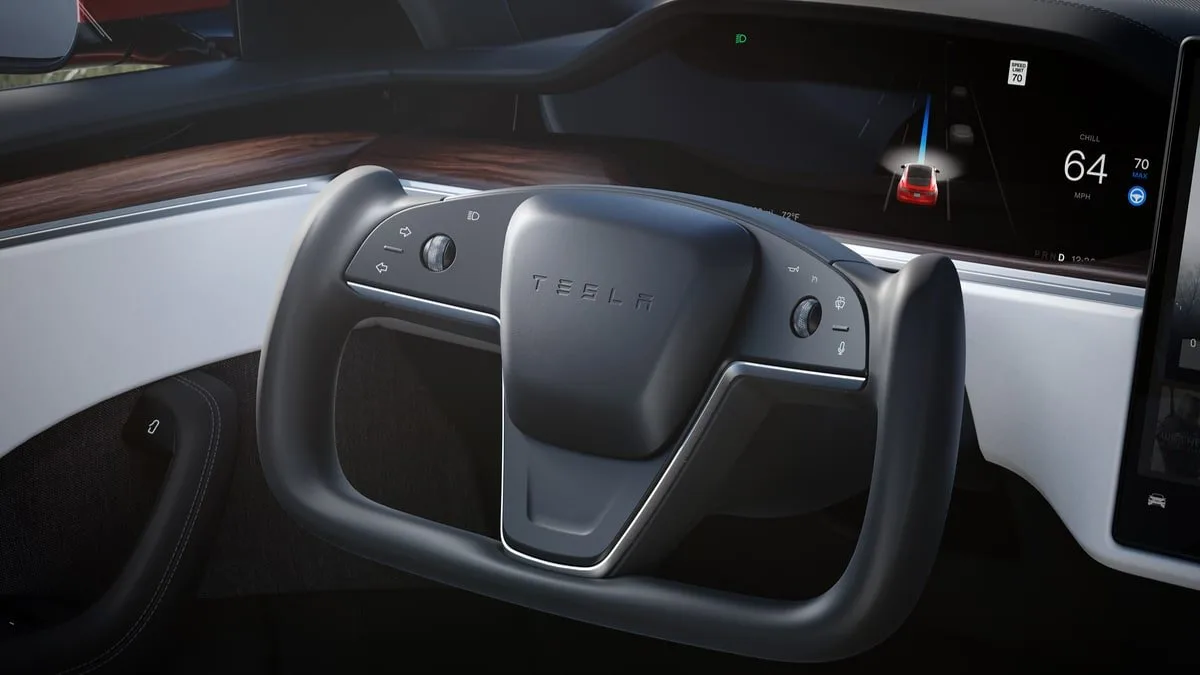
In a push for increased safety, regulators are stepping in to mandate the return of physical buttons and effectively outlaw the yoke-style steering wheel.
Turn Signal, Gear Selector and More
According to newly drafted regulations from China’s Ministry of Industry and Information Technology (MIIT), automakers like Tesla have taken the touch-screen focus too far. Starting in 2027, essential safety and driving functions must be controlled by physical buttons or switches that are easily accessible by drivers. The list currently includes gear selectors, turn signals, hazard lights, and emergency calling (eCall) features.
These are not just loose guidelines either. The mandate requires these essential controls to have a minimum surface area of 10mm by 10mm (⅜ inch x ⅜ inch) and provide clear tactile or auditory feedback to the driver when used.
This effectively bans burying critical functions in touchscreen submenus or relying on flat, haptic-capacitive panels that provide no physical feedback. It is a challenge to the interior design philosophy that has been popularized by Tesla, and heavily adopted by many other automakers, as well as Chinese giants like BYD and Xiaomi.
The Physics of the Yoke Ban
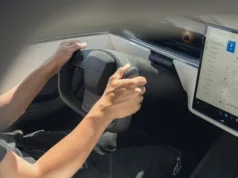
While the return of physical gear selectors and turn signals will please many drivers, the most dramatic casualty of these new regulations is the yoke steering wheel.
The Chinese government isn’t banning these on pure aesthetics, but instead, as a matter of physics and crash test dynamics. The new safety standard (GB 11557-202X) strictly updates the rules for protecting drivers from steering mechanism injuries. To pass compliance, a steering wheel must now undergo testing at 10 specific points around its rim.
For a yoke, the top half of the rim simply does not exist. This missing physical structure makes it impossible to conduct the mandated upper-rim impact tests, automatically resulting in a failure to comply. Regulators highlighted severe safety risks, beginning with the fact that a traditional round wheel acts as a large buffer zone.
That means that without a full upper rim, a driver’s body can slip past the wheel during a collision and strike the dashboard. Regulators also noted that the yoke’s irregular shape and support structure create unpredictable, potentially dangerous airbag deployments.
Global Ripple Effect
Because China is the world’s largest automotive market, these localized regulations will undoubtedly force a global design reset. Automakers simply cannot afford to design and manufacture entirely separate China-only dashboard architectures at scale.
For Tesla, which arguably started both the minimalist trend and the yoke trend, the impact of the ban might be surprisingly muted. Tesla already brought back turn signal stalks, and we could see a return of the gear stalk (although the backup PRNDL buttons (near the dome lights on the Model 3/Y and near the phone chargers in the S/X) may comply with regulations).
With the Model S and Model X production ending, the original yoke is already headed for retirement. As for the Cybertruck, its squircle steering wheel should theoretically pass the new Chinese standards. Unlike a yoke, it features a fully enclosed, continuous rim that provides the necessary physical impact points for crash testing.
While this regulation is still in the draft phase, we expect that auto manufacturers, including Tesla, are likely already beginning preparation for the changes to come online within the next couple of years.
China recently banned electric-only door handles, which will affect the design of the Model 3 and Model Y.
By Nehal Malik

Tesla is continuing to refine how its vehicles communicate with drivers during autonomous maneuvers. A new visual cue has been spotted in the latest software builds, specifically aimed at ensuring those behind the wheel are prepared to take over at a moment’s notice.
The update introduces a prominent message on the touchscreen that reads, «Keep your hands ready to steer.» This was recently highlighted by @realwhitakerb, who shared a video of the warning appearing directly within the FSD visualization on his Tesla. While the prompt was spotted in FSD v14.2.2.4, it has also been seen appearing in various earlier v14.2 releases.
New FSD message Keep your hands ready to steer pic.twitter.com/As40TZXBmF
— Whit (@realwhitakerb) February 15, 2026
Installed on 4.3% of fleet
2 Installs today
Last updated: Feb 17, 4:35 pm UTC
This change is part of a broader effort by the automaker to improve its Tesla Vision-based advanced driver assistance system. By relying on cameras rather than radar or ultrasonic sensors, the vehicle must constantly interpret the world around it, and the system is getting better at knowing when it needs a human safety net.
In recent updates, the level of driver attention required seems to depend on the complexity of the road situation. The software is becoming more context-aware; for instance, the likelihood of receiving a warning differs significantly when you are navigating an empty parking lot versus crossing a busy intersection filled with pedestrians. Interestingly, under specific road and traffic conditions, some recent point releases have been observed to be quite lenient, to the point where they might even allow a driver to text behind the wheel. We’re not saying that’s a good idea, or even legal, but it shows how the software is attempting to gauge «safe» moments versus high-stakes moments.
This new visual prompt is likely an extension of the more intelligent driver monitoring system Tesla started rolling out last fall. As the company works toward unsupervised FSD, these UI changes serve as the bridge between full automation and human supervision.
The scale of this rollout is massive. As of Q4 2025, Tesla FSD has a user base of 1.1 million vehicles, meaning over a million drivers are currently training this neural network every time they hit the road. With such a high volume of users, these small software tweaks to the «nag» or warning system are essential for maintaining safety standards while pushing the boundaries of what the hardware can do.
As the software evolves, the car is essentially learning to trust the environment, but it still needs to make sure you haven’t totally checked out. Seeing the warning directly in the flow of the visualization makes it much harder to miss than a small icon in the corner of the screen.
Have you noticed these new «hands ready» prompts on your recent drives, or has your Tesla been letting you cruise with fewer interruptions lately? Let us know in the comments if you think the system is getting smarter or just more talkative.
By Karan Singh
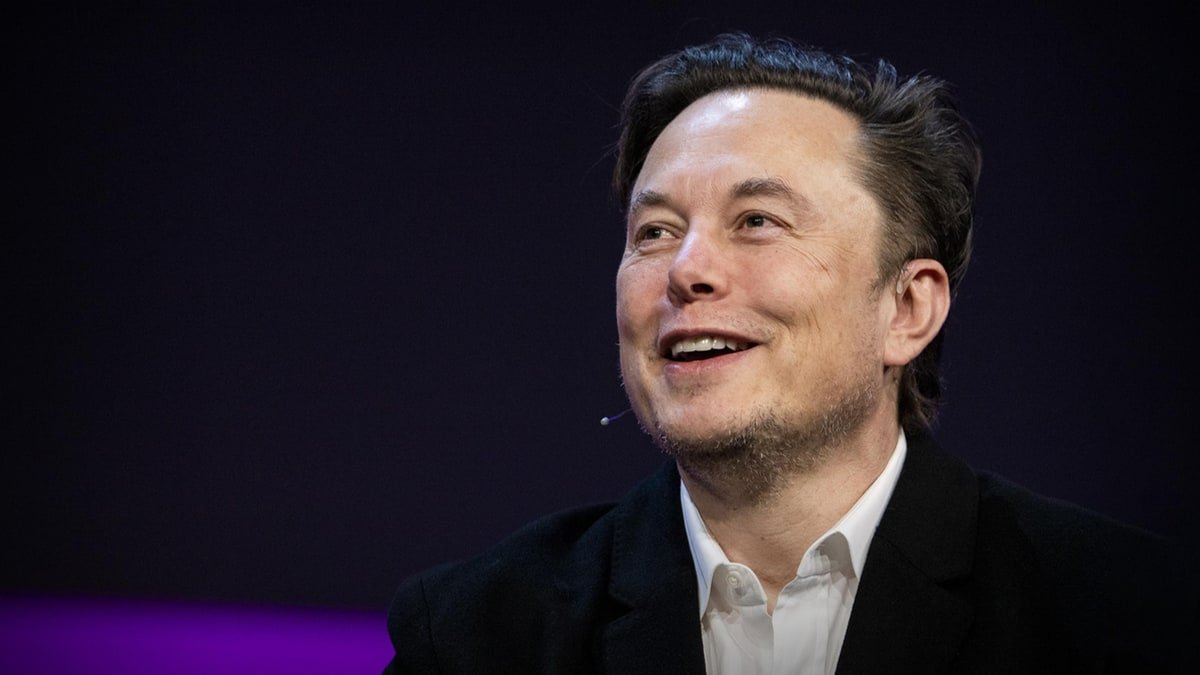
As the United States gears up to celebrate its 250th anniversary, Forbes has released its inaugural “America’s 250 Greatest Innovators” list. The ranking is designed to honor the visionaries who have transformed industries and served as the gears of the economic engine of the US.
Taking the top spot on this list is none other than Elon Musk, beating out a heavyweight list of innovators like Jeff Bezos (#2), Bill Gates (#3), George Lucas (#4), Jensen Huang (#5), and Sam Altman (#6).
The Five-Industry Unicorn
According to Forbes, choosing the #1 spot came down to an unprecedented track record of execution across entirely disparate fields. Forbes noted that Elon is the only person in history to have founded (or grown from nearly nothing) five companies, each with a multibillion-dollar valuation, each in a different industry.
-
Tesla: EVs, Stationary Storage, and Renewable Energy
-
SpaceX: Reusable Commercial Spaceflight
-
Neuralink: Restoring Human Mobility with Brain-Computer Interfaces
-
xAI: Pushing boundaries for Artificial General Intelligence
-
The Boring Company: Rethinking subterranean infrastructure
Repeatable Innovation
While legacy tech titans like Bill Gates defined the personal computing era, and Jeff Bezos transformed retail and cloud infrastructure, their successes were largely centralized around single, massive entities.
Elon’s placement at #1 highlights what Forbes’ analysts call a repeatable innovation capability. Rather than specializing deeply in a single sector, Elon has developed a highly capital-intensive, cross-industry methodology. He consistently identifies stagnant, hardware-heavy industries, applies extreme risk tolerance and vertical integration, and successfully executes a zero-to-one startup model at massive scale.
One-Third of List Immigrants
The Forbes 250 list also highlights a broader narrative about American exceptionalism. While all 250 honorees are American citizens, many, including Elon, are immigrants. Forbes noted that more than one-third of the list consists of a diverse group of people who continue to drive the American economy forward.
Ultimately, Elon’s #1 ranking is a testament to the fact that his influence has grown far beyond just cars and rockets. From his expanding footprint in Washington to his dominance in AI and space, Elon is actively shaping the future of American infrastructure.