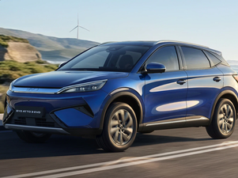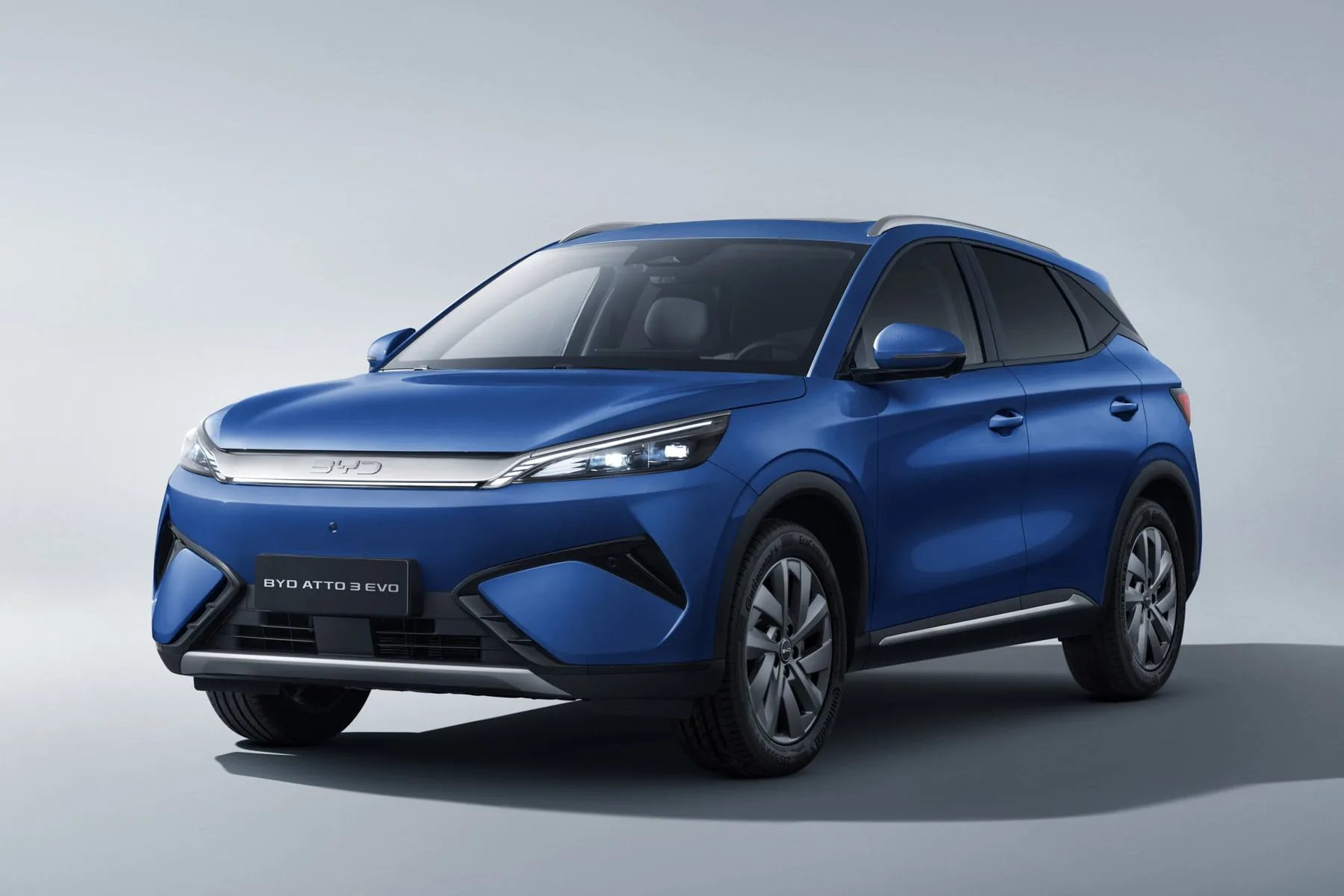

BYD UK has announced the facelift via a press release, though it is highly likely that other European markets will soon receive the updated model as well. The Atto 3 Evo closely resembles the currently available model, with only subtle visual changes. However, the updates beneath the surface are far more significant, as nearly all key components of the electric powertrain have been revised. The electric motor not only delivers more power but is now mounted on the rear axle instead of the front—and a high-performance all-wheel-drive variant will also be introduced. Additionally, the battery’s energy capacity has increased significantly, and thanks to an 800-volt system voltage, charging power has received a substantial boost.
Specifically, the Atto 3 Evo is equipped with a 74.8 kWh battery, an upgrade from the previous 60.5 kWh. As is typical for BYD, this is the brand’s proprietary Blade Battery with LFP cell chemistry. However, the cells in the Atto 3’s underbody are now configured to deliver 800 volts instead of the previous 400 volts. Combined with the larger battery and new drivetrain, the WLTP range increases to 510 kilometres—up from 418 kilometres.
The new permanent magnet synchronous motor, now mounted on the rear axle as mentioned, delivers a noticeable increase in power. Instead of the front motor’s 150 kW and 310 Nm, it now produces 230 kW and 380 Nm of torque. As a result, the Atto 3 Evo can accelerate from 0 to 100 kph in 5.5 seconds, compared to the previous factory specification of 7.3 seconds.
For an additional cost, the Atto 3 Evo can be upgraded to an even faster variant. For the first time, the compact SUV features an electric all-wheel-drive system with two motors—an asynchronous motor is fitted at the front. The system power then reaches 330 kW, with maximum torque increasing to 560 Nm. While the sprint time is reduced to 3.9 seconds, the all-wheel-drive model uses the same battery as the rear-wheel-drive version, resulting in a reduced range of 470 kilometres.
One major criticism of the Atto 3—aside from the lack of a long-range battery with 75–80 kWh—was its underwhelming charging performance. With a peak output of just 88 kW, it took 29 minutes to charge from 30% to 80%. BYD did not even provide the usual benchmark of 10% to 80%. This has now changed: with a peak charging power of 220 kW, the Atto 3 Evo delivers a solid performance, and the 25 minutes required to charge from 10% to 80% is a respectable improvement—though it does not set a new benchmark in the segment. A new Vehicle-to-Load (V2L) function has also been introduced, allowing external devices to be powered via an adapter with up to 3.3 kW.
To accommodate the electric motor’s new position on the rear axle, BYD has also redesigned the rear suspension. The multi-link rear axle now features five links instead of four, which is intended to improve handling. Additionally, the entire rear space has been reorganised, allowing the boot to offer 50 litres more cargo volume despite the motor’s rear placement, increasing capacity to 490 litres. The freed-up space under the front bonnet is now used for a 101-litre frunk.
The interior updates are more subtle. The 8.8-inch digital instrument cluster and 15.6-inch infotainment touchscreen feature new software. The bulky gear selector in the centre console, which was designed to resemble a yacht’s throttle lever, has been replaced with a stalk on the steering column as part of the Evo update. This not only makes the centre console appear more streamlined but also provides additional storage space.
The dimensions remain largely unchanged: the Atto 3 Evo measures 4.45 metres in length, with a wheelbase of 2.72 metres, a width of 1.88 metres, and a height of 1.62 metres. The rear-wheel-drive ‘Design’ variant has a kerb weight of 1,880 kilograms, while the all-wheel-drive model, marketed as the “Excellence”, weighs 1,990 kilograms. Pricing details for the UK market have not yet been released.