Young, tech-savvy, and future-focused — Philipe Andrade, 23, and Carlos Alberto Andrade, 26, embody a new generation of Brazil’s automotive elite. They are the heirs to the Brazilian auto group CAOA.
Founded in 1979 by their father, Carlos Alberto de Oliveira Andrade, CAOA stands for his name and a long tradition of manufacturing, importing, and selling vehicles in Brazil.
The company operates its own assembly plant in Anapolis, producing Hyundai and Chery models, and runs a vast network of dealerships for Asian carmakers Hyundai, Subaru, and Chery.
Currently, the two Andrade brothers are setting the course for the future of the Brazilian auto industry, as they’ve unveiled plans to start producing cars for another Chinese brand, Changan, later this year.
CAOA’s Anapolis plant doubled its output from 30,000 vehicles in 2023 to around 60,000 the following year, and expects another increase to 70,000 vehicles. The carmaker is not yet a market heavyweight even though its factory operates around the clock.
By the end of 2030, every fifth new car sold in Brazil is expected to come from China, according to a study by Brazil’s car market analyst Bright Consulting in Campinas, Sao Paulo.
A historic arrival in Argentina
The same trend is unfolding in Argentina, where the Chinese car carrier BYD Changzhou docked for the first time on January 20.
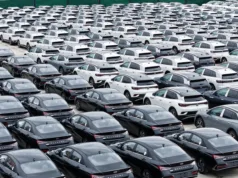
The purpose-built vessel, capable of carrying up to 7,000 cars, is reported to have unloaded 5,841 vehicles at the Port of Zarate in Buenos Aires province, strategically located on the Parana River. The shipment included not only fully electric models but also a hybrid SUV model.
BYD — the world’s largest electric vehicle maker by number of cars sold — began marketing its vehicles in Argentina last year. Instead of partnering with local firms, the company operates through a wholly owned subsidiary, keeping nearly the entire value chain under Chinese control.
BYD’s medium-term goal is to export 50,000 vehicles per year to Argentina — a target closely tied to the recent policy changes introduced by Argentina’s libertarian President Javier Milei.
Milei has gradually liberalized the market for hybrid and electric vehicles and introduced an annual quota of 50,000 cars that can be imported without paying the standard 35% import tariff. The quota could remain in place through 2029, allowing up to 250,000 vehicles to enter the country duty-free.
Elsewhere in the Latin American trade bloc, Mercosur, Uruguay is also seeing a surge in electric vehicle sales. According to the Uruguayan Automobile Association, ACAU, which represents 26 of the country’s largest automotive companies, EV sales jumped 147% in 2025, as reported in its annual review.
Europe hesitates as competition intensifies
The arrival of Chinese vehicles marks the beginning of fierce competition in car markets across Latin America.
European automakers had hoped a recently signed free trade agreement between Mercosur and the European Union would strengthen their position in Argentina, Brazil, Paraguay, and Uruguay. Instead, the European Parliament has temporarily thrown the agreement into doubt, sending it to the European Court of Justice (ECJ) for legal review.
While the deal is expected to apply provisionally, the move introduces legal uncertainty and sends a signal that Europe may not be a reliable partner when it comes to negotiated trade agreements.
«For the automotive industry, an EU-Mercosur agreement would open up significant opportunities,» a spokesperson for Germany’s auto industry association VDA told DW earlier this month, as it would reduce currently high tariffs in Mercosur, which range from 14% to 18% on vehicle parts up to 35% on new cars.
At the same time, EU tariff cuts would «create new export opportunities for Mercosur countries and strengthen their economic development,» the VDA spokesperson said.
Following the European Parliament’s decision last week (January 21) to refer the deal to the ECJ, VDA President Hildegard Müller told DW that the vote was «a disastrous signal» that could delay the agreement’s entry into force «significantly, possibly even by years.»
She called for swift and definitive clarity on the provisional application of the deal.
Germany’s high stakes
According to VDA, German automotive companies currently operate 310 sites across the Mercosur region, most of them supplier facilities that provide local jobs.
In the first half of 2025, German manufacturers produced 289,200 passenger cars in Mercosur, mainly in Brazil and Argentina. During the same period, 18,400 vehicles were exported from Europe to the region.
As competition in the global auto market intensifies, the balance of power is shifting almost as rapidly as geopolitical dynamics. The battle for South America’s two largest car markets has begun.
This article was originally written in German.