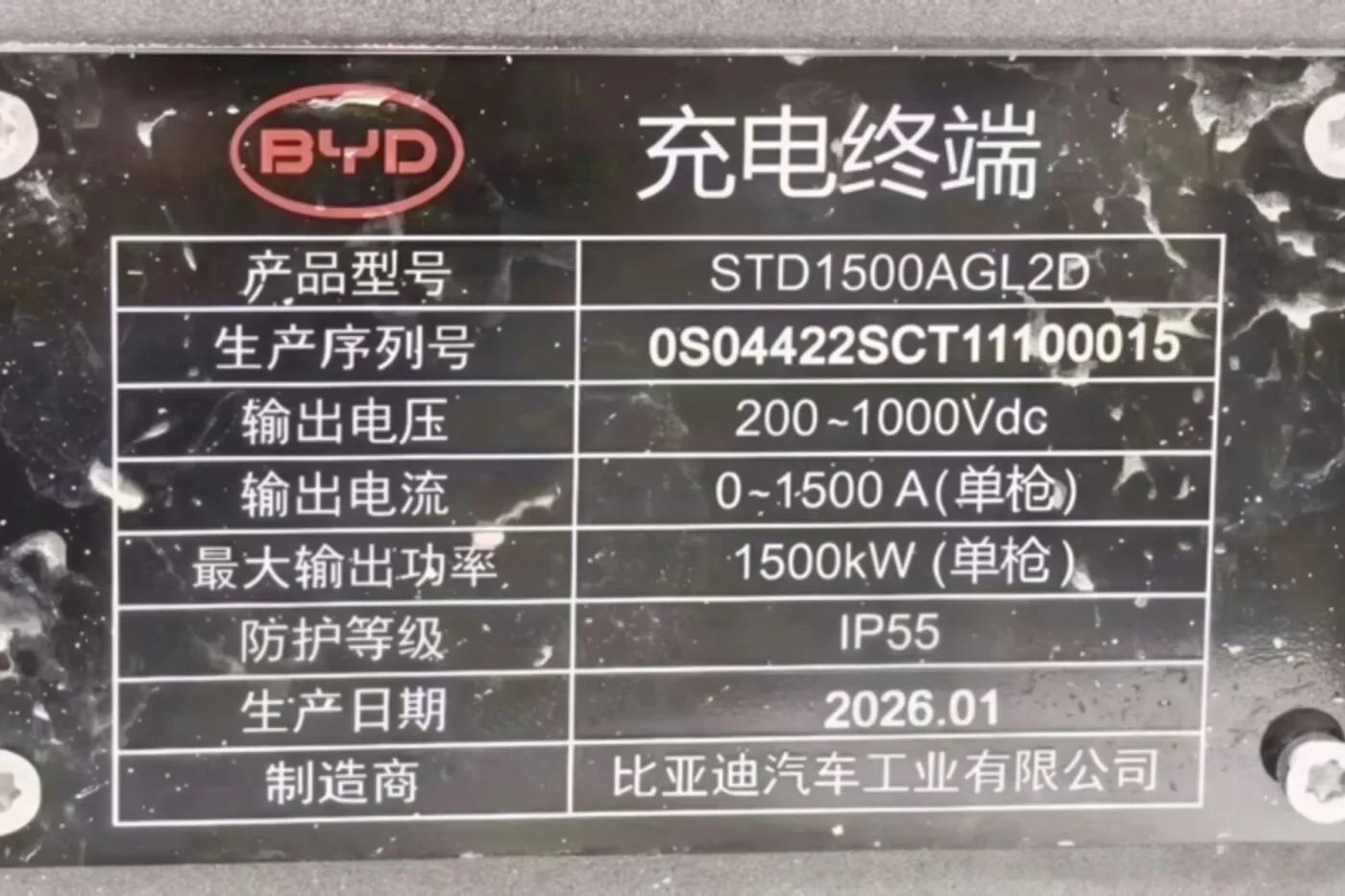
Reports in forums and articles refer to details from an alleged type plate said to belong to a second-generation “Flash Charging” charging station. Some sources claim charging power of up to 1,500 kW and a charging current of 1,500 amperes, while others cite “only” 1,360 kW. Either way, this would represent an increase over the 1,000 kW that BYD announced for the first generation in March 2025.
However, the alleged upgrades are not limited to charging power: the advanced model is also said to feature an energy storage system twice as large, enabling these short charging cycles at high power without overloading the grid. Although the photographed type plate refers to a “single gun” for the 1,500 kW in a translation tool, the concept involves charging the electric vehicle using two charging cables simultaneously. This is because the second generation of the “Flash Charger” is reportedly equipped with a T-shaped dual-charging system, to which two liquid-cooled charging cables are attached, both supplying power to the vehicle.

Like the first model, the second generation is expected to be compatible with BYD’s flagship models, such as the BYD Han L and Tang L. BYD introduced ‘Flash Charging’ alongside these two models when they were upgraded to the new ‘Super e-platform’, which is designed to support these charging capacities through two charging ports and a specialised battery cooling system.
By the end of 2025, BYD had already deployed 500 of these ‘Flash Chargers’ in 200 Chinese cities. However, the company’s ambitions are far greater: together with partners, over 15,000 of these megawatt chargers for electric vehicles are planned for installation in China. Last summer, BYD also announced the roll-out of ‘Flash Chargers’ in Europe, primarily in connection with the European launch of its premium brand Denza. The first charging stations in Europe are expected to be installed this year. Additionally, the first megawatt chargers are set to become operational in South Africa in the second quarter.