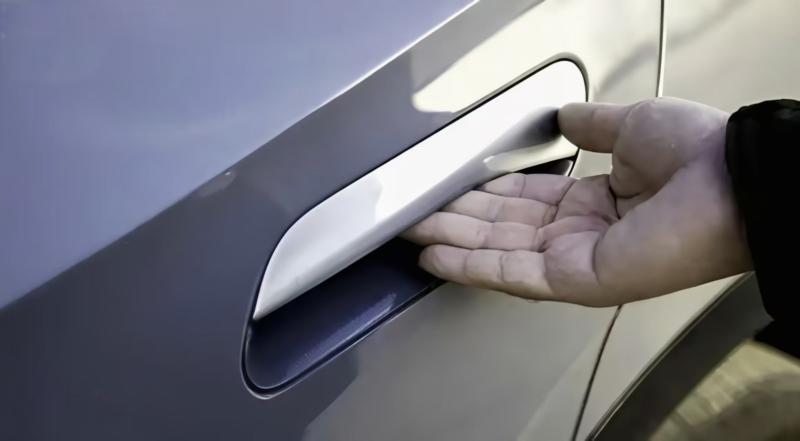
China has approved a mandatory national standard for vehicle door handles (GB 48001‑2026), effective January 1, 2027. The rules require all passenger cars and light commercial vehicles to feature mechanically releasable handles that can open under emergency conditions, including electronic system failures and crash scenarios. The standard applies to these vehicle types, with other categories encouraged to adopt the specifications, according to Autohome.
The standard addresses safety concerns related to exterior door handle operation, particularly the inability to open doors after certain incidents, as CarNewsChina previously reported. Each door, excluding the rear hatch, must have a mechanically releasable exterior handle. Handles must be located within designated shadow areas on the door surface or adjacent door frame and provide sufficient hand-operating space in all states to permit effective mechanical release during emergencies such as irreversible restraint system deployment or battery thermal events.
Exterior handles, including electrically actuated systems, must meet uniform performance criteria. Vehicles with electric release mechanisms must include independent mechanical linkages capable of withstanding forces of at least 500 N without breaking or detaching. After testing, handles must still be able to open the corresponding door to ensure reliable emergency operation.
Interior door handles are also subject to mechanical reliability requirements. Each side door must have at least one mechanical release handle, and any interior handle must independently open its corresponding door. The standard defines precise installation zones for at least one interior handle, requiring unobstructed visibility from the occupant position, placement within 300 mm of the door edge, and vertical alignment relative to the seating reference point.
The regulation also sets requirements for identification and usability. Interior handles must feature permanent, unobstructed graphical symbols of at least 100 mm × 70 mm with high contrast, and Chinese or pictorial operation instructions must be provided nearby with a minimum character height of 6 mm. Technical performance testing must confirm that rotational interior handles withstand at least 300 N and button-type handles at least 500 N without structural failure, and all handles must open the door after testing.
Phased implementation is specified in the standard. Vehicles applying for new type approvals must meet most requirements from July 1, 2025, and all requirements after 13 months. Vehicles with existing type approval must comply with all requirements by July 1, 2027, following a 25-month transition period.
GB 48001‑2026 provides a unified framework for vehicle manufacturers and component suppliers to ensure mechanical reliability, emergency operability, and consistent safety performance across passenger cars and light commercial vehicles.

Follow us for ev updates