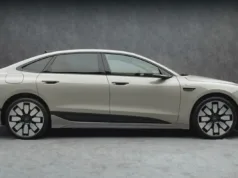
While the world’s second most populous country never truly established itself as a global leader in internal combustion engine vehicles, the rise of electric cars gave China a rare opportunity to reset the playing field — and it took it. This has even led to Elon Musk admitting China beating the U.S. to his EV vision. However, China’s EV industry is defined not just by rapid growth, but by brutal competition.
Many of China’s leading EV companies were never just automakers, and they are increasingly leaning on their roots in batteries, electronics, software, and energy to stay competitive. BYD is China’s biggest electric car maker, but the company is also known for making smartphone and laptop parts, power semiconductors, energy storage systems, monorails, industrial equipment, and even a London bus.
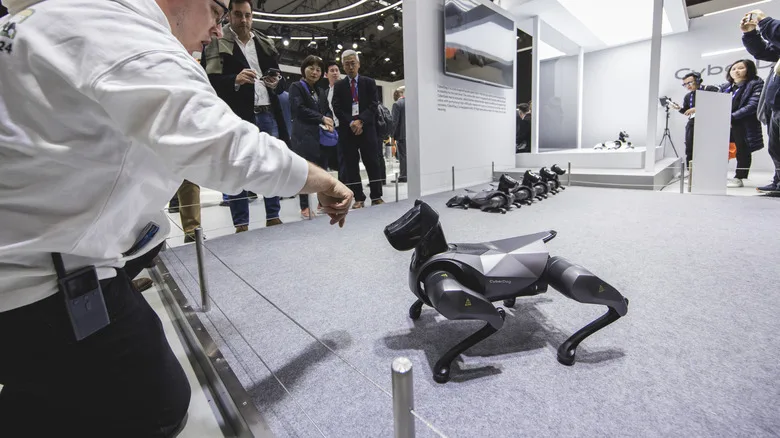
Xiaomi is another giant, best known for producing everything from smartphones and wireless earbuds to air fryers, vacuum cleaners, CyberOne humanoid robots, rice cookers, and the Cyberdog robot dog. Geely, a company initially founded to make refrigerator parts, follows a similar path, operating far beyond cars with businesses that include satellites, CaoCao robotaxis, and even Aerofugia flying cars.
How dark factories and automation speedrun China’s EV manufacturing
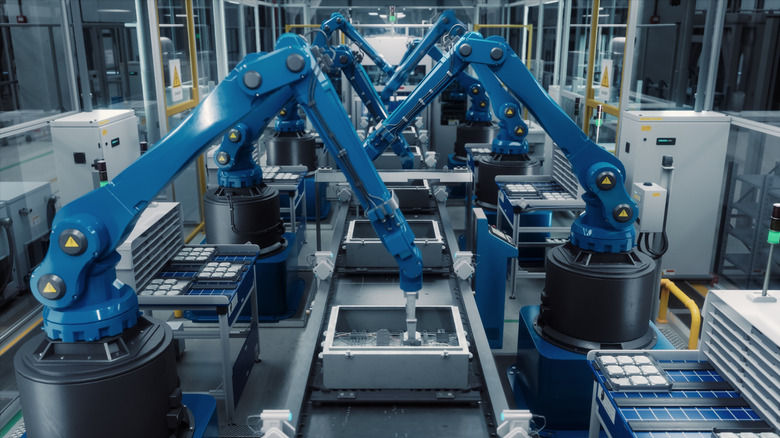
A dark factory is one that operates with minimal human activity. In practical terms, it’s a factory run by robots, a place where human workers are redundant. According to the IFR World Robotics 2025 Report, in 2024 alone, China installed 295,000 industrial robots within its factories, and that accounts for roughly 54% of all robots installed worldwide. In the U.S., the total number is 34,200, roughly one-ninth as many as China.
With the ability to work 24 hours per day, automakers are able to crank out cars at a shockingly fast rate. The EV Report notes, «Xiaomi’s Beijing factory produces a car every 76 seconds, using over 700 robots for 100% automation.» Robots also make cars with consistent tolerances, practically erasing any possibilities of human errors. Compared to a human-led factory, a robot factory is able to increase outputs by 30% to 70%, decrease downtimes by 30% to 60%, and reduce labor costs by 25% to 60%.
Thanks to a waning demand for EVs in the U.S., GM’s Factory ZERO went idle. This might signal that the U.S. EV industry is in a tough spot – and it is – but China is also facing its own issues. With such massive capacity, market restrictions, and uncertainty surrounding EVs, as many as 400 Chinese EV companies also went out of business between 2018 and 2025. This only leads to dominance of the select few, and they make a lot more than just electric cars.
Making everything makes EVs easier
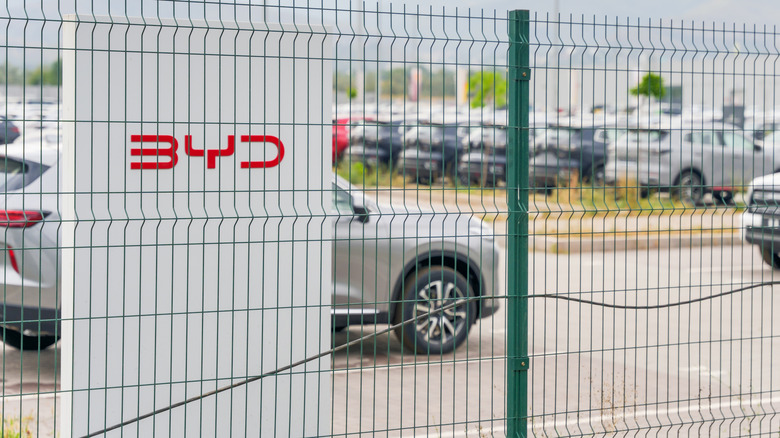
One of the reasons why China’s EV brands are so successful also has to do with short and collaborative supply chains and vertical integrations that minimize reliance on outside contractors. As mentioned, BYD makes batteries, power semiconductors, electric motors, and energy storage systems, while Xiaomi produces smartphones, sensors, battery management systems, IoT devices, and other electronics.
Making components in-house allows these companies to reduce delays, lower costs, and maintain rapid production. This (in conjunction with dark factories and automation) also allows for faster assembly, flexibility, and resilience. In 2024 China accounted for about 85% of global battery cell manufacturing capacity, while the United States and the European Union are single digits. However, EV battery manufacturing is gaining steam in America.
Because China’s battery and EV companies are state-owned or government-backed, they can sell batteries while using that income to subsidize the production of their own cars at home. China’s EV companies like Xiaomi also lead in software development tied to electric cars, and that simplifies economies of scale and further pushes China’s manufacturing power. As The Economist puts it, China is «the world’s factory,» and the next time you see a Xiaomi air fryer, remember that the same machines are fueling China’s EV revolution.