

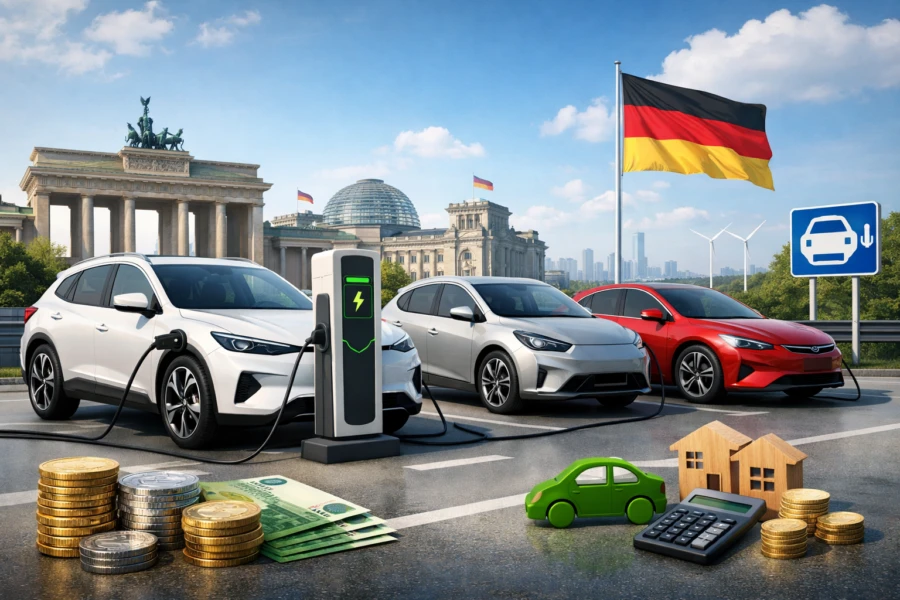
Germany will open its new €3 billion ($3.5 billion) electric vehicle subsidy program to all manufacturers, including Chinese brands, as it seeks to revive sales in Europe’s largest car market and support an auto industry grappling with uneven demand.
The incentive scheme, unveiled on Monday, marks a renewed push by Berlin to accelerate EV adoption after sales faltered when subsidies were abruptly withdrawn at the end of 2023.
While the policy is designed to bolster domestic manufacturers, the government has opted not to impose origin-based restrictions on which vehicles qualify.
Government lifts limits on foreign makers
Germany’s approach marks a departure from restrictions seen elsewhere in Europe.
While the government remains supportive of local manufacturers, it has avoided policies that would exclude foreign competition.
This decision opens the door to Chinese automakers such as BYD, which are expanding their presence across the EU.
Despite existing tariffs on Chinese EV imports, these brands continue to sell competitively in Europe due to low production costs at home.
Germany’s decision not to impose origin-based requirements contrasts with policies in the UK and France, where new schemes exclude many Chinese-made cars through carbon and assembly regulations.
Subsidy details tied to income and car type
The latest funding round is expected to support about 800,000 electric vehicle purchases by 2029. Subsidies will vary between €1,500 and €6,000.
The exact amount depends on household income, family size, and the vehicle category.
Most support will go to low- and middle-income households, widening access to electric cars beyond premium buyers.
The programme also aims to benefit carmakers like Volkswagen and Stellantis, which are now focusing on more affordable electric models.
The new incentives were first outlined in October and are now being implemented to boost market activity.
Lower prices drive renewed interest
Electric vehicle sales in Germany have been unstable, especially after subsidies were removed in late 2023. Following a drop in early 2024, sales have begun to recover as more budget-friendly EVs enter the market.
Volkswagen’s ID. Polo and Renault’s R5 E-Tech are examples of upcoming models priced near €25,000, aimed at attracting cost-conscious buyers.
With pricing now a key factor, lower-cost models are helping to rebuild demand. German policymakers are counting on this trend to drive higher adoption levels in the coming years.
Sales shift as models get cheaper
Beyond direct subsidies, Germany has introduced long-term measures to reduce EV costs. A tax exemption for electric cars has been extended through 2035.
The finance ministry estimates the extension will reduce tax revenues by around €600 million by the end of the decade.
Still, the move is seen as essential for encouraging long-term investment and consumer confidence in electric mobility.
Meanwhile, EU policymakers in Brussels are considering a new approach to Chinese EV imports, possibly introducing minimum pricing instead of tariffs.
That could further affect the competitive landscape across Europe, but for now, Germany’s market remains fully open.
Germany’s decision to allow all brands equal access to subsidies stands in sharp contrast to the UK and France, where incentives are tied to strict environmental criteria.
As new models reach the market and prices fall, the open approach may help Germany make up ground after years of missing EV adoption targets.


