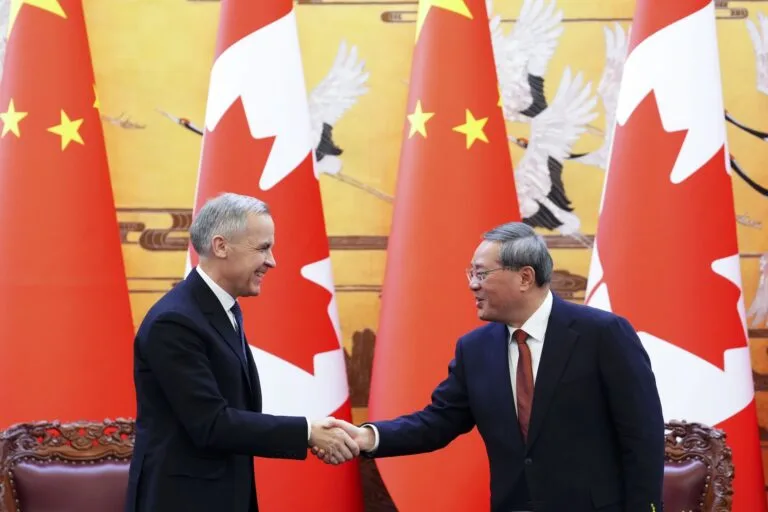
Prime Minister Mark Carney wrapped up his visit to Beijing on Friday by securing a deal to lift or reduce most of China’s tariffs on agricultural products in exchange for letting some Chinese-made electric vehicles into Canada—despite having followed the U.S. in shutting them out.
How much of the market could Chinese EVs capture?
Carney described the agreement as part of larger efforts to recalibrate the relationship with China. If Canada imports 49,000 made-in-China EVs at the lowered tariff rate of 6.1 per cent, it would roughly match China’s 2.8 per cent share of Canada’s new vehicle market in 2023, before Ottawa slapped 100 per cent tariffs on Chinese EVs in October 2024. Even in 2025 terms, 49,000 vehicles would represent less than three per cent of the Canadian vehicle market.
Related Articles


The zero-emissions vehicle market is another story. The quota’s worth of Chinese imports would have accounted for about 26 per cent of zero-emissions vehicle registrations in 2023, and about 29 per cent of EV sales in 2025, pro-rated based on the first 10 months of data compiled by Statistics Canada.
Still, the government is hoping that introducing more affordable EVs will drastically change those numbers, with aspirations to push total EV sales potentially over one million annually by 2030. The government is open to increasing the quota for made-in-China EVs to 70,000 within five years, Carney said.
What does this mean for Canada’s auto industry?
Ontario Premier Doug Ford was quick to slam the deal. “The federal government is inviting a flood of cheap made-in-China electric vehicles without any guarantee of equal or immediate investments in Canada’s economy, auto sector or supply chain,” Ford wrote Friday.
The federal government suggested economic benefits would flow from greater co-operation with China. “We expect that this will catalyse considerable new Chinese joint-venture investment in Canada with trusted partners to protect and create new auto manufacturing jobs for Canadian workers and ensure a robust build-out of Canada’s EV supply chain,” Global Affairs Canada wrote. The deal will be reviewed after three years to see if the benefits came to pass.
David Adams, CEO of Global Automakers of Canada, said there are many unknowns, including standards and where these vehicles will be sold. He said the industry is still waiting for Ottawa’s next steps on the federal EV sales mandate after pausing the regulations originally expected for 2026, and is already reeling from U.S. tariffs and Canadian counter-tariffs. “The whole industry needs greater certainty, greater understanding and the ability to move forward in an intelligent way.”
Affordability play
The federal government says that by 2030, half of the Chinese EV import quota will be set aside for “affordable” EVs that are priced at $35,000 or less. Clean Energy Canada applauded the idea, saying efforts to bring down EV prices were “desperately needed” after the federal government paused its purchase incentive program.
Dan Park, CEO of Toronto-based car e-tailer Clutch, said it would likely take some time to see lower prices in Canada, but that more competition could pressure North American manufacturers and retailers to lower prices and create a need for charging infrastructure. Park also thinks this likely means the federal rebate program, which he noted is “expensive for the government,” is unlikely to return.
What does this mean for Canada-U.S. relations?
Carney secured a deal with China amid the risk of U.S. retaliation, as President Donald Trump casts China as a threat to American economic security, and ahead of the review of the USMCA due to start by July. On Friday, U.S. Trade Representative Jamieson Greer called the deal “problematic” for Canada, but the president himself seemed unbothered. “That’s what he should be doing,” Trump said Friday. “If you can get a deal with China, you should do that.”
When the Canadian government first considered imposing the tariffs in 2024, it accused the Chinese auto industry of “lack of rigorous labour and environmental standards” and said it would need to examine how the vehicles would impact Canadians’ data security.
Would they all be Chinese companies? What about Tesla?
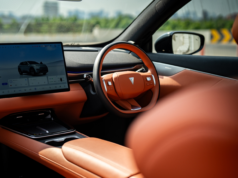
Chinese automakers like Xiaomi, Geely, Nio and BYD have gained global appeal for being affordable. So far, only a few Chinese-made EV and hybrid models from Western brands like Tesla, BMW, Volvo and Polestar have reached Canadian roads. Tesla has previously sold EVs from its Shanghai factory in Canada, but any return to that model would likely be limited by the newly announced affordability limits.