Major Chinese car manufacturers have announced their annual sales targets, revealing divergent strategies in an increasingly competitive landscape.
Traditional auto groups are taking a conservative approach with steady growth targets of 10-15%, while focusing on deepening their EV transition and expanding overseas. In contrast, EV startups and tech companies entering the automotive space have set much more aggressive goals, with some targeting growth rates as high as 67.5%, leveraging their 2025 momentum to capture larger market shares in the intelligent electric vehicle sector.
| Company | 2025 Sales | 2026 Target | Target Growth |
|---|---|---|---|
| Geely Auto | 3.025 | 3.45 | 14% |
| Changan Auto | 2.913 | 3.30 | 13.30% |
| Dongfeng Motor | — | 3.25 | — |
| Chery Group | 2.806 | 3.20 | 14.03% |
| Great Wall Motor | 1.324 | >=1.80 | >=36% |
| Leapmotor | 0.5966 | 1 | 67.50% |
| Xiaomi Auto | >0.41 | 0.55 | 34% |
| Nio | 0.326 | 0.456–0.489 | 40%–50% |
| Xpeng | 0.43 | 0.55-0.60 | 28%-40% |
Traditional automakers prioritize steady growth
Several established automotive groups have set year-on-year growth targets between 10% and 15%, with electrification serving as the key driver for sales growth.
Geely Automobile, after exceeding its 3 million vehicle target in 2025, has set a 2026 goal of 3.45 million units, representing approximately 14% growth. The Geely brand will shoulder 2.75 million units, while Zeekr and Lynk & Co aim for 300,000 and 400,000 units, respectively. New energy vehicles remain Geely’s top priority, with a target of 2.22 million units (32% growth), increasing NEV penetration from 55.8% to 64.3%.
Changan Automobile plans to sell 3.3 million vehicles in 2026, a 13.3% increase, with new energy vehicles accounting for 1.4 million units (26.2% growth). The company has also set an overseas sales target of 750,000 units, representing 17.7% growth.
Chery Group targets sales of 3.2 million vehicles, a 14.03% increase from its 2025 performance of 2.806 million units. Li Xueyong, Executive Vice President of Chery Automobile, stated that the group plans to launch 17 key models in 2026, with its five major brands jointly advancing electrification and intelligent technology.
Dongfeng Group has set a similar target of 3.25 million units, including 1.7 million new energy vehicles and 600,000 exports. This goal builds on the achievement of its “double million” sales target for new energy vehicles and self-owned passenger cars in 2025.
Great Wall Motors has taken a more cautious approach, setting a minimum target of 1.8 million units for 2026. Compared to its actual sales of 1.324 million units in 2025, this still represents significant growth potential, with EV transition remaining a core task.
EV startups set ambitious targets
In stark contrast to the traditional manufacturers’ cautious approach, EV startups and tech companies have set much more aggressive 2026 sales targets.
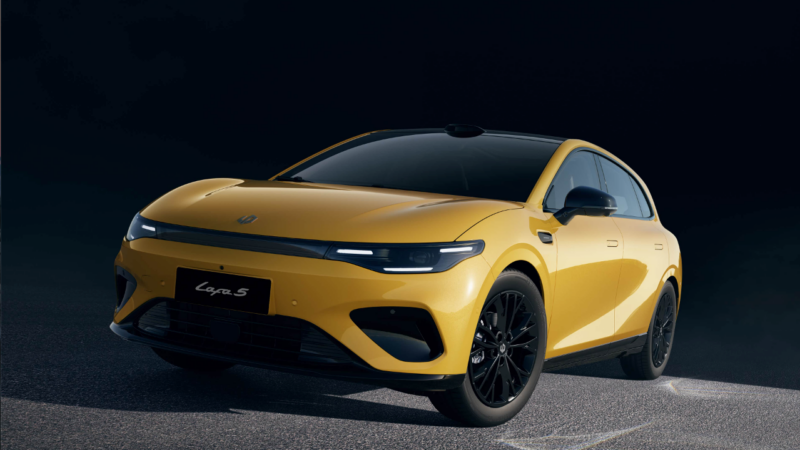
Leapmotor emerges as the most ambitious among new EV manufacturers. After delivering 596,600 vehicles in 2025 (a 103% increase), it has set a bold 2026 target of 1 million units, representing a staggering 67.5% growth as it aims to become a “world-class intelligent electric vehicle manufacturer.”
Xiaomi Automobile, as a tech crossover representative, exceeded its original 2025 delivery plan of 300,000 units with over 410,000 vehicles delivered. For 2026, Xiaomi targets 550,000 deliveries, a 34% increase. The company plans to launch four new models, including an SU7 facelift, SU7 executive version, and two range-extended SUVs to support this rapid growth.
Nio has proposed an annual sales growth rate of 40% to 50%, which translates to a 2026 sales target between 456,000 and 489,000 units. The company will rely on new models like the ES9 and Onvo L90 with LiDAR to strengthen its position in the high-end pure electric market.
Industry consolidation looms in a flat market
According to the Passenger Car Market Information Association, China’s passenger car retail market is expected to reach approximately 24 million units in 2026, representing just 1% growth year-on-year. New energy vehicle penetration is projected to reach 61%, up 0.6 percentage points from the previous year.
Against this backdrop of minimal growth, competition in China’s domestic auto market will intensify further in 2026, regardless of whether companies have set conservative or aggressive targets. Industry consolidation is expected to accelerate, with all manufacturers facing greater challenges.
Consulting firm Roland Berger, quoted by Chinese newspaper NBD, notes that compared to developed markets where the top 10 manufacturers typically control over 90% of the market, China’s automotive sector still has significant room for consolidation. Although elimination of weaker players is steadily accelerating, the industry restructuring could turn into a prolonged battle as various competitors continue to adjust strategies and address weaknesses.
Editor’s comment
BYD, SAIC, and FAW have not yet announced their sales targets for 2026. In 2025, BYD and SAIC were the top two domestic automakers by sales volume, achieving 4.6 million and 4.507 million units, respectively. FAW ranked third with 3.3 million units. This implies that BYD and SAIC’s 2026 sales targets will likely be at least 4.5 million units each. FAW’s target is also expected to be at least 3.3 million units. It is anticipated that seven automakers will set sales targets exceeding 3 million units for 2026.

Follow us for ev updates