![China and United States' trade war breaks down [GETTY IMAGES]](https://koreajoongangdaily.joins.com/data/photo/2025/12/23/6cbf2699-65e2-486e-a2cd-7012a3b9c959.jpg)
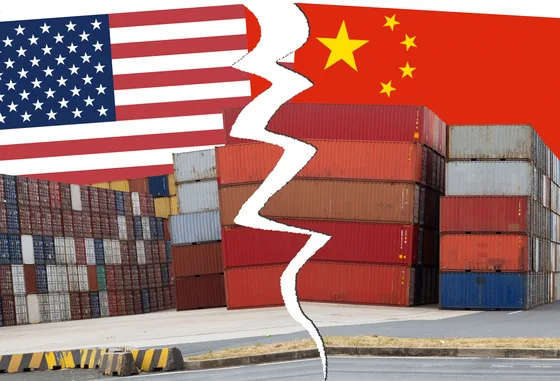
China and United States’ trade war breaks down [GETTY IMAGES]
[NEWS ANALYSIS]
As global carmakers like Tesla and General Motors successively declare a shift away from Chinese-made components, a long-muted sense of optimism is emerging for Korea’s battery and parts manufacturers like LG Energy Solution, Samsung SDI and LG Innotek.
Triggered by U.S. President Donald Trump’s restrictions on prohibited foreign entities (PFE), goods from Korea have been cited as the most viable and pragmatic alternatives to those from China.
GM is reportedly making the most aggressive moves, having internally set a goal to eliminate Chinese components by 2027 and communicated this target to its suppliers. GM CEO Mary Barra said they’ve “been working now for a few years to have supply chain resiliency… sourcing parts in the same country where we build the cars, whenever possible,” during a quarterly conference call in October.
EV giant Tesla has not specified a concrete timeline, but some core components have already been replaced with non-Chinese alternatives, while remaining items are being phased out in an orderly manner.
![Tesla vehicles line at a parking area at the company's factory in California on Aug. 5. [AP/YONHAP]](https://koreajoongangdaily.joins.com/data/photo/2025/12/23/363258c3-93e4-452c-b427-5f8aaf0759fe.jpg)
Tesla vehicles line at a parking area at the company’s factory in California on Aug. 5. [AP/YONHAP]
Korea closes gap in battery game
Among EV parts, batteries rely most heavily on China — due to its unique ability to produce low-cost, safe lithium iron phosphate (LFP) batteries — and Korea has emerged as the most likely candidate to realize this technological capacity.
Tesla uses LFP batteries from CATL and BYD in the Model 3 and Model Y, while GM uses LFP batteries for its more affordable EV options, including the Chevy Bolt.
Korea’s three major battery firms — LG Energy Solution, Samsung SDI, and SK On — have already mass-produced LFP batteries for energy storage systems (ESS), while those for EVs are in the final phase of development, with a goal of commercialization no later than 2027.
With manufacturing sites in North America, they will also be able to meet U.S. automakers’ growing demand for supplier diversification.
Last year, LG Energy Solution became the first Korean battery maker to secure a supply contract for EV LFP batteries. Under the deal with France’s Renault, it will supply 39 gigawatt-hours of batteries over five years through 2030. The production takes place in the Poland plant.
![A Model X sits outside a Tesla dealership in Littleton, Colorado. [AP/YONHAP]](https://koreajoongangdaily.joins.com/data/photo/2025/12/23/9a652457-3ee8-4302-bc19-e105f947cfd1.jpg)
A Model X sits outside a Tesla dealership in Littleton, Colorado. [AP/YONHAP]
The battery company has already converted part of its battery line at its Michigan plant to ESS-focused LFP production as of June, and plans to begin producing LFP batteries at its Arizona facility starting in 2026.
Ultium Cells, a battery joint venture with GM, announced plans to retool production lines at its second plant in Spring Hill, Tennessee, to establish mass production of LFP batteries, with full-scale output expected to begin in 2027.
“As U.S.-China tensions intensify, the United States is likely to phase out Chinese supply chains through PFE regulations,” said Lee Jin-myung, an analyst at Shinhan Securities, adding that “the accelerating shift away from China will present a structural opportunity for Korean battery makers.”
Samsung SDI also plans to secure 30 gigawatt hours of LFP battery capacity by the fourth quarter of next year at its joint battery plant with Stellantis in Indiana. The company is currently in talks with multiple global automakers for orders, with some agreements said to be close to finalization as early as end of the year.
SK On, meanwhile, aims to produce LFP batteries at its Georgia plant no later than the second half of next year. It also intends to establish a dedicated ESS battery production line with an annual capacity of 3 gigawatt hours at its Seosan plant in South Chungcheong.
«It is simply impossible to compete with China on price. Their products are two to three times cheaper,» said a source from Korea’s major auto parts maker. «If U.S. companies were to exclude Chinese suppliers, there would be few outcomes more favorable for us.»
![An employee inspects the battery production process at LG Energy Solution's plant in Holland, Michigan on June 1. [LG ENERGY SOLUTION]](https://koreajoongangdaily.joins.com/data/photo/2025/12/23/be7a328c-d497-4083-b347-9b45ffd2d564.jpg)
An employee inspects the battery production process at LG Energy Solution’s plant in Holland, Michigan on June 1. [LG ENERGY SOLUTION]
Korea as hub for auto parts
Beyond batteries, Korean firms are asserting a strategic advantage in critical EV components, notably AI-enabled high-performance camera modules integral to Tesla’s autonomous systems.
LG Innotek and Samsung Electro-Mechanics have each secured major supply contracts for Tesla’s autonomous-driving camera modules, worth 1 trillion won and up to 5 trillion won, respectively.
While Samsung Electro-Mechanics’ core business remains multilayer ceramic capacitors, automotive camera modules now account for 24 percent of total revenue. Leveraging advanced microfabrication and packaging technologies, the company excels at producing ultra-compact, high-resolution lenses.
![The new GM logo is seen on the facade of the General Motors headquarters in Detroit, Michigan on March 16, 2021. [REUTERS/YONHAP]](https://koreajoongangdaily.joins.com/data/photo/2025/12/23/c465e3a6-3832-4d4e-890c-6dabf378c4fd.jpg)
The new GM logo is seen on the facade of the General Motors headquarters in Detroit, Michigan on March 16, 2021. [REUTERS/YONHAP]
LG Innotek, the world’s largest supplier of smartphone camera modules, has set automotive cameras as a new growth pillar. As of this year, over 80 percent of its sales came from its optical solutions business.
“Amid U.S.-China trade tensions and the restructuring of North American supply chains, China’s foothold in key product categories has diminished, while Korea’s standing has strengthened,” said Kim Gyu-won, a researcher at the Korea International Trade Association, pinpointing that the gains were “particularly evident in machinery, electrical and electronic products, and automobiles,” the three largest categories where Korea has benefited.
Ola Källenius, Chairman of Mercedes-Benz, visited Korea in November and said he will establish a parts procurement hub in Korea, aiming to “create a strong base for long-term business growth and partnerships in the region.”
BY SARAH CHEA [[email protected]]