The electric car market is booming – just not in the United States.
One-quarter of new cars sold around the world so far in 2025 have been electric. That share is forecast to continue rising rapidly in coming years, reaching one-half in the early 2030s.
But the electric share of new car sales in the U.S. has plateaued at a mere 10% since 2023, and the Trump administration has implemented policies and regulatory changes that have slammed the brakes on a shift to EVs.
As a result, many developing nations in regions like Southeast Asia are passing the U.S. in EV adoption, while China and a number of European countries like Norway (as Will Ferrell comedically informed us in a GM advertisement) are leaving the rest of the world in their dust. On the sales side, China’s advanced EV manufacturing has allowed the country to take the lead in global auto exports.

Road transportation accounts for about 12% of global climate emissions. So electric vehicles are a key climate solution, “highly recommended” by the experts at Project Drawdown, a nonprofit organization that researches the most effective climate solutions. They estimate that widespread EV adoption could reduce climate pollution worldwide by over 2 billion tons of carbon dioxide per year.
Although alternative transportation methods like walking, biking, and public transport are the lowest-emissions options, replacing fossil-fueled cars with EVs also cuts pollution. The International Energy Agency estimates that EV deployment will account for about 10% of the total emissions prevented by climate policies around the world in 2030.
Read: Electric vehicles use half the energy of gas-powered vehicles
But the global and American trajectories in this key clean energy technology are turning in different directions. And with most other countries racing to adopt EVs as a more efficient, cost-effective, and cleaner mode of transportation, China’s growing dominance of this technology may help that country become the next global economic superpower.
China’s growing EV dominance is spreading around the world
China has the world’s largest auto market, with over 30 million car sales per year. That’s about twice as many as the second-largest market, the U.S. Nearly 40% of all new global car sales took place in China this year.
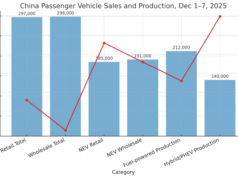
And so it’s significant that over half those new cars sold in China this year were electric and plug-in hybrids. In fact, dwindling Chinese interest in fossil-fueled cars has forced the country’s automakers to export more of them to foreign markets like Russia, Latin America, and the Middle East, reaching 2.7 million Chinese internal combustion engine vehicle exports in 2024.
Chinese car companies like BYD have also rapidly ramped up EV manufacturing capacity, exporting 1.7 million EVs last year, primarily to markets in Europe and Southeast Asia. This growth allowed China to surpass the U.S. in car exports in 2021.
What’s more, China has overtaken Japan and the European Union to become the world’s largest auto exporter. Chinese companies accounted for 18% of EV sales in Europe, 30% in Southeast Asia, and over 80% in the smaller Latin American market in 2025.
Affordable Chinese EVs have been widely adopted in Southeast Asia, with EVs accounting for over 13% of new car sales this year and forecast to surpass 50% by 2035. As a result, the EV market share in countries like Singapore, Vietnam, and Thailand now rivals many European countries, with the U.S. far back in the rearview mirror.
Americans are still guzzling gas and belching pollution
High tariffs have thus far prevented Chinese automakers from entering the American market. The U.S. auto market is also structurally unique, with SUVs and trucks accounting for about 80% of American new car sales, compared to less than 50% globally. Consumers in most other countries have a stronger preference for smaller, more fuel-efficient vehicles.
EVs have accounted for only about 10% of car sales in the U.S. this year, compared to the 25% global average. The Biden administration and previous Democratic-controlled Congress tried to boost domestic EV adoption by implementing stronger vehicle tailpipe emissions and fuel efficiency standards and a $7,500 tax credit for new qualifying, largely made-in-America EVs.
But domestic EV sales nevertheless stagnated since 2023, and this year, the Trump administration and Congress have tried to throw up roadblocks by repealing the vehicle emissions and fuel efficiency standards and the EV tax credit.

But it’s not all bad news. Congressional Democrats are calling on their Republican counterparts to preserve government EV charging investments in an upcoming transportation infrastructure funding bill. A number of automakers, including Ford and GM, plan to soon introduce new affordable EVs, and the number of electric models available to Americans for under $42,000 is expected to double from eight this year to 16 by the end of 2026.
And a 2023 analysis by energy systems modelers at Energy Innovation found that when accounting for their lower fuel and maintenance costs, many EVs are already cheaper than fossil-fueled equivalents in the U.S. With more affordable models coming to the American market and battery prices continuing to fall, EV sales are expected to rebound despite recent policy changes.
But the American EV market nevertheless faces stiff headwinds, with over 70% of Americans saying in a recent survey that their next vehicle will be fully fossil-fueled, and another 20% preferring standard hybrids, compared to only around 10% who plan to go electric. Americans are expected to trail the rest of the world on EV adoption until the 2040s.

The rest of the world is going electric
There are now more than 50 million EVs on roads around the world, and that number is projected to quadruple by 2030. That’s largely thanks to China, which has already deployed 30 million EVs, with that number rising fast. Another 10 million are in Europe, where many countries are seeing widespread EV adoption, and affordable Chinese imports are beginning to make inroads.
According to an analysis by the International Council on Clean Transportation, climate pollution from global road transportation may have peaked in 2025 thanks to accelerating EV deployments around the world.

A rapid transition to EVs yields a number of benefits. A recent Energy Innovation report found that slowed EV adoption will make Americans sicker and poorer due to increased air pollution and higher total ownership costs.
And with countries around the world rapidly shifting from fossil fuels to cleaner and more efficient electric technologies like EVs, whoever best takes advantage of this immense transition could become the next global economic superpower. That is increasingly looking like a race China is positioned to win.